

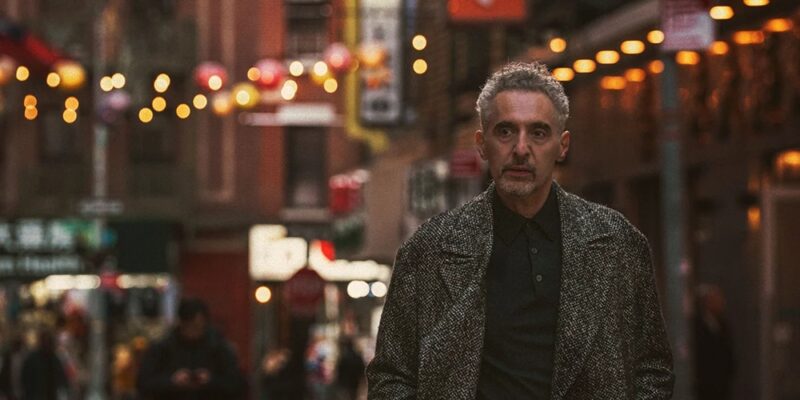
Technology may have finally achieved what decades of law enforcement couldn’t: put expert pickpocket Harry Lehman out of business. Nobody carries cash anymore. Phones can be tracked. Credit cards can be cancelled before you’ve even made it to the next subway stop. For the wonderfully weathered criminal at the centre of Noah Segan’s The Only Living Pickpocket in New York, it isn’t simply his profession becoming obsolete. It feels like the entire city has moved on without him.
John Turturro has played enough eccentrics, criminals, oddballs and wounded men across his career that Harry initially seems like a role he could inhabit in his sleep. Instead, Turturro delivers one of his most beautifully understated performances, finding enormous humanity in a man whose fingers remain considerably quicker than the changing world around him.
Harry is a thief, but Segan wastes little time establishing that he operates according to a code. He knows who deserves to be relieved of their wallet, treats the people around him with kindness, and returns home each evening to care for his disabled wife, Rosie (Karina Arroyave). His criminality isn’t excused so much as comfortably absorbed into the ecosystem of a New York he has spent his life navigating. Everybody seems to know Harry, including Ben (Steve Buscemi), the pawn shop owner who fences his stolen goods, and Detective Warren (Giancarlo Esposito), the cop who once put him behind bars and now regards him with something approaching affection.
Harry belongs to an older version of New York, and Segan shoots him accordingly. The film has a tactile, lived-in quality that feels pleasantly removed from the polished sheen of many contemporary crime thrillers. Pawn shops, subway carriages, sidewalks and neighbourhood businesses aren’t merely locations through which the plot travels; they’re pieces of Harry’s identity.
His undoing arrives in the form of someone who represents virtually everything he doesn’t understand about the modern world. Will Price’s smug, tech-savvy Dylan attracts Harry’s attention, leading the veteran thief to steal a bag from his car. What initially appears to be another score quickly becomes considerably more dangerous when Harry discovers he has taken something worth far more than he realised. Worse still, Dylan isn’t merely some obnoxious rich kid. He has connections to organised crime, the technology to locate Harry, and very little patience for an ageing pickpocket who no longer possesses what he stole.
Suddenly Harry has a ticking clock, an increasingly desperate hunt to recover the missing property and, most importantly, Rosie’s life hanging over him.
It’s an enjoyably economical premise, and at a lean 88 minutes Segan thankfully doesn’t suffocate it beneath unnecessary plotting. The Only Living Pickpocket in New York occasionally wanders into conversations and encounters that initially seem peripheral, but that’s also part of its considerable charm. This isn’t really a movie interested in whether Harry can pull off one final elaborate criminal masterstroke. It’s interested in what a man does when he realises the clock may genuinely have run out.
That distinction gradually transforms what could have been a modest crime caper into something considerably more melancholic.
Harry spends much of the film moving through the remnants of the life he has built, encountering people who represent different chapters of it and quietly taking stock of what will remain when he is gone. Tatiana Maslany appears as his estranged daughter Kelly in a small but emotionally potent role, whilst Harry’s devotion to Rosie provides some of the film’s most tender moments.
If anything, Rosie deserved greater dimensionality beyond what she means to Harry. Arroyave communicates a great deal through relatively little, and Turturro completely sells Harry’s love for her, but their shared history remains more suggested than explored. It’s one of the few areas where the film’s brevity works against it.
Elsewhere, that economy proves one of Segan’s greatest assets. He moves comfortably between thriller, character drama and dry comedy without any one genre overwhelming the others. Harry can be staring down a genuinely frightening threat in one moment and navigating some wonderfully mundane New York absurdity the next. The humour never punctures the danger; it instead reinforces the sense that this is simply another particularly bad day in a city Harry has survived for decades.
Segan has also assembled exactly the cast necessary to sell that tone. Buscemi is unsurprisingly perfect as Ben, bringing his particular brand of twitchy warmth to a friendship that feels as though it existed for decades before the cameras arrived. Esposito is similarly enjoyable when afforded the opportunity to step away from the imposing villains he has played so effectively in recent years. His scenes with Turturro possess the easy shorthand of two men who long ago stopped viewing each other solely as cop and criminal.
Maslany makes the most of her limited screen time, whilst Price proves effectively detestable without tipping Dylan entirely into caricature. Jamie Lee Curtis also arrives late in proceedings for a memorable appearance that gives the film’s final stretch an additional sardonic kick.
But this is Turturro’s film from beginning to end.
Harry knows exactly who he is. The tragedy is that the world increasingly has no use for the particular person he has spent decades becoming. Turturro finds humour in that indignity, but also tremendous sadness. Watch how Harry observes people, how effortlessly he moves through crowds, or how his body changes when he’s practising the craft that has defined his adult life. Pickpocketing isn’t simply how he earns money. It’s one of the few languages in which he remains completely fluent.
That also gives the generational divide between Harry and Dylan more texture than the familiar old-school-criminal-versus-young-punk construction might suggest. Harry’s methods require proximity, observation and an intimate understanding of human behaviour. Dylan’s generation can locate someone through a device. One man survives by reading people; the other barely needs to look at them.
Thankfully, Segan doesn’t belabour the contrast or turn the film into an insufferable lament about how everything used to be better. Cities change. People age. Skills become redundant. The melancholy comes from watching someone recognise that inevitability whilst still desperately trying to carve out one final piece of permanence.
It’s also why the film’s depiction of New York proves so essential. Segan isn’t photographing the city as an assemblage of postcard landmarks. His New York exists in routines, familiar faces and unexpected conversations. Harry’s relationship with the city feels almost romantic, and there’s something fitting about a pickpocket – someone whose entire livelihood depends upon disappearing into a crowd – becoming the vehicle through which Segan celebrates the individuals who give that crowd its character.
By the time The Only Living Pickpocket in New York reveals what kind of story it has really been telling, its thriller mechanics have almost become secondary. What remains is a surprisingly tender consideration of ageing, legacy, marriage, estrangement and the strange families accumulated over a lifetime.
Funny, tense and increasingly moving, The Only Living Pickpocket in New York has the soul of an old-school New York crime movie without feeling like a hollow imitation of one. And in Turturro, Segan finds the perfect face for a city and a way of life stubbornly refusing to disappear quietly.


THREE AND A HALF STARS (OUT OF FIVE)
The Only Living Pickpocket in New York is screening as part of this year’s Toronto International Film Festival, running between September 10th and 20th, 2026. For more information, head to the official site here.
