

There are certain films that feel as though they’re speaking directly to you.
Test is one of them.
On paper, Sam McConnell‘s drama could easily be dismissed with a glib elevator pitch: the gay bodybuilding movie. But reducing it to that does both the film and its creator a disservice. Yes, bodybuilding is its world. Yes, sexuality is central to its story. But what actor/screenwriter Brock Yurich has written is ultimately a deeply compassionate exploration of identity, masculinity and self-worth – one that uses competitive bodybuilding not as a gimmick, but as the perfect metaphor for the impossible standards we often set for ourselves.
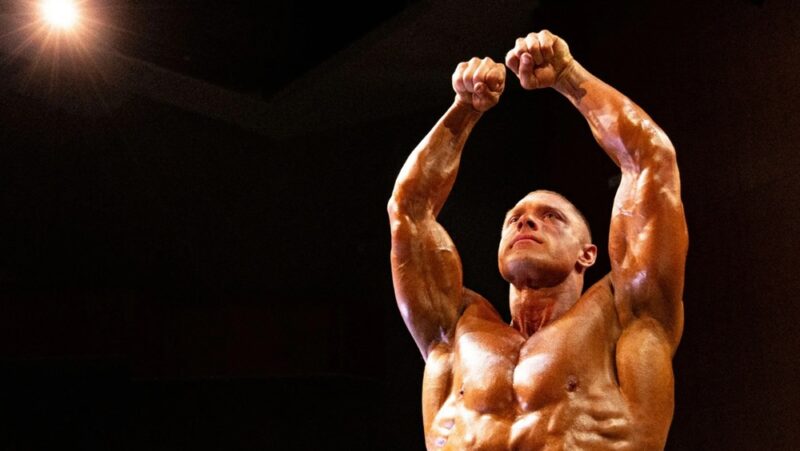
Yurich stars as Eddie, an amateur bodybuilder who has devoted years of his life to earning the elusive professional card that has always remained just out of reach. Living with his deeply religious, alcoholic mother Joanne (an exceptional Tammy Blanchard), Eddie spends his days waiting tables and his nights working as a cam performer to fund a dream that has slowly become inseparable from his sense of self. When experienced coach Mike (Mike Edward) enters his life, Eddie begins reshaping both his physique and, more importantly, his understanding of who he is beneath it.
It’s tempting to compare Test to Jonathan Majors’ largely sidelined 2023 drama Magazine Dreams, simply because both films examine the obsessive pursuit of physical perfection through bodybuilding. But where Elijah Bynum’s film spiralled into psychological darkness, Yurich’s screenplay is interested in something gentler. Eddie isn’t consumed by rage. He’s consumed by uncertainty.
And that’s what makes him so compelling.
The film never forces Eddie into a tidy coming-out narrative or builds toward some grand declaration of identity. Instead, it allows confusion to exist. His lingering feelings for his former girlfriend Abby (Paloma Garcia-Lee, tenderly affecting) feel entirely genuine, while his growing attraction to Mike unfolds with equal sincerity. Rather than presenting sexuality as a binary destination, Test embraces its complexity, allowing Eddie the space to simply exist without demanding immediate answers. It’s a refreshingly mature approach that trusts both its character and its audience.
That same restraint extends throughout the film. McConnell understands that quieter moments often carry the greatest emotional weight, allowing conversations, lingering glances and uncomfortable silences to reveal far more than exposition ever could. The result is a film that feels intimate rather than melodramatic, confident enough to let emotion breathe.
As someone who grew up gay while wrestling with body image and the often confusing relationship between masculinity and identity, Test landed on a profoundly personal level.
Competitive bodybuilding represents one of the most hyper-masculine environments imaginable. It’s a world built around discipline, physical perfection and impossible standards – qualities that can easily become tangled with ideas of what masculinity is supposed to look like. Yurich understands that intimately, and the film never mocks or diminishes that culture. Instead, it celebrates the dedication, sacrifice and artistry that bodybuilding demands while gently challenging the idea that sexuality somehow exists in opposition to strength.
That balance is what makes the film feel so refreshing. Test recognises both the masculine and surprisingly graceful, almost delicate qualities of bodybuilding. Every carefully choreographed pose, every sculpted physique and every vulnerable moment backstage becomes part of Eddie’s search for authenticity rather than performance.
For anyone who has ever questioned whether they belonged inside traditionally masculine spaces, there’s something quietly reassuring here. The film suggests that your sexuality doesn’t diminish your work ethic, your competitiveness or your masculinity. More often than not, the barriers exist within ourselves far more than they do in the people around us. That’s a comforting message, particularly for queer athletes – or anyone who has ever felt pressured to compartmentalise parts of themselves in order to fit in.
Yurich delivers an outstanding lead performance. It would be easy to call it “brave” given how emotionally and physically exposed Eddie becomes throughout the film, but that word feels almost too convenient. What’s genuinely impressive is how human the performance is. Eddie never becomes a symbol or a collection of issues. He’s funny, awkward, hopeful, insecure and deeply likeable. Yurich possesses an effortless screen presence that makes you invest in Eddie’s journey long before the emotional stakes fully reveal themselves.
Blanchard is equally remarkable as Joanne. She could easily have become a one-note portrait of addiction or religious hypocrisy, yet Blanchard refuses to flatten her into a villain. Joanne loves her son fiercely, even as she repeatedly hurts him, creating a painful contradiction that feels painfully believable. Her unwavering faith becomes both comfort and weapon, and Blanchard captures that internal conflict with heartbreaking complexity.
What impressed me most is that Test never becomes defined by a single theme. It’s a sports drama. A coming-of-age story. A portrait of addiction. A meditation on faith. A queer romance. An underdog tale. Somehow, it manages to be all of those things without any one element overwhelming the others.
There are echoes of Moonlight in the film’s tenderness and emotional patience, yet Test ultimately carves out an identity entirely its own, finding remarkable compassion for every character it introduces.
At a time when queer stories are still too often framed around trauma or tragedy, Test offers something quietly radical: empathy. It understands that discovering yourself is rarely a single revelation. More often, it’s hundreds of small moments that slowly reshape how you see yourself – and how you’re willing to let others see you.
It’s a sincere, moving and unexpectedly uplifting debut that deserves to find an audience well beyond LGBTQ+ cinema. Yurich announces himself as both an actor and writer of genuine promise, delivering a story that feels deeply personal without ever becoming self-indulgent.
For me, Test wasn’t simply about bodybuilding or sexuality. It was about finally realising that accepting yourself might be the hardest challenge you’ll ever train for.


FOUR AND A HALF STARS (OUT OF FIVE)
Test is screening as part of this year’s OutfestNext, running between July 23rd and 26th, 2026 in Los Angeles. For more information on the festival, head to the official site here.
