

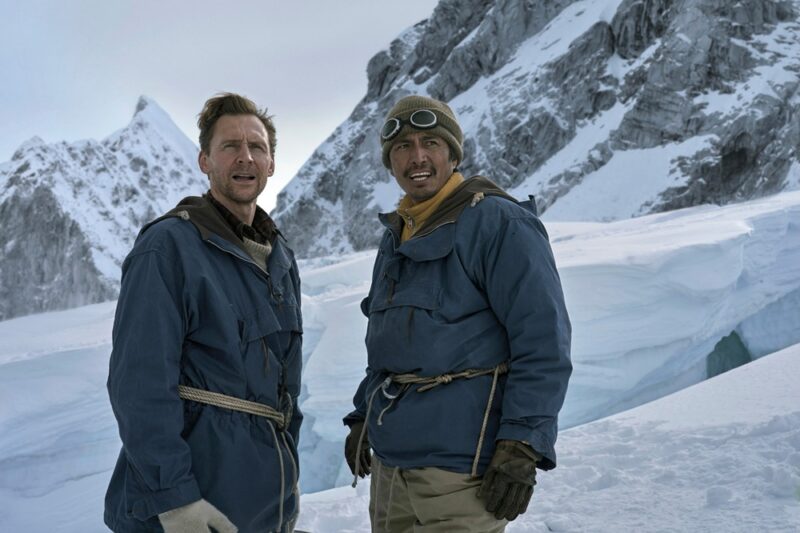
History has a funny way of remembering partnerships as individual achievements. Ask who first reached the summit of Mount Everest and Edmund Hillary’s name will likely arrive before Tenzing Norgay’s, despite the two men standing together atop the world’s highest mountain on May 29th, 1953. Jennifer Peedom’s Tenzing seeks to redress that imbalance, shifting the perspective away from the Western adventurers so often celebrated in mountaineering mythology and towards the man whose knowledge, persistence and connection to the Himalayas made him far more than the accompanying Sherpa history too often reduced him to.
It’s a story unquestionably deserving of such treatment. If only the film telling it was as adventurous as the man himself.
Making her narrative feature debut after an acclaimed career in documentary filmmaking, Peedom is hardly an outsider to this world. Her extraordinary 2015 documentary Sherpa examined Everest through the Nepalese workers who continually risk their lives facilitating the ambitions of predominantly Western climbers, and that understanding of the mountain and its people is evident throughout Tenzing. There’s an authenticity to the film’s perspective that prevents its protagonist from ever feeling like a supporting character who has finally been promoted within somebody else’s story.
Played across various stages of his life before Genden Phuntsok assumes the role for the pivotal 1953 expedition, Tenzing is presented as someone whose relationship with the mountain predates the historical moment that would eventually make him famous. By the time Colonel John Hunt (Willem Dafoe) assembles the British expedition that will attempt Everest, Tenzing has already repeatedly challenged its slopes. He isn’t being introduced to greatness by the men arriving from overseas; they are finally recognising the expertise that has been in front of them all along.
It’s an important distinction, and one Peedom and screenwriter Luke Davies return to throughout. The expeditions that turned Western mountaineers into legends relied heavily on local men carrying equipment, understanding the terrain and accepting extraordinary levels of danger, whilst receiving a fraction of the recognition. Tenzing doesn’t turn every British climber into a moustache-twirling colonial villain to underline that imbalance, but there’s an uncomfortable hierarchy always lingering beneath proceedings.
This is particularly evident when Tenzing is elevated from hired Sherpa to an official member of the expedition. The recognition is meaningful, but the fact that his status has to be formally bestowed upon him says plenty about the system in which he is operating.
Peedom is less interested in raging against such inequality than gently correcting the historical perspective. That restraint is admirable, though it can also prove frustrating. There are moments where Tenzing brushes against more complicated ideas concerning colonialism, ownership and who is afforded the privilege of becoming a historical hero, only to retreat into the safer contours of an inspirational prestige drama.
And those contours are very familiar.
There’s the doubted outsider determined to prove himself, personality clashes amongst the expedition, inspirational speeches, personal sacrifices, montages and the gradual development of camaraderie between men who initially understand very little about one another. The mountain itself provides an inherently formidable antagonist, but Davies’ screenplay adheres so faithfully to the inspirational true-story template that the film occasionally feels as if it’s ticking off expected emotional beats rather than discovering them organically.
Its nonlinear construction doesn’t entirely help matters. Flashbacks explore Tenzing’s childhood, his earlier attempts at climbing, and his relationship with eventual wife Dawa (Thinley Lhamo), clearly intended to establish the emotional life behind his obsession with reaching the summit. But these passages don’t always possess the depth required to make their eventual callbacks land with the force Peedom intends.
Dawa, in particular, feels more dramatically functional than fully realised. We understand what she represents to Tenzing and why their relationship matters, but the screenplay affords them too little space together for that love story to become the emotional anchor it clearly wants to be.
The same problem occasionally affects the developing friendship between Tenzing and Hillary.
Tom Hiddleston wisely avoids turning the famous New Zealander into either the film’s white saviour or an antagonistic obstacle. His Hillary is reserved, practical and gradually appreciative of Tenzing’s abilities, with their partnership strengthening as the increasingly hostile environment strips away whatever cultural distance existed between them. Hiddleston is particularly effective when allowed to communicate through expression rather than exposition, but the screenplay can be frustratingly economical in depicting the evolution from fellow climbers to the lifelong friends they eventually became.
Thankfully, Phuntsok and Hiddleston compensate for much of what remains underwritten. There’s an understated generosity to their chemistry, and the film is at its best when it simply allows the two men to exist alongside one another against an environment entirely indifferent to their ambitions.
Phuntsok, making his English-language debut, has the more difficult task. Tenzing needs to be inspirational without becoming saintly, and Phuntsok finds a warmth and quiet determination that keeps him human. His smile is infectious, but there’s something more interesting occurring underneath it: the weariness of a man accustomed to demonstrating his worth to people who benefit from his abilities whilst not always recognising him as their equal.
Dafoe, meanwhile, is reliably commanding as Hunt, bringing dimension to a role that could easily have become the stock stern expedition leader. Caitríona Balfe similarly makes an impression as Jill Henderson, an early advocate for Tenzing whose recognition of his capabilities helps him navigate a world seemingly designed to keep him on its periphery.
But the film’s undeniable star is ultimately Everest itself.
Cinematographer Stefan Duscio captures the Himalayas with a grandeur that practically demands the largest screen possible. There are images here of staggering beauty, but importantly, Peedom never romanticises the mountain to the point that we forget its lethality. Ice formations dwarf the climbers beneath them, crevasses appear almost bottomless, and sudden shifts in weather turn magnificent landscapes into potential death traps.
Once the expedition begins its final push towards the summit, Tenzing noticeably comes alive.
The conventional dramatic machinery that weighs down portions of the opening hour becomes considerably less bothersome when the characters are battling altitude, exhaustion and terrain that seems fundamentally incompatible with human survival. Peedom’s documentary instincts prove invaluable here. She understands scale, danger and the physical absurdity of what these men were attempting, resulting in several sequences that achieve the tension and awe the more intimate material sometimes struggles to generate.
Rebekka Karijord’s sweeping score adds considerably to that sensation, even if it occasionally works overtime to provide emotional cues the screenplay hasn’t quite earned for itself.
There’s also an inherent limitation in dramatising an achievement this famous: we know where everyone is going. Suspense can’t come from whether Tenzing and Hillary reach the summit, but from making us understand what reaching it costs. Tenzing is only intermittently successful on that front. The physical cost is vividly rendered; the emotional one remains more elusive.
Where the film ultimately finds its greatest purpose is in what happens to history once the climb is over. The question of which man stepped onto the summit first became its own revealing obsession, reducing an extraordinary shared achievement to a competition seemingly desperate to establish a hierarchy between the two men. That Tenzing and Hillary resisted such simplification says more about their partnership than some of the screenplay’s more overt attempts at emotional bonding.
And it reinforces the film’s central corrective. Tenzing Norgay wasn’t the anonymous Sherpa who helped Edmund Hillary conquer Everest. He was an enormously experienced mountaineer who reached the summit alongside him.
Tenzing is perhaps too respectful of its subject to become the truly incisive film his story invites. For all the political and historical complexity surrounding the expedition, Peedom largely packages it inside the reassuring structure of a handsome prestige biopic, and the screenplay’s emotional shorthand prevents certain relationships from resonating as deeply as intended.
But conventional doesn’t mean ineffective.
When Phuntsok is framed against the impossible enormity of Everest, Tenzing finds the majesty its storytelling sometimes lacks. Peedom has made an exquisitely photographed, sincerely performed and deeply respectful tribute to a man whose contribution to one of the twentieth century’s defining achievements has too often existed behind somebody else’s name.
The film may not conquer every dramatic peak it attempts, but in finally placing Tenzing Norgay at the centre of his own Everest story, it makes sure history’s camera is pointing in the right direction.


THREE AND A HALF STARS (OUT OF FIVE)
Tenzing is screening as part of this year’s Toronto International Film Festival, running between September 10th and 20th, 2026. For more information, head to the official site here.
Tenzing is scheduled for release on Apple TV on October 16th, 2026.
