

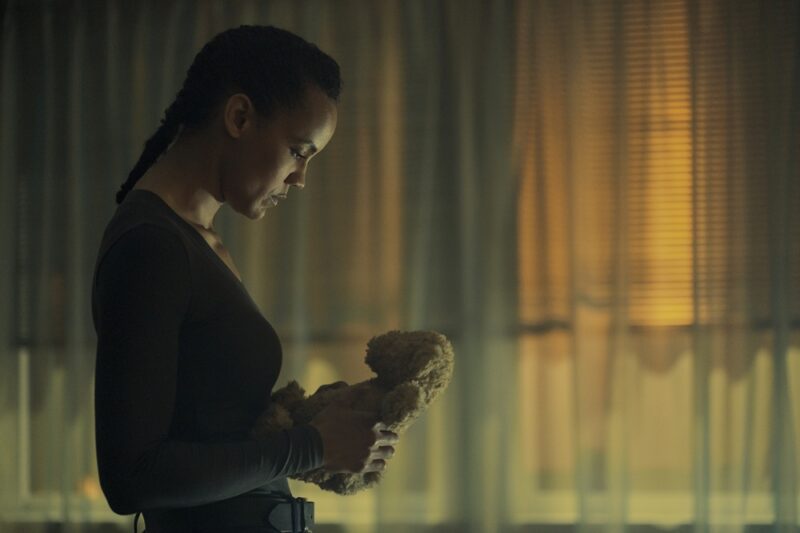
It was almost inevitable that Frances Neagley would earn her own series. From the moment Maria Sten first appeared opposite Alan Ritchson’s human brick wall in Reacher, she proved one of the few characters capable of matching his intimidating competence without feeling like she had been engineered purely to keep up with him. She was colder, quicker and considerably less interested in announcing herself, and across subsequent appearances Sten steadily transformed what could have remained an effective supporting player into someone who felt as though an entire life was continuing whenever Reacher wasn’t around.
Neagley finally lets us see that life. And, perhaps wisely, creators Nick Santora and Nicholas Wootton haven’t attempted to reinvent what already works. This is still a world populated by suspicious deaths, exceedingly bad men, conspiracies that reveal themselves at a satisfyingly propulsive rate, and people foolish enough to underestimate a protagonist who can dismantle them before they’ve finished explaining how dangerous they are. But if Neagley comfortably inherits the pulpy pleasures of Reacher, Sten ensures the series develops a personality distinct enough to justify its existence.
Returning to Chicago, private investigator Frances Neagley is pulled into the suspicious death of childhood friend Tommy Crane (Jhaleil Swaby), whose apparent suicide immediately fails the smell test. Tommy was supposedly high when he walked naked in front of a subway train, except the man Neagley knew wasn’t a drug user. His recent connection to Echo Canyon, a seemingly benevolent commune overseen by the enigmatic Lawrence Cole (Damon Herriman), only deepens her suspicions, and soon Neagley is doing what she does best: following the details everyone else has dismissed and making life increasingly unpleasant for anybody standing between her and the truth.
The conspiracy eventually widens to include Matthew Del Negro’s pharmaceutical executive Pierce Woodrow and a potentially lucrative psychedelic drug, and it’s here that Neagley most comfortably settles into the reliable machinery of its parent series. There are sinister corporations, morally bankrupt operators and enough interconnected clues to keep the eight-episode season moving at a pace that rarely affords us time to question how conveniently Neagley can extrapolate an entire investigative avenue from seemingly innocuous evidence.
But plausibility has never been the chief currency of this universe. Momentum is. And Neagley understands that beautifully.
What separates the series is that its central mystery ultimately matters less than what solving it forces Neagley to confront about herself. Reacher travels light in virtually every sense of the phrase; Neagley only pretends she does. Her self-sufficiency has always been one of her defining qualities, but placing her at the centre of the narrative exposes how much that independence doubles as emotional armour. She is extraordinarily comfortable entering somebody else’s crisis, fixing the problem and disappearing again. Allowing somebody into hers is considerably more difficult.
The series smartly uses her established haphephobia – an intense aversion to physical touch – as something more meaningful than a character quirk, gradually interrogating what it says about the walls she has constructed around herself. Her complicated relationship with her ailing father further pulls at threads she would much rather leave alone. None of this suddenly transforms Neagley into an oppressively introspective character study – there are still far too many faces requiring fists for that – but it gives Sten emotional terrain she was rarely afforded in Reacher.
And Sten is more than capable of carrying it.
There’s a wonderfully contained quality to her performance. Neagley doesn’t need to dominate a room because she has already assessed everyone in it. Sten plays that intelligence without making the character robotic, allowing tiny flashes of amusement, irritation and vulnerability to puncture her otherwise formidable composure. More importantly, she understands that Neagley’s strength and emotional guardedness aren’t contradictory characteristics. The deeper the season digs into her past, the clearer it becomes that one has helped create the other.
Physically, Sten also establishes a language distinct from Ritchson’s entertainingly uncomplicated brutality. Where Reacher can frequently solve a confrontation by simply being the largest object occupying the room, Neagley moves with greater speed and precision. The fights have an energetic, tactical quality that suits her frame and training, and the choreography never feels compelled to artificially inflate her strength simply because audiences are accustomed to watching Reacher treat grown men like inconvenient furniture.
It helps, too, that Neagley understands its heroine works particularly well when forced into relationships she hasn’t requested.
Greyston Holt’s Detective Hudson Riley proves an effective counterweight, himself burdened by a family reputation he would rather escape. Where Neagley has painstakingly built an identity that precedes her, Hudson is attempting to separate himself from one he inherited, and their gradual ability to recognise the vulnerabilities beneath each other’s respective armour gives the season one of its more compelling dynamics. Holt has an easy chemistry with Sten that thankfully avoids diminishing either character in service of the other.
Adeline Rudolph’s ambitious Renee Birdwhistle and Jasper Jones’ Keno further complicate Neagley’s preferred existence as a one-woman operation. Renee’s determination to learn from someone who has absolutely no interest in becoming anybody’s mentor creates an enjoyably prickly dynamic, whilst Keno brings a welcome looseness to proceedings. Collectively, they become something dangerously close to a makeshift family – precisely the type of emotional entanglement Neagley would probably rather investigate than participate in.
And then, of course, there’s Reacher.
Ritchson’s appearance could easily have felt like Prime Video nervously reminding audiences which enormously successful show spawned this one, but his presence is thankfully handled with restraint. He exists as an important part of Neagley’s world rather than its gravitational centre. Their friendship remains convincing precisely because neither character requires much from the other, and the series understands that allowing Reacher to swoop in whenever things become difficult would defeat the entire purpose of giving Neagley her own vehicle.
If there is a limitation to Neagley, it’s that the series occasionally seems reluctant to venture too far from the architecture that made Reacher successful. The villains aren’t exactly drowning in moral ambiguity, certain revelations can be spotted well before Neagley arrives at them, and anyone hoping the spin-off might radically reconfigure this universe will quickly realise that isn’t the assignment.
But perhaps it doesn’t need to be.
The great pleasure of Reacher has always been its lack of embarrassment about what it is: muscular, efficient pulp entertainment in which awful people eventually discover they have selected the worst possible person to antagonise. Neagley retains that immensely watchable simplicity whilst finding just enough unexplored emotional space inside its heroine to give the formula a different pulse.
More importantly, it proves Frances Neagley was never interesting simply because she could keep up with Jack Reacher.
Maria Sten has spent several seasons quietly making the character her own, and given eight episodes to finally occupy the centre of the frame, she doesn’t merely justify Neagley’s promotion from supporting player to leading woman. She makes you wonder why it took this long.


FOUR STARS (OUT OF FIVE)
All episodes of Neagley Season 1 are now streaming on Prime Video.
