

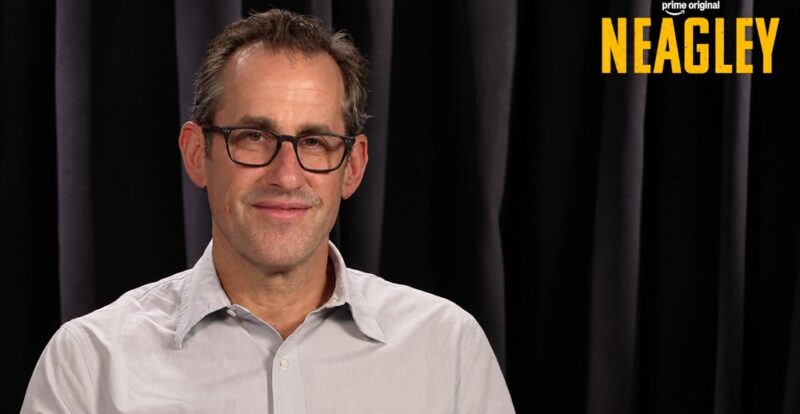
There’s an inherent challenge in spinning a supporting character off from a series as successful as Reacher. Frances Neagley (Maria Sten) has already proven herself a fan favourite, but the qualities that make a character compelling in concentrated doses don’t necessarily translate to carrying an entire series. For creator and showrunner Nick Wootton, the answer wasn’t to reinvent Neagley, but to start pulling at the threads Reacher had deliberately left unexplored.
Unlike Alan Ritchson’s nomadic hero, Neagley has roots. She’s a private investigator in Chicago with a career, relationships and a history capable of finding its way back to her. When the suspicious death of a beloved friend sends her searching for answers, those connections pull Neagley into a case that becomes increasingly personal, while forcing her to confront parts of herself she has long kept at a distance.
That includes her haphephobia – her aversion to physical touch – which Wootton saw as an opportunity to investigate not only where it came from, but what it reveals about the life Neagley has constructed around herself. While the people entering her orbit are all striving to escape their pasts or prove themselves, Neagley begins the series believing she has nothing left to prove. The journey instead asks whether the contentment she feels is actually complacency, and if there might be a richer life waiting beyond the walls she has built.
Speaking with our Peter Gray ahead of the show’s release, Wootton discussed the fundamental difference between telling a Reacher story and a Neagley story, finding eight episodes of complexity within a character audiences thought they already knew, and ensuring that when Reacher inevitably enters her world, he supports Neagley’s emotional journey without ever becoming the man who needs to save the day.
Reacher is a character who can essentially wander into anybody’s story, fix a problem, then disappear. But Neagley has roots, a career, relationships, a past that’s looking for her. When you started building a series around her, did you realise that distinction fundamentally changes the kind of storytelling you can tell?
It changes the access point because, for Reacher, it really is about walking into this kind of fire. For Neagley, it’s what you said – it’s these connections. In Chicago, she has roots, and it’s the tendrils of those roots that lead back to her.
That’s what we were thinking about in season one. It’s an old school friend, a family friend, that connection. And we’ve written season two with the hope that we get to make it, and the idea there is that it also comes from a Chicago connection.
So it really changes the way these things come into her orbit. But, similarly, these are cases that essentially would have fallen through the cracks had they not come to either Reacher or Neagley.
Going off that, there’s something really fascinating about taking a character audiences already love in concentrated doses and then asking her to sustain eight episodes. Was there something about Neagley that worked beautifully when she was a supporting character that you actually had to dismantle or complicate once she became the protagonist?
Well, yes, certainly, but it’s more about investigating and unpacking her haphephobia. That was the element of her not being able to touch people, or wanting to touch or be touched, and it’s never really explained. It’s not discussed where it comes from or why she is this way.
So our thought was: how can we take this element that people know about and that has been discussed, but never really delved into, and explore it? And by doing so, learn more about her, her past, why she is the way she is, and evolve the character.
Because without that element, we would have either had to invent something, or find another way in. That was really the thing that made us go, “Oh, there’s a show here.”
One of the things that I appreciated as this throughline is that people are trying to prove something. Hudson wants to escape his family’s reputation; Keno wants to overcome his past; Renee wants to establish herself in this male-dominated world. But Neagley enters the story as someone whose competence is unquestioned. Was proving yourself part of the architecture of the series, and does Neagley eventually discover something that she has to prove as well?
Absolutely. I think the other characters are strivers. They really want to go beyond their origins and their past. Neagley doesn’t want that at all. She’s totally fine where she is, and if these people or this case had never come into her life, she would have told herself she was perfectly content.
This story is the crack in that egg. She starts to understand that there is more for her – that there’s a more complicated, interesting and emotionally deeper life available to her. She realizes that what she thought was contentment was actually a bit of complacency, and it’s time for her to find a new level for herself.
And just before letting you go, was there ever a danger that bringing Reacher into the series could accidentally validate the idea that Neagley needs him? How carefully did you have to calibrate his presence so that audiences enjoyed that relationship again without his arrival making her feel less capable in her own story?
He’s the one who lays it out for her about how she’s dealing with her father, and ultimately he becomes the capstone of that emotional journey at the end. So he’s really bookending her emotional story rather than coming in to save the day.
All episodes of Neagley Season 1 are now streaming on Prime Video.
