

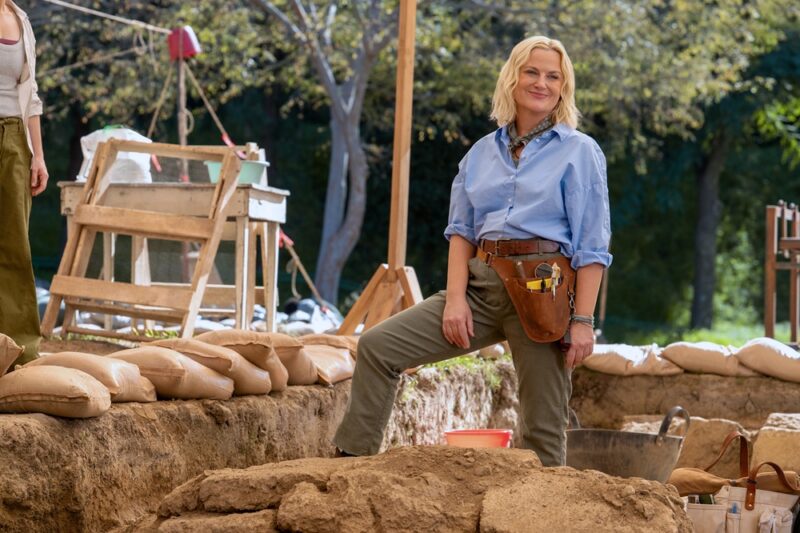
Given the collective comedic pedigree of Amy Poehler and Michael Schur, expectations were understandably high for Dig, the pair’s latest collaboration following the enduring brilliance of Parks and Recreation. After all, Schur has built something of a television empire around the idea that even the most dysfunctional workplaces can become unlikely communities, finding considerable humour and humanity in everything from municipal government to the afterlife.
Taking that sensibility to an archaeological excavation in Greece, with Poehler leading an ensemble of wonderfully mismatched personalities, certainly sounds like fertile ground for another comedy triumph. And while Dig, adapted from Kate Myers‘ novel “Excavations,” has enough eccentricity, amusing performances and occasional flashes of genuine warmth to suggest its creators haven’t lost their touch, its ten-episode debut ultimately feels like a series still searching for its identity. The ingredients are all there, but the resulting excavation unearths considerably less treasure than one might have hoped.
Poehler stars as Elise DeBellnick, an accomplished but increasingly embittered archaeologist whose professional ambitions have spent years being quietly suffocated by her charismatic mentor, Dr. Neville Wycombe (Hugh Laurie). Neville has made something of a tradition out of announcing his retirement, only to inevitably reconsider, leaving Elise perpetually waiting for an opportunity to prove herself beyond his considerable shadow. Her frustrations are compounded by the personalities surrounding her, including the impulsive Dylan (Geraldine Viswanathan), whose unexpected return to the excavation resurrects old grievances; the meticulously organised Clare (Antonia Thomas), whose personal and professional relationships are similarly complicated; and Patty (Fina Strazza), Neville’s painfully enthusiastic assistant whose determination to be useful frequently produces the opposite result.
When the discovery of an extraordinary ancient statue presents Elise with an opportunity to finally claim some professional recognition, the women’s decision to conceal their findings sets in motion a mystery involving a missing artefact, questionable loyalties and an increasingly ridiculous collection of potential suspects. It’s a premise with considerable comic potential, particularly when the show embraces the absurdity of its academic environment, but the competing demands of workplace comedy, character drama and archaeological whodunit don’t always coexist particularly comfortably.
Part of the frustration is that Dig frequently seems more interested in telling us who its characters are than allowing their personalities to emerge organically. Elise’s emotional guardedness and professional resentment provide Poehler with an intriguing departure from the irrepressible optimism of Leslie Knope, but the writing struggles to meaningfully explore the vulnerability beneath her abrasive exterior. Dylan’s unreliability becomes an increasingly repetitive character trait, while Clare, despite Thomas’ considerable charm, feels frustratingly underwritten, her complicated personal history rarely translating into the emotional investment the series clearly intends.
The central mystery, meanwhile, initially functions more as a narrative obligation than a particularly compelling source of suspense, with revelations arriving before the relationships surrounding them have been sufficiently established. Schur’s finest comedies have always understood that their more outrageous personalities become endearing through the gradual accumulation of small, revealing moments, and Dig rarely affords its ensemble that luxury. At just ten half-hour episodes, the season moves briskly enough to remain watchable, but that efficiency comes at the expense of the character development that might have elevated its more predictable comedic machinery. It’s only once the women begin operating as a genuinely collaborative unit that the series discovers a more engaging rhythm, suggesting that the friendships developing beneath the mystery were always its most promising material.
Fortunately, the performances frequently compensate for the shortcomings of the writing, with Strazza emerging as the show’s most delightful surprise. Patty initially appears destined to be little more than an exaggerated collection of nervous mannerisms, social catastrophes and increasingly elaborate physical humiliations, but Strazza finds something unexpectedly touching beneath the character’s desperation for approval. Her comic timing is impeccable, particularly when navigating Patty’s seemingly endless capacity for embarrassment, yet it’s the sincerity with which she approaches the character’s loneliness that makes her so endearing. Where several of the more established personalities remain frustratingly static, Patty is afforded a genuine sense of progression, and her interactions with Elise provide some of the season’s most affecting moments.
Laurie, meanwhile, is clearly enjoying himself as the pompous Neville, lending the character just enough charm to prevent his considerable self-importance from becoming entirely insufferable, while Kayvan Novak brings an appealingly ridiculous romantic energy to his appearances as local mayor Stavros. The supporting ensemble, including the reliably chaotic Jason Mantzoukas, contributes additional bursts of comic absurdity, even if the series occasionally treats its impressive collection of performers as little more than opportunities for amusing cameos. And although the humour rarely reaches the delirious heights associated with Schur’s previous work, the picturesque Mediterranean setting and occasional moments of inspired silliness ensure there’s usually something pleasant to appreciate, even when the storytelling loses momentum.
Perhaps the most disappointing thing about Dig is that its shortcomings feel less like a failure of imagination than a reluctance to give its strongest ideas sufficient room to develop. Beneath the archaeological intrigue sits a potentially affecting examination of professional disappointment, female friendship, generational expectations and the uncomfortable realisation that dedicating one’s life to something doesn’t necessarily guarantee the recognition one deserves. Elise’s struggle to distinguish loyalty from stagnation is particularly compelling, and there’s an appealing thematic parallel between the buried histories these women spend their days uncovering and the personal resentments they’ve allowed to accumulate. Unfortunately, such ideas are too often brushed aside in favour of increasingly convoluted plotting and jokes that inspire a smile rather than genuine laughter.
Still, the final stretch demonstrates a noticeably stronger understanding of what makes this particular ensemble work, offering enough emotional connection and comedic chemistry to inspire cautious optimism about where a second season might venture. Dig isn’t the triumphant reunion its creative pedigree might suggest, nor is it the kind of effortlessly addictive comedy that immediately demands repeat viewing. But there’s something undeniably appealing about watching Poehler and company slowly discover the potential of their own material. For now, it’s an entertaining, occasionally frustrating excavation that uncovers just enough promise to make you hope there’s something more substantial waiting beneath the surface.


THREE STARS (OUT OF FIVE)
All 10 episodes of Dig are now available to stream on Peacock in the United States and Foxtel On Demand and Binge in Australia.
