

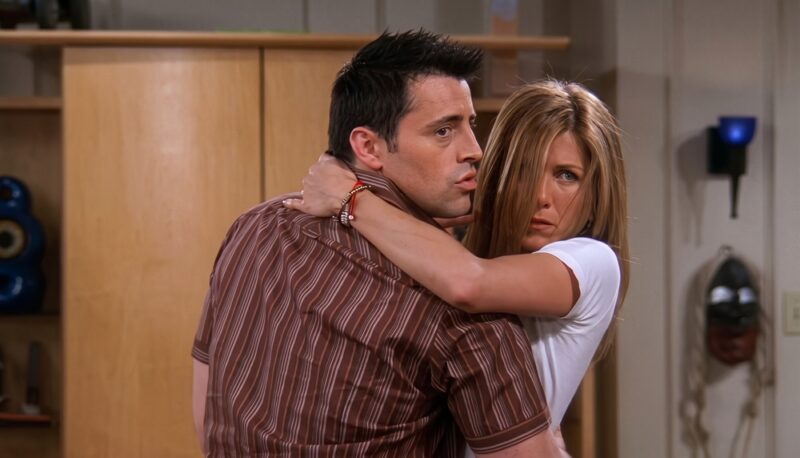
Of all the romantic choices Friends made across ten seasons, few have been treated with as much contempt as Joey and Rachel. Their brief attempt at becoming a couple is regularly dismissed as a late-series mistake, a storyline born from writers running out of ways to keep Ross and Rachel apart before inevitably putting them back together.
But what if Joey and Rachel weren’t the mistake?
What if the uncomfortable truth is that, by the later seasons of Friends, Joey may have actually become a healthier romantic partner for Rachel than Ross was?
That doesn’t mean Ross and Rachel shouldn’t have ended up together. They were always going to. Friends essentially promised that ending from its pilot, when Rachel, all flushed from running out on her wedding, burst into Central Perk, disrupting Ross’s post-divorce blues. Their decade-long history became part of the show’s DNA, and Rachel getting off the plane remains an enormously satisfying piece of television because it completes a story the series had been telling for ten years.
But narrative destiny and romantic compatibility aren’t necessarily the same thing.
Ross and Rachel were iconic because they were volatile. Their relationship was built on enormous chemistry, longing and unresolved history, but also jealousy, possessiveness and an astonishing ability to hurt each other. Ross’s insecurity over Mark contributed to the collapse of their original relationship. Their subsequent fights became vicious. They interfered with each other’s romances, struggled to communicate honestly and spent years trapped in a cycle where neither could fully move on while simultaneously proving incapable of making a relationship work.
They loved each other, but that doesn’t automatically mean they were particularly good at loving each other.
Joey, surprisingly, offered Rachel something very different.
By the time he fell in love with her, their relationship had already developed without romantic expectation. They lived together. They knew each other’s habits. They made each other laugh. Joey supported Rachel through her pregnancy and became someone she could rely on without wondering whether his kindness came with conditions attached.
And when Joey realised he had feelings for Rachel, his first instinct wasn’t to pursue her. It was to feel guilty.
For a character whose relationship with women had largely been defined by immediate pursuit, that distinction is enormous. Joey doesn’t see Rachel as something he deserves simply because he loves her. He worries about Ross. He worries about Rachel. He worries about damaging friendships that mean more to him than getting what he wants.
When Rachel initially doesn’t return his feelings, Joey accepts it. That shouldn’t be remarkable, but within the romantic history of Friends, it is.
Joey doesn’t become resentful. He doesn’t punish Rachel for rejecting him. He doesn’t attempt to sabotage whoever she might date next. His feelings hurt, but Rachel’s autonomy matters more than his disappointment.
Compare that with how frequently Ross and Rachel’s love manifests through jealousy.
Ross struggles when Rachel develops an independent professional life that introduces her to people outside their shared circle. Rachel struggles watching Ross move forward with other women. Both repeatedly behave as though their history gives them some continuing claim over the other’s romantic choices, even when they aren’t together.
Joey’s love for Rachel is considerably less possessive. He simply loves her. And perhaps the most interesting thing about the storyline is that Rachel eventually sees him differently too.
Her attraction to Joey is often cited as the moment Friends loses credibility, but why shouldn’t Rachel be attracted to him?
Joey is handsome, funny, affectionate and fiercely loyal. More importantly, Rachel already knows what living with him is like. She has seen him at his stupidest, sweetest, most selfish and most vulnerable. This isn’t Rachel becoming infatuated with someone she barely knows. It’s Rachel suddenly recognising romantic potential in a man who has quietly become one of the safest people in her life. Their relationship also reflects Rachel’s evolution in a way Ross sometimes doesn’t.
Ross fell in love with Rachel Green when she was still the beautiful, popular girl from high school he had placed on a pedestal. Even years later, traces of that dynamic remain. Their relationship carries the weight of who they used to be.
Joey meets Rachel as an adult.
Their closeness develops when Rachel has built a career, experienced serious relationships, become independent and, eventually, become a mother. Joey isn’t in love with the fantasy of Rachel Green that existed when they were teenagers. He falls for the complicated adult woman living down the hall. That difference matters.
There’s also an ease to Joey and Rachel that Ross and Rachel rarely sustain. They enjoy each other’s company without needing constant emotional drama to prove that they care. Their senses of humour align. They can be ridiculous together. Rachel doesn’t need Joey to intellectually challenge her, and Joey doesn’t need Rachel to pretend he’s something he’s not. Their relationship is built on companionship before romance ever enters the equation. In many ways, they accidentally construct the foundations of a healthy relationship before either realises that’s what they’re doing.
And then Friends panics.
Once Joey and Rachel are finally permitted to explore their attraction, the series suddenly insists that they can’t comfortably have sex. Joey can’t undo Rachel’s bra. Rachel keeps slapping him when he tries to touch her. After years of building emotional intimacy and establishing physical attraction, their incompatibility is resolved through a comic mechanism that conveniently makes the problem disappear almost overnight. The show treats their inability to immediately transition from friendship to sex as proof that the relationship itself is wrong.
But there’s another, arguably more interesting interpretation. Of course it’s awkward. Joey isn’t trying to sleep with another random woman. He’s trying to cross a boundary with one of his closest friends, someone he once loved enough that he was prepared to bury those feelings rather than risk hurting her or Ross. Rachel isn’t casually hooking up with Joey either. She’s attempting to fundamentally redefine one of the safest relationships in her life.
And hovering over both of them is Ross.
The idea that two people carrying that much emotional baggage might struggle to simply fall into bed together doesn’t prove they lack chemistry. It proves the situation means something.
The greater problem is that Friends doesn’t allow them enough time to find out what that something is.
Joey and Rachel didn’t necessarily need to be permanent. They didn’t even need to last particularly long. But allowing them a genuine relationship could have provided both characters with meaningful growth.
For Joey especially, it could have completed an arc the show repeatedly flirted with but never fully embraced.
His love for Rachel demonstrated that the perpetual womaniser was capable of wanting something deeper. He discovered what it felt like to love someone enough to put their happiness ahead of his own. Rather than following that revelation somewhere meaningful, Friends largely reset Joey to factory settings.
Rachel could have learned something equally important. A relationship with Joey might have shown her that love didn’t always have to feel like emotional warfare. That’s ultimately why the argument for Joey and Rachel doesn’t require pretending Ross and Rachel weren’t meant to be together. They obviously were. Their chemistry, history and importance to the series made their reunion almost inevitable.
But “inevitable” isn’t the same as “healthiest.”
Ross was Rachel’s great love story because Friends decided he was from the beginning. Joey became a compelling alternative because the characters evolved in ways the writers perhaps hadn’t anticipated. Ross and Rachel had history. Joey and Rachel had friendship. Ross and Rachel had extraordinary chemistry. Joey and Rachel had emotional safety. Ross and Rachel repeatedly hurt each other because neither could completely let go. Joey was prepared to let Rachel go precisely because he loved her.
And maybe that’s why the storyline remains more interesting than its reputation suggests.
Rachel getting off the plane for Ross is the right ending for Friends. It’s romantic, cathartic and faithful to the story the series had spent ten seasons telling. But Joey and Rachel deserved more than being treated as an embarrassing experiment that had to be quickly erased before the finale.
Because for a brief moment, Friends stumbled onto a genuinely provocative possibility: the person who gives you the biggest love story of your life isn’t necessarily the person who gives you the healthiest one.
Ross may have always been Rachel’s endgame. Joey might have been the man who was actually better at loving her.
All 10 seasons of Friends are now available to stream on HBO Max and Netflix in Australia.
