

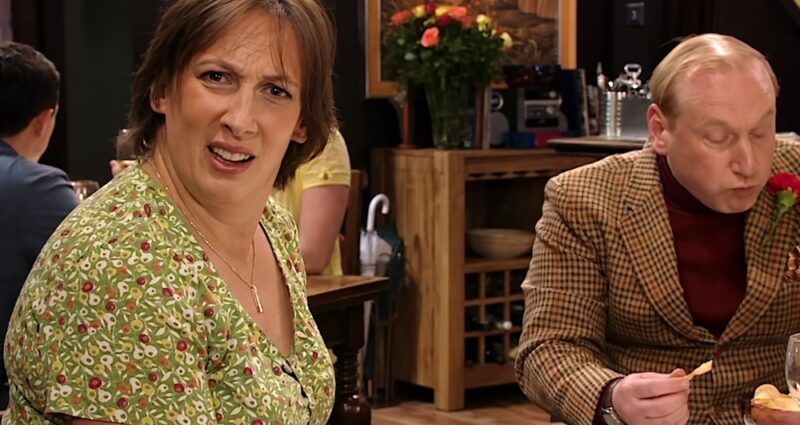
As audiences fall in love with Miranda Hart all over again, rumours of a sitcom revival couldn’t come at a better time. With traditional television comedy becoming an increasingly rare commodity, perhaps what we need now is a little more laughter, a little less cynicism, and a return to the wonderfully chaotic world of Miranda.
Sometimes it takes an entirely unexpected setting to remind us why we fell in love with someone in the first place. For Miranda Hart, that setting has been a Scottish castle filled with deception, suspicion and strategically orchestrated murder. Hardly the most obvious environment for one of Britain’s most beloved comedians to stage a television comeback, yet her appearance on the second season of The Celebrity Traitors UK has achieved something rather extraordinary. In a reality competition built around dishonesty, Hart has emerged as a wonderfully sincere presence, reminding audiences of the warmth, vulnerability and gloriously unselfconscious humour that made her a household name. And, perhaps more importantly, why television has been considerably less joyful without her.
The outpouring of affection surrounding Hart’s return to our screens has been impossible to ignore. Whether adopting the persona of amateur detective Mrs Marple, throwing herself wholeheartedly into the game’s increasingly ridiculous challenges, or forming unexpectedly touching friendships with her fellow contestants, Hart has demonstrated that her particular brand of comedy hasn’t lost any of its appeal. If anything, it feels more welcome than ever. Her emotional reaction to the banishment of Joe Lycett, culminating in her delighted declaration that “my love was real!” upon learning of his Faithful status, was the kind of beautifully spontaneous television moment that no amount of carefully manufactured reality drama could replicate.
But beneath the laughter has been something considerably more affecting. Hart has spoken candidly about the chronic illness that kept her largely absent from television for years, revealing how Lyme disease and myalgic encephalomyelitis/chronic fatigue syndrome (ME/CFS) profoundly affected her physical and emotional wellbeing. During one particularly moving moment on The Celebrity Traitors, she reflected on having once feared she might never enjoy something as simple as a walk in the park again, only to find herself in the Scottish Highlands enthusiastically pushing an enormous head in a wheelbarrow. It was ridiculous, certainly, but also quietly triumphant.
Her reaction to the loss of a fellow contestant was similarly revealing. “Connection and laughter and joy are bigger than this game,” she explained, admitting that illness had deprived her of the opportunity to experience that sense of playfulness for far too long. Suddenly, what might otherwise have been dismissed as another celebrity reality television appearance felt like something much more meaningful. We weren’t simply watching Miranda Hart being funny again. We were watching someone rediscover the pleasure of being funny.
And judging by the response, audiences have been rediscovering that pleasure right alongside her.
It is perhaps unsurprising, then, that reports have emerged suggesting the BBC is exploring the possibility of reviving Hart’s much-loved sitcom Miranda, either through a fourth series or a one-off special. Nothing has been officially confirmed, and any potential return would understandably depend on Hart’s own enthusiasm and wellbeing, but the suggestion alone is enough to make a compelling case for why the show deserves another opportunity to entertain us.
Because, quite frankly, television could do with a little more Miranda.
First broadcast in 2009, the semi-autobiographical sitcom followed Hart’s socially awkward, perpetually accident-prone alter ego as she navigated friendships, romance, family expectations and the everyday humiliations of being a grown woman who had never quite mastered the art of behaving like one. Alongside her were an ensemble of wonderfully exaggerated personalities: Sarah Hadland‘s fiercely competitive best friend Stevie, Patricia Hodge‘s gloriously overbearing mother Penny, Sally Phillips‘ hilariously self-absorbed Tilly, and Tom Ellis‘ impossibly handsome Gary, the object of Miranda’s romantic affections.
On paper, it was hardly revolutionary. A woman struggling through romantic misunderstandings, embarrassing social encounters and the occasional disastrous family gathering is familiar sitcom territory. But Hart understood something that television comedy occasionally seems determined to forget: originality doesn’t always come from reinventing the format. Sometimes it comes from finding a performer whose personality is so distinctive that even the most familiar situations become entirely their own.
Miranda was unapologetically old-fashioned, and that was precisely its charm. Filmed before a live studio audience, complete with physical slapstick, exaggerated misunderstandings, recurring catchphrases and Hart’s delightful habit of breaking the fourth wall to address viewers directly, the series embraced the traditions of classic British situation comedy without the slightest trace of embarrassment. It wasn’t afraid of a pratfall, a ridiculous facial expression, a perfectly timed double entendre or a joke so gloriously silly that its very predictability became part of the pleasure.
And crucially, it was never afraid to be kind.
For all the indignities Miranda endured, the series never treated its central character with genuine cruelty. She was awkward, insecure, occasionally selfish and frequently her own worst enemy, but she was also recognisably human. Her longing to be loved and accepted, particularly in a world seemingly obsessed with conventional ideas of adulthood, gave the comedy an emotional foundation that elevated it beyond a succession of physical gags. We laughed at Miranda’s misfortunes, certainly, but we also understood them. Who hasn’t wished the ground would swallow them following an embarrassing social encounter? Who hasn’t felt painfully out of place in a room full of people who appear to have life figured out?
Hart made those insecurities funny without ever suggesting they were something to be ashamed of.
That ability to balance absurdity with genuine emotional recognition helped transform Miranda into a cultural phenomenon. Across three series and two concluding specials, the sitcom attracted millions of viewers, earned multiple award nominations and established a devoted international following, including here in Australia. Its final episode, broadcast on New Year’s Day in 2015, offered something increasingly uncommon in television: a genuinely satisfying conclusion that allowed its central character to embrace both romantic happiness and self-acceptance without fundamentally changing who she was.
Yet more than a decade later, the possibility of revisiting that world feels less like an unnecessary exercise in nostalgia and more like an opportunity to reclaim a style of comedy that has gradually disappeared from mainstream television.
Of course, the traditional multi-camera sitcom isn’t entirely extinct. Reba McEntire continues to champion the format with NBC’s Happy’s Place, bringing her familiar comedic warmth to a new workplace ensemble, while Netflix’s Leanne, starring comedian Leanne Morgan, has demonstrated that there’s still an audience for character-driven, studio-style comedy built around relatable domestic chaos. The recently released Newlyweds, featuring Téa Leoni, Tim Daly and Jamie Lee Curtis, similarly contributes to the continuing appetite for familiar personalities navigating the absurdities of relationships and everyday life.
These shows serve as reminders that the format still has a place, even if the television landscape increasingly seems more interested in single-camera comedies, genre hybrids and prestige productions that blur the boundaries between humour and drama.
None of those approaches are inherently inferior, of course. Some of television’s finest contemporary comedies have emerged from precisely that creative evolution. But somewhere along the way, the traditional sitcom seems to have acquired an unfair reputation for being outdated, overly broad or insufficiently sophisticated. The presence of a studio audience, the familiarity of recurring locations and the comfort of recognisable character dynamics are sometimes treated as creative limitations rather than the storytelling opportunities they can be.
And perhaps that’s what makes the prospect of Miranda returning so appealing.
There is something uniquely comforting about a sitcom that invites us into a familiar world for half an hour, surrounds us with characters whose eccentricities we understand, and allows us to laugh without demanding that every joke conceal a darker psychological truth. Comedy doesn’t always need to be confronting, ironic or deliberately uncomfortable to feel relevant. Sometimes the simple act of making people laugh, particularly when the world beyond our television screens feels increasingly exhausting, is a worthwhile artistic ambition in itself.
That’s not to suggest that a revival of Miranda should merely recreate what worked fifteen years ago. In fact, the most interesting possibility would be to acknowledge how much time has passed, both for the characters and the woman who created them.
Where the original series frequently explored Miranda’s anxieties about relationships, professional expectations and the perceived milestones of adulthood, a fourth season could find equally fertile comic territory in middle age. What does Miranda’s wonderfully chaotic existence look like now? Has marriage to Gary brought any greater sense of domestic competence, or has she simply discovered an entirely new collection of ways to embarrass herself? Has Penny mellowed with age, or would the prospect of grandchildren inspire an even more spectacular level of maternal interference? And surely Stevie’s competitive streak would only have intensified with the passing years.
More importantly, there would be something rather lovely about seeing a character who spent so much of her early adulthood worrying about whether she was enough discover that growing older doesn’t necessarily mean growing out of the qualities that make us ourselves.
The series could even reflect Hart’s own evolving understanding of happiness, connection and the importance of embracing life’s smaller pleasures, without turning her personal experiences with illness into a fictional obligation. After everything she has publicly shared about her health, the idea of returning to a character whose greatest strength has always been her refusal to surrender her capacity for joy carries an undeniable emotional resonance.
Of course, revivals are notoriously difficult propositions. Nostalgia can be a powerful motivator, but it doesn’t automatically translate into compelling television, and revisiting a beloved series always carries the risk of diminishing what made it special. There’s also the question of whether Hart herself would want to return to the physical demands of a sitcom built so heavily around her extraordinary talent for slapstick. The last thing audiences should want is for an entertainer whose wellbeing has been so hard-won to feel pressured into revisiting a role simply because everyone else misses it.
But a carefully considered return, shaped entirely around Hart’s creative ambitions and circumstances, could be something genuinely special.
Perhaps the most persuasive argument for bringing Miranda back, however, has already played out before millions of viewers in that Scottish castle.
For all the elaborate deception and theatrical backstabbing of The Celebrity Traitors, some of its most memorable moments have come from watching a woman delight in the simple pleasure of human connection. Hart’s vulnerability hasn’t diminished her comedic appeal; it has deepened our appreciation of it. The laughter feels more precious now because we understand something of what it has taken for her to find it again.
When she spoke about the importance of playfulness, joy and friendship, it was difficult not to recognise those same qualities as the emotional foundations of Miranda. The sitcom was never simply about a woman falling over furniture, embarrassing herself in front of attractive men or enduring her mother’s increasingly desperate matchmaking attempts. It was about finding happiness in the middle of life’s imperfections, surrounding ourselves with people who love us despite our peculiarities, and accepting that perhaps being a little ridiculous isn’t such a terrible way to live.
Those ideas haven’t aged. If anything, they’ve become more relevant.
And at a time when so much entertainment is driven by cynicism, confrontation and the endless pursuit of cultural relevance, the prospect of returning to a comedy that wears its heart so openly on its sleeve feels almost radical.
We don’t necessarily need Miranda to reinvent the sitcom, challenge the boundaries of television comedy or offer some grand commentary on the state of modern society. We simply need it to remember what made it special: a brilliantly funny woman, an ensemble of gloriously eccentric characters, and the reassuring knowledge that no matter how disastrous the situation becomes, there’s always room for a little kindness and a lot of laughter.
Whether the BBC ultimately commissions another season, a one-off special or nothing at all, Hart’s return to television has already reminded us of something worth celebrating. Her particular brand of comedy was never merely a product of its time. It was a reminder that laughter can be generous, silliness can be sophisticated, and being unapologetically yourself might just be the funniest and most courageous thing of all.
And if a new generation of viewers is discovering that through The Celebrity Traitors, perhaps it’s only right that they should have the opportunity to discover the sitcom that made so many of us fall in love with her in the first place.
After all, wouldn’t that be such fun?
The Celebrity Traitors is now available to stream on Channel 10 and Paramount+. Miranda is available to stream on BritBox.
