


The housing crisis has become such a relentless part of modern conversation that it’s often reduced to statistics, market forecasts, and political finger-pointing. But in Birthright, writer-director Zoe Pepper turns that anxiety into something far messier, darker, and deeply human. The film follows Cory (Travis Jeffery) and his pregnant wife, Jasmine (Maria Angelico), after they’re forced to move back in with his parents (Michael Hurst and Linda Cropper), transforming a recognisable generational pressure cooker into a feverish psychological spiral about masculinity, class, entitlement, and the impossible expectations placed on younger Australians.
Blending biting satire with emotional unease, Birthright taps into the uniquely Australian discomfort around housing, privilege, and family dynamics, with Pepper walking a razor-thin line between comedy and tragedy. During her conversation with our Peter Gray ahead of the film’s release she spoke about why she refused to make the parents outright villains, how class obsession shaped the film’s DNA, the psychological toll of a generation locked out of adulthood, and why older audiences often leave the film in stunned silence while younger viewers laugh all the way through the discomfort.
What struck me in your director’s statement is that you didn’t seem interested in making the parents villains. Was it important to you that the film interrogates systems more than individuals?
Yeah, and I really wanted the audience’s sympathy to keep shifting throughout the film like that – that everyone is essentially playing the hand they were dealt and finding themselves stuck in this pretty shitty situation. It’s tough for the parents because they really don’t want their millennial kids moving back in with them, and when your back’s against the wall, you’re not your best self. No one comes out of this film unscathed. But I do hope that, through this exaggerated representation of generational misunderstanding, it sparks discussion and maybe encourages people to see things from a different perspective.
Given the housing prices and the fact that it’s almost impossible to buy a house for certain people, I think this film is truly coming out at the perfect time. I think it’ll be really interesting to see the amount of discussions that will come out of this film for audiences.
Yeah, definitely. Those discussions are long, intergenerational discussions. I find it interesting how a lot of when I speak to baby boomers after they’ve watched the film, they feel a very strong need to tell me that they are not those characters. They want to distance themselves in a way. Most people don’t feel the need to say, “I’m not that character in that film,” (laughs), which always made me think that I’ve hit a nerve.
The housing crisis is usually discussed in statistics and politics, but you’ve framed it almost like psychological horror. At what point did you realise that this subject wasn’t just social realism, but it was fertile ground for something surreal and emotionally dangerous?
Yeah, I think you’re absolutely right. The housing crisis, when it’s fed to you as statistics, is one thing, but the impact it has on a generation’s psyche is really profound. We were raised to believe that owning a house – or at the very least renting and living independently, not with your parents – was just a normal rite of passage into adulthood. And now it’s becoming increasingly impossible. How can you not internalise that and feel like a failure? Then you start seeing the effect that has not only on your psyche, but on your relationships as well. It almost becomes an inequality of status as much as it is wealth inequality.
Going off the reactions of audiences, because this premise is so inherently uncomfortable – which I love – but it’s super, super funny at the same time. How did you calibrate the tone so that audiences are laughing and quietly spiraling at the same time?
I worked in theatre for about a decade, and a lot of my work sits in that space where it’s really walking the line between comedy and tragedy. It’s always quite satirical, with exaggerated characters. I think that theatre background was what really helped me hone that tone and made me well-equipped to bring it to the screen and, ideally, make it land.
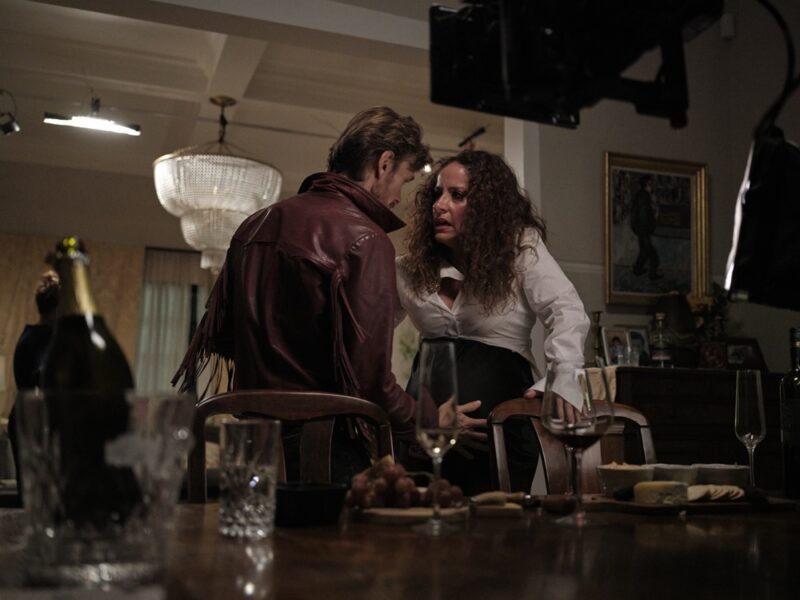
And there’s obviously a very uniquely Australian discomfort around talking about class. I think we still like to pretend we’re this egalitarian society. Did that tension interest you creatively?
Yeah, big time. I’m pretty obsessed with class as a theme, to be honest. With Jasmine coming from more of a working-class background, I really wanted the film to make a comment on class, but also to have a level of self-awareness that there’s a lot of privilege on screen. This is ultimately a very middle-class family who are doing pretty well. But that sense of entitlement and privilege is also what makes the story so ripe for satire. It’s very easy to laugh at that.
The film weaponizes that awkwardness of family dynamics. Were there specific moments from your own life that you referenced? Or more just observations that you thought were horrifying, but also objectively hilarious?
Not really from my own life. That is one compliment that I’m really kind of enjoying through this run of playing at festivals (though), is that the amount of people who come up to me and say, “It feels like you hung out in our family room,” or that I was spying them at dinner (laughs), because people are having these exact conversations with their parents about housing. I love that it’s representing Australian culture on screen in a way that’s fun and engaging.
Travis has this ability where he wears just everything on his face. You can just tell at every single moment what he’s going through. You can see that there’s a desperation to prove himself. It feels so deeply tied to masculinity and the idea that a man’s worth is tied to providing. Were you consciously unpacking that pressure as well as the economic themes?
Yeah. It’s very much a story about masculinity as well. People have said that I’m particularly good at emasculating men (laughs). I’ll take that. It’s kind of like the old guard and the new guard, which is a very well-born story in terms of the old guard not wanting to relinquish power. I listened to this lecture where Australian baby boomers were likened to Saturn in the Goya painting, where Saturn was devouring his son.
Here’s this prophecy where he’s told that one of his children is going to overthrow him, and so he eats each of his children at birth so that the prophecy can’t come true. It’s a hectic parallel to draw, but this economist was saying that baby boomers are like that. They’ve got this iron grip on wealth, and they just don’t want to let it Australia’s economy prosper.
The character of Cory starts to slip psychologically in a way that resembles someone almost radicalising themselves through resentment. Did you think about the pipeline from disappointment into delusion while writing him?
Yeah, I mean, I thought about it a lot while I was writing. I had this saying in my head: without his parents, he’d be nothing – they gave him everything. But because of his parents, he’s also nothing. He can’t really become an adult or flourish because they won’t fully move out of the way and let him assume that role. So once he finally breaks out of that, he’s filled with this rage of, “I’m not going to try to impress you anymore.” He starts standing up to his father, and that’s where there’s a real shift in both the story and in Cory himself.
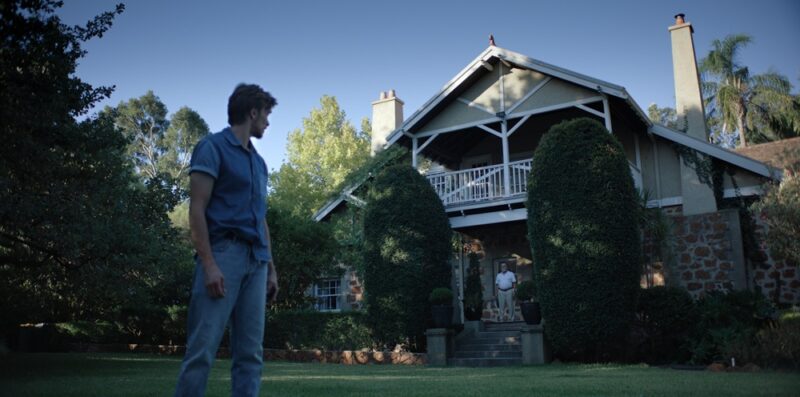
The film has this heightened, almost feverish energy where the reality keeps bending. Were there cinematic touchstones for that? Or did it come from theatre and the performance of language for you?
I think it was more from theatre and performance for me. That was where the conceit of it being four characters in one house meant that I could lean on an artistic voice. I like to think in those terms of how I would represent things more creatively and more abstractly. It gave me a lot of freedom in that way.
Going back to your director’s statement. It’s incredibly personal. Was it scary to build a film around fears that you were kind of actively living through, rather than fears at a safe distance?
I feel like that’s just part of the gig, really. It was a period where I was trying to buy a house, and in that period it felt like the bubble was going to burst. This was 2021 and the average time for a house to stay on the market was like five days. It was that thing of you’re spending more time trying to buy a pair of jeans than you do buying a house. It felt completely insane. That gave it a kind of feverish stress underneath. That was kind of feeling in the writing of it.
With a title like Birthright, it’s suggesting entitlement, inheritance, legacy, even ownership. What did that word unlock for you thematically?
Yeah, it was really about this sense of entitlement, which is a little bit built into the millennial generation. This growing up with this middle-class trappings…obviously I’m speaking about a certain class if millennials. I think in the title is this expectation, whether it’s right or wrong, that what is your parents will become yours. It’s a dirty reality.
Having played for a multitude of different international audiences, have you found there’s something particular audiences are responding to stronger than others?
Yeah, the Americans probably found it a little lighter and laughed a bit harder at the oddity of the cultural differences. The swearing seems to make them laugh in a way that Australian’s don’t. We just don’t laugh at swearing the same way. The real big difference I’ve noticed is the generational reaction. Playing in Melbourne and Sydney, we were playing to much younger audiences, where the laughs kept going through to the end. Whereas we played at Cinefest down in Busselton (Western Australia), which was a much more mixed crowd – a lot more older audiences. The tragedy really landed there. There was a heaviness and a reflectiveness that wasn’t there with younger audiences. But that was more my intention. I found it interesting how it sat with an older audience.
Birthright is screening in Australian theatres from May 21st, 2026. Madman Films will be hosting a series of Q&A events in the lead up to its national release at the following locations:
NSW: Ritz Cinemas with director Zoe Pepper and actor Travis Jeffery on May 13th and Dendy Newtown on May 14th.
WA: Luna Palace Leederville with director Zoe Pepper on May 19th and Luna Palace on SX on May 21st.
QLD: Five Star Cinemas New Farm with director Zoe Pepper and producer Cody Greenwood on May 15th.
