
Set against the breathtaking expanse of the Ningaloo Reef and filmed on Baiyungu Country, Whale Shark Jack is a sweeping yet intimate family adventure that explores grief, healing, and our deep connection to the natural world. The Stan Original follows 12-year-old Sarah, played by Alyla Browne, a fearless ocean kid raised aboard a research catamaran with her marine biologist parents, played by Abbie Cornish and Michael Dorman. When tragedy strikes, Sarah is pulled from the only life she’s ever known and forced to navigate a world on land that feels entirely foreign – all while holding onto hope that her closest companion, a whale shark named Jack, will return.
At the heart of the film is a powerful creative collaboration between sibling directing duo Miranda Edmonds and Khrob Edmonds, making their feature debut, and writer/author Kathryn Lefroy, whose story channels both the magic of childhood and the emotional weight of loss. Developed by a Western Australian team and grounded in cultural authenticity through close collaboration with Baiyungu creatives, the film blends spectacle with sincerity – pairing the awe of the ocean with a deeply personal coming-of-age journey.
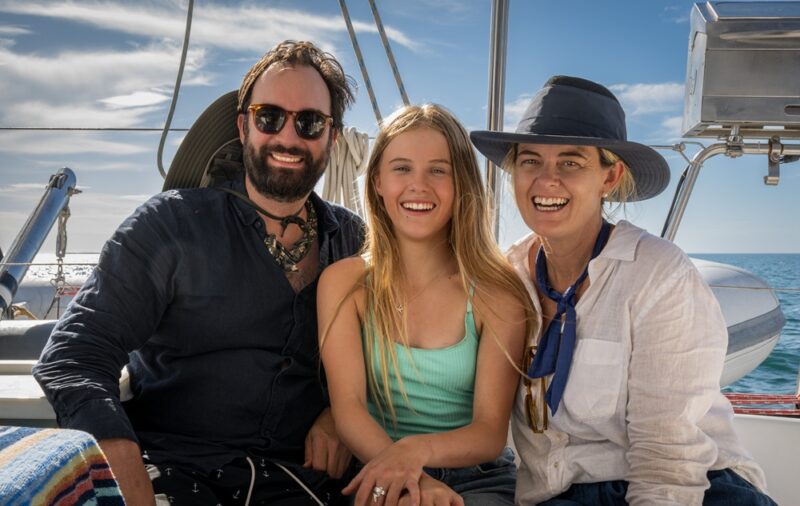
As Whale Shark Jack prepares to make its debut, our Peter Gray spoke with both Miranda and Khrob Edmonds, along with Lefroy, to talk about bringing this ambitious story to life – from capturing the majesty of whale sharks on screen to exploring the quiet, complicated process of healing when your whole world has been turned upside down.
I wanted to ask you first, Miranda and Khrob, this film has all of these breathtaking elements – sharks and the ocean – but it’s told through a child’s grief. How did you make sure that the scale of the environment never overwhelmed the intimacy of Sarah’s emotional journey?
Miranda Edmonds: Wow, that’s a great question.
Khrob Edmonds: I think one of the things with the scale and the natural environment is that the world is vast. We are part of it. I don’t think one overrides the other, because we are part of this huge thing. Sarah is such an ocean girl. Seeing Alyla (Browne) swimming in the beautiful blue water, and she’s just a part of it. I’ve always felt like the natural world, the closer you are to the vastness of it, the smaller you feel, but the better you feel.
Miranda Edmonds: I agree. And I think it’s that her character finds comfort from those vast horizons. That’s one of the things when swimming with whale sharks, is that as soon as you dive in, you can’t see the bottom. It’s just blue forever around you. But, weirdly, you feel very at home as soon as you’re near that big creature.
Kathryn Lefroy: Can I add something? The very first time I went swimming with whale sharks, I did not want to get in the water, because it’s terrifying. You’re in the middle of nowhere, but once you’re underwater and the shark is there, you really feel connected and tethered to these beautiful creatures. It does bring this sort of grounding force to this vastness. I think that’s what (Miranda and Khrob) captured so amazingly with all the underwater shots. They captured the vastness, but they also captured this really intimate relationship between Sarah and Jack. I don’t know how they did it. They’re obviously geniuses.
Miranda Edmonds: Well, a lot of that was Alyla, and you’ve probably got questions about her, but she was truly amazing. Both as an actor, which we already knew, but we didn’t know she was this brilliant free diver. And she just loves it now. She started when she was on the film, quite early, and she started training, and now she goes snorkeling all the time. Her being comfortable in the water really comes through.
Looking at that personal connection, Kathryn, I know that you wrote this after returning to Western Australia. How much of this story came from that feeling of reconnection versus imagination?
Kathryn Lefroy: So the first draft was very much imagination, because I’ve never been Exmouth before I wrote the first draft. I think it was only when we did a location scout to Exmouth to shoot some of the whale sharks that I finally sort of found the heart of the story. Miranda had been up swimming with the whale sharks for years. She was the one who wanted to make a story about a girl and a giant fish. I was like, “Yeah, no problem.”
But once we got out there, and once I got in the water and experienced swimming with a whale shark for myself, and experienced the town of Exmouth, I think that’s when it took the story and the script to a whole new level. That’s when I feel like it really started to come alive on the page. We could all see it then. No movie is easy to make, but it’s been quite a beautiful process throughout the making of it. From the first draft of the script…
In a story like this, where you have this bond between a child and an animal, as well as dealing with loss, it’s the type of film that could so easily become overly sentimental. How did you all find that line between emotional honesty and emotional manipulation?
Miranda Edmonds: It was really interesting, because in previous drafts there were a lot more sad scenes. We found that the actors were so brilliant at conveying that duality of their day-to-day life, plus what they are dealing with, that we just found we didn’t need (those scenes). We scaled back a lot of the grief. We just love when Sarah’s character goes to school and meets the other kids, and there’s this nice energy once she hits school and has to deal with all of that. That’s something every kid can relate to in some way. But it was definitely a balance. It’s a film about hope and this beautiful way of moving forward when we’re up against those really hard things. We wanted to keep that hope in there, and that way they actually find their way back to some happiness.
It is nice, given this crazy world we live in right now, to have a film that proves how good things can still be.
Khrob Edmonds: There is hope in the world, but it takes courage and it takes effort. We can’t forget that. But with courage and effort, good things can happen. And they do.
Kathryn Lefroy: And I think one of the main themes of the film is that you’re never too small to make a difference. And that’s what Alyla-slash-Sarah carries with her right from the start. Even though she’s just a kid, she’s the one who can actually drive this story, and she has the courage and the bravery to make a difference.
Well, on the mention of Alyla, I spoke to her a few years ago when Furiosa was coming out, and she seemed like someone almost wise beyond her years. How did she come about for you? Did Sarah ever change once you met Alyla?
Khrob Edmonds: We met with her before she even started filming Furiosa. We were casting a different role, and one of the casting agents was saying we should look at (Alyla) for Sarah. We had lunch with her and her mother over in Sydney, and she had a notebook filled with questions about the character, about what it was going to be like, how long will she need to hold her breath for…I don’t know how young she was, but she’d already done so much on various different sets. She just had this enthusiasm about animals too. For so long, Sarah and Alyla have been indivisible in our heads.
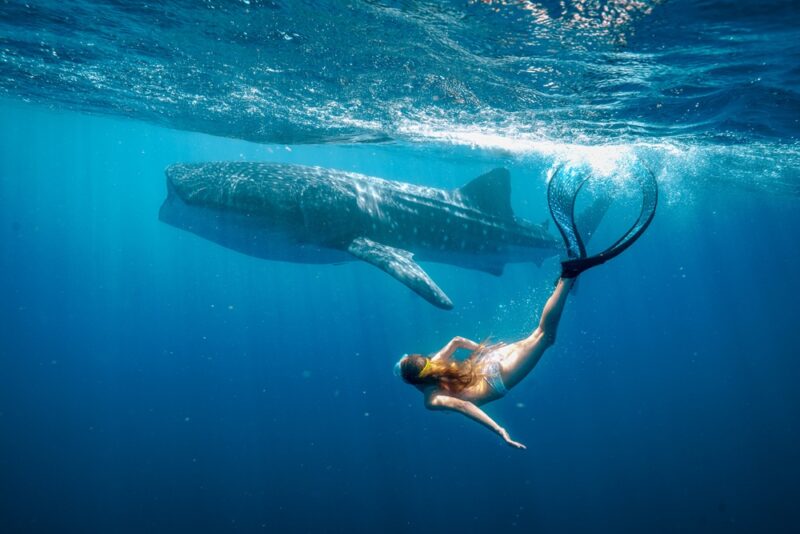
With the mention of animals, I know the film has a mix of puppetry and prosthetics, and then there’s real animal footage too. Was there a moment where the reality of being in the water with an actual whale shark changed the way you approached certain scenes?
Miranda Edmonds: No, that was from the very beginning. We knew we wanted to show the real actors with the real whale sharks. We did a test shoot, and it looked amazing. That was always the plan. The interesting bit was the year we shot, there was a massive marine heat wave up at Ningaloo. I was really quite emotional to be there and see that happening. It meant all the whale sharks, it was too hot for them. We were traipsing up and down the back of the reef looking for them. It was actually a lack of whale sharks that proved an issue. Then this one shark came along, and he was so friendly, and he loved Alyla. He kept swimming so close. We couldn’t get a shot, because there’s a lot of rules around shooting them, which is great.
But he would swim under the boat and kept circling, and it was brilliant. It was the last morning and we just shot so much footage, so much of the real life whale shark (you see) is just this one particular shark. And they actually have this fingerprint under their pectoral fin, so if you take a photo and register it – and the shark’s not registered – you get to name them. He’s a teenage male shark, just like Jack, so we named him Jack. It’s pretty special.
It’s nice to know that you’re star shark wasn’t a diva! I wanted to ask you, Kathryn, a writer question. I know that you’ve worked with writers such as John Collee and Dot West. Is there a piece of feedback or a note that fundamentally changed the story for you?
Kathryn Lefroy: Not really. I can’t think of one in particular, because the story was evolving the whole time. Even during the shoot, I was rewriting bits and pieces. Everyone did such an amazing job. I learned a lot from John and Dot, they’ve both given such incredible advice, but I don’t think there was one specific thing that changed the trajectory of the film. It was more this beautiful collaborative effort right from the start, to be honest.
We all worked with Hazel Walgar, who is a Baiyungu woman who lives up near Exmouth and Coral Bay, and she’s an associate producer on the film. She worked with us very closely on shaping the story to make it seem very realistic and, you know, just helping us understand life up there, basically. She was a dream to work with.
That brings me to my next question about the cultural responsibility. I know that it is so deeply embedded in the film. Did that collaboration shape the storytelling in ways that might not be immediately visible to the audience?
Miranda Edmonds: The Ningaloo Reef is now managed by a joint management committee. So Hazel’s always been quite involved in that as well. It’s lovely that we are getting every part of the culture up there.
And the film talks about exploring an almost quiet bravery. What does that mean to all of you? And how is it different from the kind of heroism we usually see in family films?
Kathryn Lefroy: Quiet bravery. I love that. I might steal that one.
Miranda Edmonds: I do have thoughts on this. Life is challenging, right? I just love that everyday people are just getting though these really hard things. You walk around, and you don’t know the hard stuff people are going through. I hate horror. There’s enough horror out there, but I do think that Sarah brings that bravery, and she almost does it without thinking. It’s just in her nature. She must save Jack in the way that we all look after our friends.
Whale Shark Jack will be available to stream on Stan Australia from April 2nd, 2026.
