


A beautiful, affective drama about the resilience of the human spirit, Treading Water features a star-making turn from Joe Gill as Danny, who, following his release from prison, tries to take control of the mental health issues that have shaped his life.
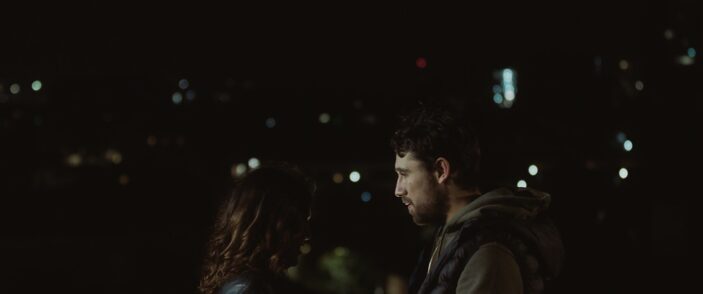
When a chance encounter with a former flame, Laura (Becky Bowe, in an equally stunning turn), offers him the possibility of love and redemption, Gino Evans‘ bold, unapologetic drama unfolds against the iconic Manchester skyline as it looks, with a both an honest and compassionate lens, at the lack of opportunity afforded to many people in parts of society and how we can so often be our worst enemy, even in the face of vindication.
Following its acclaimed turn out of the BFI London Film Festival, Peter Gray spoke with Evans, Gill and Bowe ahead of the film’s digital release, touching on what made the director want to tell this story specifically, and how the actors came to create the lived-in mentalities of their characters.
Gino, you’ve said that the seed of this film came from your time working in supported housing. What was it about that world of hardship and resilience that made you want to put it on screen?
Gino Evans: I was working a lot with the housemates and I just really got on with them. And it wasn’t just one house. There was one house in particular I worked a lot in, but there were lots of other houses, and there was a lot of fun, a lot of camaraderie. But lots of problems (too). You know, addiction, mental health issues, and some really sad stories…they were really open about their chaotic stories. And I felt that, mixed with their resilience and their “having a go” positivity, and even the staff in the supported houses and that strange family structure, all of that felt like a world that I knew.
It took me a while (to write the script), because I did that in my late 20s, early 30s, but then life gets in the way. I was doing corporate stuff, and then I just bit the bullet, quit my company, and went for it. I tightened up the script, did more research, and the producer was in a crossroads in his life (so) he came on board and funded the majority of it. I funded a little bit, and, luckily, we got to make it. And we got to make it how we wanted to make it. So I feel very lucky.
I feel like so many of these stories where a character comes out of prison, it focuses on them trying to find work. With everything that the character of Danny goes through, I wanted to ask you, Joe, how did you approach portraying his intrusive, violent thoughts without leaning on cliches?
Joe Gill: Yeah, it’s interesting you say that, because that was one of the things that we really discussed at length as a team. Danny’s not well, so a lot of his decision making is very fractured, fragmented and instinctive. It’s not always the best thing to do. So we came at it from two angles, which was what Danny’s actually got going on in his head, which are these very violent, at times grotesque, intrusive thoughts.
It’s all about the restraint within him to not act on these things. Danny is never actually violent within the film, really, apart from in his own mind. He’s so scared of himself, and I think that’s where slight empathy can come towards him. But we didn’t want to, as you said, make it cliche, especially with his OCD. Some people who don’t know a lot about the matter can hear OCD and think a certain thing, like that you need to tidy a room a lot. And it’s really not like that. It’s a lot more complex and works at various different scales. Danny is at the very high end of a scale, and it’s all about him trying to control things that are inevitably not in his control.

And Becky, your character, Laura, is not just a supporting figure. She’s fighting her own battles. How important was it to you in showcasing that complexity?
Becky Bowe: Yeah, she has so much going on. She’s pregnant. She’s a sex worker on the streets. She’s not necessarily doing that by her own choice. She’s also got a child at home. But we didn’t see a lot of that context. So many of her moments are with Danny, and what he represents to her is almost like a version of escapism. It’s a moment of nostalgia, of who she was when she was at school when she knew him. I love that first meeting (between them) because you’re seeing her at her most vulnerable. She’s on the street literally looking for work, and then she bumps into this person she knew from her past, and they just instantly have that vocabulary between them. That banter, that humour, and I think I felt it was really important that you rooted for them. Or you almost want them to be together. In another version of their life you can see how they could work, and it’s almost frustrating for her, because he’s there for her in those moments in the night. The more attached he gets, the more she has to reject, and the more he feels there’s hope, the less she feels there is potential for them. It was a beautifully complex thing to play, and it’s a testament to Gino’s script that he wrote her with all the humour and liveliness.
Was there a backstory that you and Joe created between Danny and Laura? We know they knew each other from school, but did you come up with anything specific between the two of you?
Joe Gill: We probably did, you know, didn’t we? We spoke at length about whether they kissed down by the canal when they were in Year 7, and things like that.
Becky Bowe: You know what’s interesting that you asked that question is because you start realising how much you’d built in your own head through those improvisations. I don’t think we necessarily set any rules of “this is how they started”, but we found the camaraderie between them in just those improvisations.
Joe Gill: That’s actually only just dawned on me now, yeah. That’s absolutely right. In answer to the question, it’s kind of like we actually uncovered truths about the character that weren’t necessarily in the original scripts (and) through the technique of how Gino liked to work and shoot, which was really interesting.
One of the lines of dialogue that feels like the heart of the movie in a lot of ways is “The world doesn’t fit for everyone.” For all three of you, did you each interpret that in a certain way when making the film?
Gino Evans: It was a very important line. It’s all a set-up society. You know, people are born into these structures, and you kind of feel that these characters have got to play the hand they’re dealt. They’ve got to play what’s going on in how they were brought up by their families. Their genetic makeup, if you like. I think some people can just slide into the world, and it’s easy for them, but then I feel like you’ve got to, or you should, empathise with people that have limited choices.
For me, the film was about resilience, but also about empathy for people who haven’t got a lot of choice, and sometimes the choices they make are probably they only choices they can make.
Becky Bowe: I just think it’s so nice that, because there’s so many stories, this film has brought a representation to these communities, especially from the north of England, where I don’t think there’s enough industry investment into stories like this. It’s really interesting, because I always think people say to me how welcoming everyone is from the North, and that’s because these places are built on these communities, and everyone is interested in each other. It’s not that they’re only friendly, it’s that people are open to hearing about other stories. It’s just an interest in humans. I’m so pleased that (Treading Water) has been on the journey it has, and hopefully it will resonate and get more people to make stories like this.
Joe Gill: Yeah, man, I absolutely agree. I think that Gino’s done a great job of being so truthful to these characters. And the people who are represented in the film, they are the most wonderful, interesting, humorous, kind-hearted people you can meet. There’s a great line at the end of the film, which is “Bit by bit. Day by day.” For the people represented in this film, it’s a matter of survival. They haven’t got amenities or the finances to plan further in advance.
They’re just looking to survive the day, so to speak. I don’t think that communities and the people like those displayed in the film are show enough, especially in British cinema. We’re hoping that the film can be more of a catalyst for more films to be made.
Gino Evans: I think it’s about the human spirit. It’s about the resilience of the human spirit. I think everyone, at some point, feels alienated from society, and inequality is growing. Since I wrote this film it’s only gotten worse. I thought that maybe I’d missed the boat, but it’s only gotten worse. When I wrote Treading Water, homelessness was a smaller problem because a lot of people were given housing off the streets. There was more funding in supported houses. But I think supported houses have gotten worse. It really is about the human spirit and how people can just keep going.
Treading Water is now available to rent and/or buy on Digital and On Demand.
