
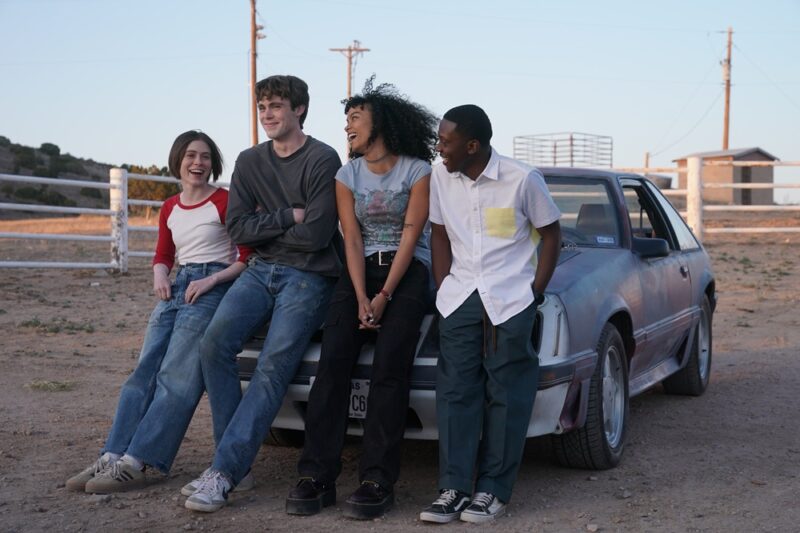
El Paso DEA Agent Ray Seale (Dave Bautista) and his team infiltrate a drug trafficking operation run by notorious cartel boss ‘Guzman’. But things go wrong and one of his team is shot and killed. In the aftermath, the slain agent’s son, Jesse (Blu del Barrio), is devastated and struggles financially having to move back to Spain with his mom. Ray’s own son, Cody (Jack Champion) feels sorry for Jesse and bands together a group of other DEA kids (Sophia Lillis, Whitney Peak, and Zaire Adams) to utilize their skills and access to resources to enact revenge, stealing money from trap houses operated by the Guzman family.
As the teenage ring of thieves goes for riskier targets, the DEA and the cartel close in. Cody quickly realizes he’s entered them all into a deadly game, and when Ray Seale finds out the truth, he must desperately protect his son from the increasing danger that has resulted from their heists.
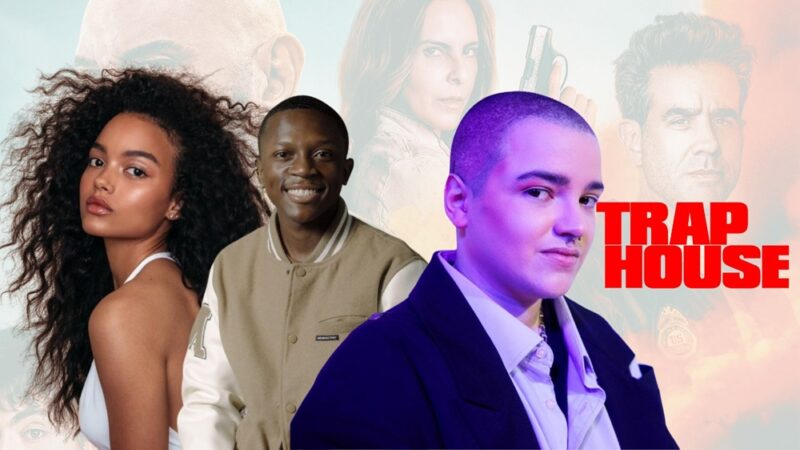
From Michael Dowse, the director of Stuber, and the creators of The Fast and the Furious, Trap House is an exciting new take on the action genre, and to coincide with the film’s release, Peter Gray spoke to cast members Whitney Peak, Zaire Adams and Blu del Barrio about the importance of visibility and representation on screen, and if they would personally be able to execute a heist successfully or not.
I know that Michael talked about how the group needed to feel sloppy but real. What was the difference for all of you between “movie friendship” and “real friendship”? Did you see one feeding the other during the film’s making?
Whitney Peak: Good question. I feel what Michael really tried to do, what (writers) Gary (Scott Thompson) and Tom (O’Connor) did as well, is they didn’t really want any of these characters to fit into any trope. I think within the friend group, we really don’t have that much in common, in terms of interests or things that we’re passionate about, other than our family. Our parents (on screen) have the same job. It feels very similar to our real lives, it’s like we were brought together because we are all a part of this movie, and we all have different interests outside of our profession. It was really cool to learn from each other, and have these endless conversations about how we’re all different.
Zaire Adams: You said that well.
Blu del Barrio: You said it perfectly. Usually with younger people in movies, or teenagers in movies, it’s always the dialogue that gets me when it feels inauthentic. I loved our script. Michael was also really, really big on letting us improvise where we wanted to. And I think that helps so much, especially with teen dialogue and friendships around that age range. It felt natural.
Zaire Adams: Michael wanted our true, real life differences to stay in the film. He didn’t want us covering up our tattoos, I could keep my nose ring in…I think he wanted these differences to shine through the screen and amplify that we are different from one another. It was fun.
With that, it really goes towards redefining visibility and identity on screen. What part of yourselves did you bring into this film that might not have been welcome a few years ago? Do you feel that you’re representing what it is to be a younger actor working today?
Zaire Adams: I think that it’s important for kids to see people like us on screen that are different. That look different or, more so, look like them. I’m all for visibility. I hope that there’s a little black boy somewhere that can watch this movie and feel inspired and think that he can do it as well.
Blu del Barrio: The visibility conversation is huge. And I love the fact that this friend group in the film is so all over the map. It’s just what is true to life and what people experience normally. For some reason it doesn’t get shown a lot. For me, personally, this was the first time I’ve gotten to play a trans-masc (character). The character was not written as trans-masc. It was written as a cis male character, and this is the first time I’ve been cast as a role written for a cis male originally. The rest have been non-binary or trans-masc labeled from the start. So that was huge for me. I give huge props to the creative team for letting me step in and do that. It’s never part of the conversation for (my character), it’s just it is what it is. It was awesome.
Your generation does feel more emotionally aware…
Blu del Barrio: I feel like anger in youth is so justified right now, that it’s very invigorating for people to see that coming to fruition. I love that there are these kids that are the ones that are pushing forward.
Zaire Adams: I can agree with that. I think the film shines light on that. Jack’s (Champion) character is very impacted about feeling like his family has been done wrong. There’s a lot of angst there. I think he doesn’t feel heard, and there’s this layer of the youth not feeling heard, not feeling recognised. I think that bled into his motives behind doing what he did in the film.
Obviously, with a film about pulling off a heist, did you ever have the conversation about who would be the one to survive such a situation? Who would be the one to immediately give away the whole thing?
Zaire Adams: I don’t know if we had specific conversations on set about it. I don’t think so. But I feel like I know I wouldn’t snitch us out. Maybe one of y’all (laughs).
Whitney Peak: I would definitely not get away with it. I can’t lie.
Your characters are using their parents skills against the system. It’s like a form of generational rebellion. Did you feel in any way the film was a metaphor for your own generation pushing back on inherited messes? Whether it’s political, environmental, or emotional?
Zaire Adams: Not for me, but when you put it in that light, I can definitely see it like that. That’s a really nice flip on it. That’s a really dope perspective on the film. I like that one.
Blu del Barrio: Yeah, I didn’t immediately go to that. I like it a lot. What stuck out was the smaller message of, like, even if you’re young, if something is not working for you, you can change it. You don’t always have to wait for an adult, or wait to become an adult.
Whitney Peak: I think you make a great point, Peter. It does kind of highlight to a certain extent that we’re given so much. We take so much from our parents, because it’s all we know. Everything comes when we kind of build our personalities and identities and moralities around that. There comes a certain point where you can’t use that as a crutch anymore, and you have to form your own beliefs and opinions and stand for things that you believe in, regardless of whether it’s things that your parents would necessarily agree with or not. I do think we’re living in a different world than our parents grew up in, for better or worse. That’s a very profound point that you brought up. Thank you for that.
Trap House is now screening theatres in the United States, before arriving to stream on Prime Video in Australia on December 31st, 2025.
