

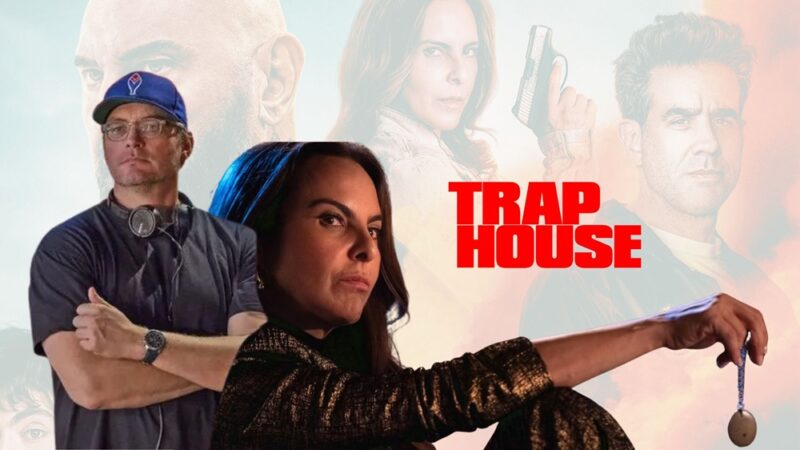
El Paso DEA Agent Ray Seale (Dave Bautista) and his team infiltrate a drug trafficking operation run by notorious cartel boss ‘Guzman’. But things go wrong and one of his team is shot and killed. In the aftermath, the slain agent’s son, Jesse (Blu del Barrio), is devastated and struggles financially having to move back to Spain with his mom. Ray’s own son, Cody (Jack Champion) feels sorry for Jesse and bands together a group of other DEA kids (Sophia Lillis, Whitney Peak, and Zaire Adams) to utilize their skills and access to resources to enact revenge, stealing money from trap houses operated by the Guzman family.
As the teenage ring of thieves goes for riskier targets, the DEA and the cartel close in. Cody quickly realizes he’s entered them all into a deadly game, and when Ray Seale finds out the truth, he must desperately protect his son from the increasing danger that has resulted from their heists.
Directed by Michael Dowse, Trap House is a new take on the action genre, and to coincide with the film’s release, he and actress Kate del Castillo spoke with Peter Gray about grounding the on screen physicality with an authenticity and emotionality, as well as how important Dave Bautista proved as a father figure on set.
Michael, I know you’ve said preparation is where movies get made. Was there a scene that completely changed once you got it on its feet? Something that defied all of your shot lists?
Michael Dowse: That’s a great question. Like, something that took a life of its own once we got going? Yeah, it’s a really good question. I think certain action (sequences), like the sand and the beer truck heist, that’s such a beast. It was such a big production, and you make it in convert with the second unit. For me, it was the first time I was really working with a really robust second unit. It was a lot of moving parts and a lot of forming that relationship with the second unit and the director and the crew. There’s a lot of trust there. That one, for me, as much as you can prep, there’s so many elements and so much you have to know. You just let people do the best they can with all the elements. It turned out really well. It was always an ambitious set piece to do, and I was pleasantly surprised with the results. That one probably surprised me the most in terms of what came back.
And Kate, your character operates in this morally gray world. She’s surrounded by men who they think control it. How did you approach grounding a woman’s perspective and agency inside that very testosterone-fueled system without it becoming cliche or reactive?
Kate del Castillo: Yeah, I think families are everything for these (characters), but also their cartel, (so) they’re going to protect it as much as they can with their lives, because it’s their legacy. With this, the script was amazing. That was something for me that I said yes (to), because I wanted to do this movie because it was different from the others I’ve done. They wanted it to be really humanizing. Not making them great, but humanizing in the way that they do care for family. I think the layers it has to these characters, these three dimensional characters, was the most challenging. (My character) has to be very tough because she’s living in a man’s world and she needs to have this respect. Women in that world do have respect, but it takes a lot more to be that powerful.
You mentioned, Michael, that Dave Bautista is a great writer. Was there a specific scene or beat that his notes directly changed the shape of the film in any way?
Michael Dowse: Oh, for sure. There’s lots. This whole project generated from him. It’s a Bautista concept. For all his scenes there’s levels of notes and talking to him ahead of time. Specifically the ending, he was very all over, in a good way, in terms of making sure it landed. And it was something we were all worried about. But he’s just very protective. He was also very protective of Jack (Champion) in a great way, just as a father and son relationship. It kind of bled into real life. Jack doesn’t need much protection, in that sense, but as a writer, a person, he understands dialogue and what works and what doesn’t. So, yeah, a lot of his scenes have his stamp on. It just happened naturally in a lot of ways, and that’s just who he is.
The mention of that protectiveness. The story hinges on parents and kids almost mirroring each other’s mistakes. As filmmakers, as actors, as parents, as children, was there a truth about family that surprised you both while making this?
Kate del Castillo: I don’t have kids, but I can totally relate, and I loved that in the script I could relate with this father and son. I’m very close with my dad, so, for me, that was very touching. This big man, but he’s fragile, because they’re dealing with this loss, and they share that.
Michael Dowse: Going off what Kate was saying, I think the thing that resonated was just that idea of that there’s no wrong answers in grief. Everybody deals with it separately and within their own way. You see a father and a son that are dealing with the loss of a wife and a mother, and they are so different, but both relatable. They’re closed off, but they clearly love each other. But there’s so much pain and hurt there (too). I think that’s the thing I related to. And I think most audiences will too. The film is about much more than that, but I think at the heart of it, that’s the journey that those two characters go through. It’s very relatable, because there’s no right or wrong answer in grief and dealing with that. There’s no playbook.
Kate, you’ve built a career on playing women who survive systems built to crush them. Was there something you learned about power that’s not glamorous, but true throughout everything you’ve worked on?
Kate del Castillo: I don’t think there’s anything glamorous in that world. And that’s why I loved it. They were looking for authenticity, and they got it, and I praise that. They wanted a Mexican to play a Mexican, which is really good. But (these characters) can never be in peace. They can’t use their money the way they want to. It feels more about power and pride. And I want to say that it was a very safe environment, and so many amazing people to work with. Michael, being the head of everything was amazing because he gave us the chance to play. Although we’re all very professional and serious when we’re working, but we also had fun and the freedom to improv sometimes. That was really nice.
Trap House is now screening theatres in the United States, before arriving to stream on Prime Video in Australia on December 31st, 2025.
