

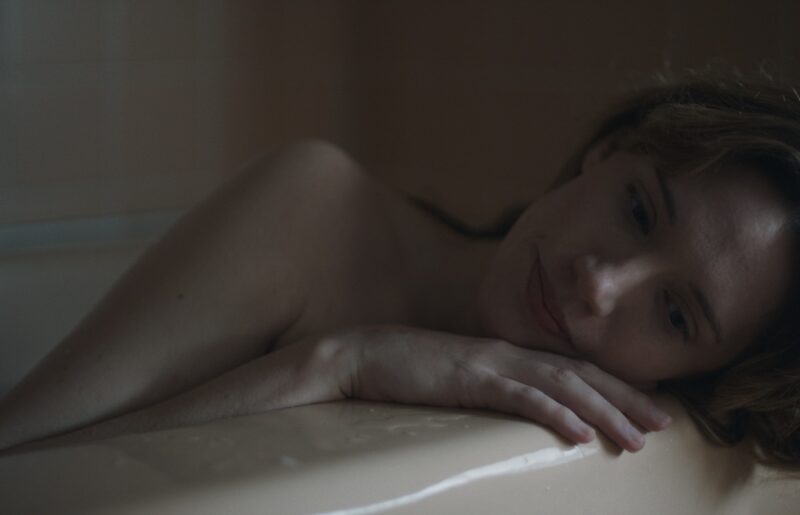
Struggling new mother Harper (Katie Parker) moves in with her own mother to renovate a fading suburban farmhouse. The two are joined by her mother’s new boyfriend and a mysterious live-in home aide, both who claim to be dedicated to Harper’s postpartum care.
But a sinister presence lurks within the house…one that has designs on Harper’s child.
As Harper investigates, she uncovers dark truths about the nature of her reality, and questions the intentions of those entrusted with her care.
A multi-generational love story disguised as a horror, The Beldham explores the fine line between care and control, and the desperate lengths mothers will go to to protect the daughters they love.
As the film arrives on digital platforms in the United States (you can read our review here), Peter Gray spoke with actress Parker and The Beldham‘s director, Angela Gulner, about finding the emotional truth of the story, and what they hope audiences will take away from such a deep, dark, personal story.
Before I get to The Beldham, which is so much more than a horror film, but it has horror inclinations, absolutely. For both of you, was there a horror film that was your gateway into the genre?
Katie Parker: I’m not a horror movie person. I have a very delicate nervous system. I’m a very nervous person. I get really gripped by watching something. I’m one of those people that’s immediately in it, and then I can’t let it go. I really avoided horror, and it wasn’t until I moved to Los Angeles and was trying to be an actor and I just happened to meet Mike Flanagan, who became a very close friend. He’s obviously the horror king, so that’s how I started. But I had never really seen a horror (movie). I saw The Sixth Sense, and I loved that, but I don’t do the slasher stuff. It’s really been in my 30s that I started to watch more, because I’m more curious about how they do the twists.
Angela Gulner: Mine was definitely The Sixth Sense. That just has one of the best twists ever. It knocked my socks off. And I’m a big Shyamalan fan, which is probably why this film has a twist to it.
Angela, you’ve described the film as being born from watching the three generations of women navigate care and decline. How did you transform that cycle of love and loss into something cinematic? Not just thematically, but visually and emotionally as well?
Angela Gulner: It’s a good question. This might have some spoilers, but with my grandmother, moving her out of the house and then into assisted living, it was this slow move forward. I read a lot of books, and it kind of surprised me how much went into the film once I started visiting her. I was seeing these images, and I talked a lot with friends who had gone through this experience with grandparents, and I was just reading a lot about the paranoia and the violence that can come out, and the way you speak can change when you’re experiencing dementia. The “monster” was one of the last pieces that came into fruition. It took me a handful of drafts to get through (my) emotional distance from the story and from the characters, and do enough fictionalization to say, “Okay, I’m allowed to have fun with the horror.” I had to take my time to build the distance. Otherwise, it was just too painful to put these characters through this.
And Katie, your character Harper, her journey is both psychological and supernatural. She’s haunted by care, essentially. How did you ground that experience so that it didn’t feel like just horror acting, but something emotionally truthful about motherhood and identity?
Katie Parker: Such beautiful questions, Peter. Angela really helped me with that. We had talked pretty extensively about the script and the character, and I think something I can rely on in my skillset as an actor, is the big emotional well that I have. I’m trying to not play in that area all the time, because I want to grow and have other skills, but I just felt really supported by Angela and the crew to make (my own) choices. And because we were shooting in the same location, the house kind of lent itself as another character in this. Our art department was incredible. Really, this space was one of those creative experiences where just being there…it was all there. I find filmmaking very frustrating, because I can’t control a lot, and I want to control everything, and just leaning on what was happening naturally and letting it reveal itself was really helpful.
You’ve both described the film as a love story disguised as a horror film. Why do you think horror is such an effective vessel for exploring the limits and the costs of love?
Angela Gulner: I mean, gosh, such a great question. Katie started in theatre, and I find horror to be so theatrical. You can do so much movement, and on a second watch if you pay attention to Katie’s body language, there’s such beautiful work in the way she’s holding her body. It’s really subtle. I think you get to explore these really expanded feelings without falling into melodrama or sentiment, and there’s a space for those films too, but fear is a really exciting emotion that can kind of feel close to grief or close to anger, and they’re all vibrating in this heightened space. I don’t know, I think maybe feeling one gives you freedom to allow yourself to feel another without having to directly have the conversation about the really hard thing right away. That’s how I experience it.
Katie Parker: I feel like in life we’re always playing with the duality of the light and the dark. The truth of our universe is that it’s incredibly dark, but there are babies being born, and people falling in love, and people are laughing, and then there is a war in Gaza and there’s genocide happening. Not to bring it there, but that is the duality of being alive on planet Earth. I think horror is the most accurate genre of living in that space all the time. Certainly with this movie, it’s horrific and frustrating and violent, but at the centre there’s a root of love.
It really was a film that had so much more to it than its horror inclinations, and it’s clear this vision comes from such a personal space. This family legacy is of caregiving and loss. Did that intimacy on Angela’s part change how you, Katie, approached your performance or your collaboration?
Katie Parker: Angela and I are good friends, and she actually wrote this part for me. It was good information to have in the way of doing research. I haven’t had that personal experience, so it’s such a gift to have a writer and director give you their personal take. I like asking directors who the character is, or who the character is to them, because they can usually map right back to their own personal story. But a lot of the emotional stuff came from my own lived experience.
And a lot of horror movies about motherhood focus on guilt or madness. This film reaches for reconciliation and understanding. What kind of emotional catharsis do you both want audiences to walk away with?
Angela Gulner: I want caregivers to feel seen. You can get angry and frustrated, and sometimes you get ugly or mean, and it’s just because you’re human. I am hoping that people who have been through that experience can see themselves and not be a villain. Maybe a bit of compassion and understanding for the person in the centre of the storm.
Katie Parker: I think, for me, I want people to call their mother. And if you don’t have a great relationship with your mother, that every part of you deserves a seat at the table to be seen, and that is the most authentic way to be a person, to allow all the parts for us to be seen. And especially women, I feel like we all get fixated on being a certain way, and the human experience is way more complicated than that.
The Beldham is now available On Digital and On Demand in the United States.
