

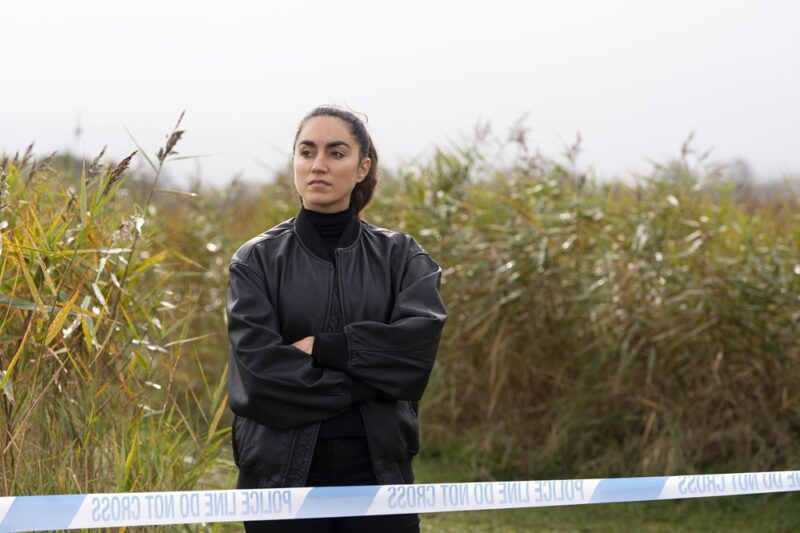
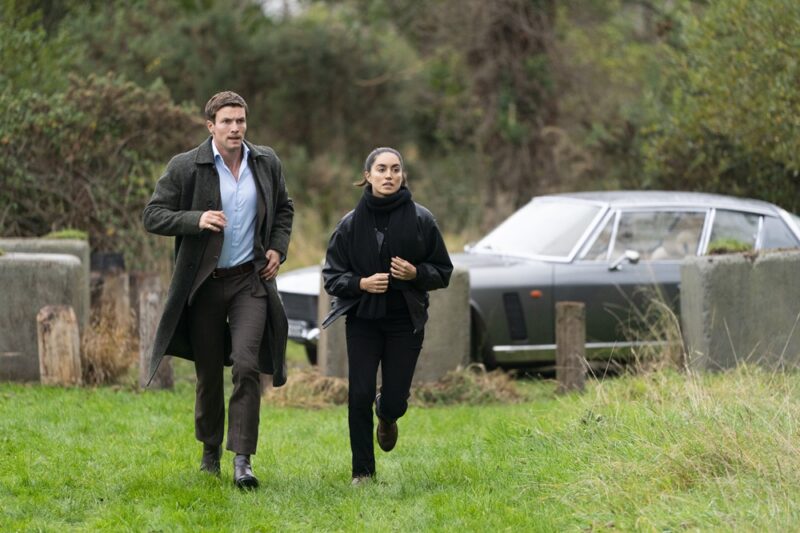
A fresh take on Elizabeth George’s Inspector Lynley novel series, Lynley follows the weekly adventure of a mismatched crime solving duo – an aristocratic police detective (Leo Suter’s Lynley) and maverick sergeant from a working class background (Sofia Barclay’s Havers). Together, the opposing duo become a formidable team, bonded by their desire to see justice done, while the series tackles issues around personality, gender and class.
As the series premieres in BritBox Australia, The AU Review’s Peter Gray spoke with both Leo Suter and Sofia Barclay about their roles on the show. Here, Sofia Barclay spoke about the joy in playing a flawed female character, the role’s unexpected challenges, and her own personally created backstory to ensure Havers’ own enrichment.
This Lynley is a reimagining. Were there aspects of Havers as a character that you felt needed updating or rethought for a modern audience? And were there elements you also felt were essential to preserve?
I felt that the reimagination, as you put it, was really up to the writer. That was Steve’s (Thompson, writer) angle on it, and that was the decision and call before we came on board. That sort of gave us a carte blanche to really go forth a little bite more and make those choices that you’re alluding to. Then the choices that I specifically made were just the fact that I felt there was a female character who’d been written so unorthodox and so boundary-less. And that’s the bit I instinctively loved. I felt that that had to be preserved. I think that the people who love the books, people who love the (original) TV show, that’s something that would hopefully look out for and react to. That felt like a little torch that I wanted to keep alight.
Havers comes from a working class background and has that maverick attitude. How did you explore, or embody, that class background, in terms of accent, behaviour, posture, and reactions to having a more aristocratic partner?
Oh, that’s such a good question. I actually found my posture was terrible (laughs). I really remember thinking she’s quite a physical character. She’s quite the way I see her. She’s got a very big…not just a chip on her shoulder, but she has a strong defense around her at all times. She’s got quite strong walls up. I think that was the kind of physical embodiment part. As for the accent, I felt that the fact they set her up in Norfolk, but they kind of invented a three-countries police station, and I took into account that this is for an American audience as well, so going specifically for Norwich would be quite alienating. I just kind of settled into something that was actually an accident. I heard someone in a coffee shop up there (Norwich), and I recorded them, and I told them after the fact, and I just kept that as my guiding light. Yeah, I geeked out on what kind of actor-y things (I could do). Where you go and physicalize the character, researching and imagining what their life was growing up, and what corners they stood on when they were a teenager. I love doing that for any of my roles.
I was going to ask about that. Looking at family and upbringing and loss, all the stuff that we don’t see and hear. Was there anything you worked with specifically that affected your performance choice? Almost as if you made a backstory for her…
Peter, that’s a great question. The number one thing you have to do with a character like Havers…I mean, the framework of the show is that they’re detectives, right? You’ve got to ask the question, “Why is she a detective?” It’s a very difficult industry. From the research I’ve done into it, it’s also a very difficult job to be a woman in, and I thought that there must be a very strong reason why (Havers) is making these choices. And Steve’s script obviously corroborates it. For me, it became very clear that, for Havers, because of her personal loss and what she’s suffered in her personal life, that every kind of justice that she gets to serve at her desk is a personal justice that she gives to herself.
It’s almost like a corrective experience that she tries to give herself. (It’s something) she never got in that very sad incident with her brother years ago. It was very much in the forefront of my mind, and I put a little papier-mâché picture of her and her brother on my desk, and I created a backstory about why (her brother) made it for her and that he wanted to be a policeman, and so she had done it as a way to fulfill his dream. I had all these wonderful textures about what made her get up in the morning. Why does she pick that job day after day? I think, as an actor, there’s a parallel. “Why do I do what I do?” It’s a tough job. It’s an easy job in some respects, but the rejection can be hard. It’s not a hard leap to imagine where someone has such a difficult job to do, but such a strong vocation to it that they persist.
From my understanding, this is your first time playing a detective. Is there technical or physical challenges – whether it’s dialogue or forensic details – that were more of a challenge than you were expecting?
I actually played a cop in an American pilot that never aired, but we did a lock of backstory research. I obviously spent a lot of time talking to American investigators and policemen, and even traffic wardens, everyone in the American system, to understand what’s my day-to-day. I have notes and notes on what that experience was like. What was difficult for me was plotting all the red herrings and plotting out all the detective elements of the story. But what was great is Leo loved that, and I always thinking about the emotional arc of scenes, like, “Okay, my character has to get really pissed off at this point, so where are we on the day?” How were we going to come together for the next scene? I was always caring about that, and I was then always losing myself when it came to the perspective. Leo was so good at that.
And Havers is someone who is strong, she’s unfiltered, but she’s also a very flawed human. How did you ensure that she’s not just an archetype?
I think you’re allowed to find her a bit grating. The thing with TV is that you have to follow these characters, so you have to like them on some level. And that’s a very fundamental. This might be unorthodox, but in my approach I like the fact that she wasn’t particularly likeable. That, for me, would be the reason to keep watching. I felt that the writing really showed her humanity (too), and that really shone through as one of her more engaging aspects. Her guy instincts are very on point, her sense of justice is very strong, her sense of loyalty and family love is incredibly present. All those things, I think, are so wonderful.
As an audience member, the women I’m drawn to on screen are not always the most likeable. I love watching characters who are really messy, or feral. I particularly love stand-up comedy and female stand-up comedians. It’s such an area of inspiration for me, because I think that there was a time when people said that women can’t do comedy. Obviously, that’s trash now. But the point is that women have to find this “likeable” thing, like you’re not allowed to be messy or swear or say crude things. I think comedy is where you see that as the touch point the most. That was a very long winded answer to that (laughs). I love the fact that she’s flawed, it’s a joy to play.
The first episode of Lynley is now available to stream on BritBox Australia, with each episode releasing weekly.
