

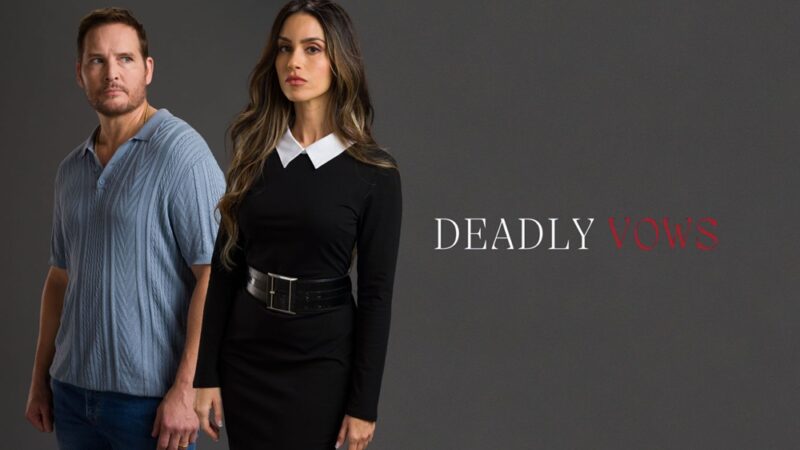
Inspired by true events, Deadly Vows is a gripping thriller about love turned lethal. After fleeing the Iran Iraq war, Darya (Shiva Negar) begins a new life in Los Angeles and is swept off her feet by the charming Sam Lebon (Peter Facinelli). But behind his promises of safety lies a violent darkness. As their relationship twists into abuse and control, Darya makes a daring escape – only to discover Sam has ordered her death. Hunted and alone, she must outwit a relentless predator before his vow becomes her execution.
More than a film, Deadly Vows is a powerful reflection of survival, resilience, and the urgent need to confront the realities of domestic violence. Its themes made for an important, reflective conversation between Negar and Facinelli and our Peter Gray, speaking as the film releases on Digital in the United States, touching on respecting its real-life elements and how they stayed mentally safe during the making of such a psychologically damaging film.
I know this film is taking a true story and channeling it through a lens of tension, intimacy and survival. I wanted to ask both of you, how did you navigate the responsibility of portraying real human pain, but also a gripping cinematic experience at the same time?
Shiva Negar: It’s a very, very heavy topic, as you know, and it took months of me working on the character and bringing my own experiences into it as much as I could to really access the pain, We all have our own stories, and probably our own share of tragedy and domestic violence. I resonated with the character in the sense that I’m also an immigrant and from an Iranian background, and we went through a lot of tragedy to be able to survive. I escaped Iran when I was a kid with my mom and my sister, migrating over a five-year journey until we found our home in Canada. I grew up in Toronto for the most part, before I moved to Los Angeles, and so that whole experience of coming from that part of the world and seeing so much that you may not necessarily see if you’re just born and raised in Canada or the US…I definitely took a lot from those experiences.
Peter Facinelli: For me, when I read the script, I was fascinated by how a couple that had so much love for each other and walked down the aisle with each other could get to a point where the husband was hiring someone to kill his ex-wife. You’re like, “How did you have this much love to that much hate and abuse in between?” When I approached it, it was more looking at the domestic violence and exploring the why and how behind my character. Understanding his trauma from growing up, and how he repeated that trauma and the guilt and the shame. The alcohol abuse to numb the pain, and that underneath this person doing all these horrible thing is just a scared child.
What’s really wonderful to watch is Shiva in this film, taking this character who goes through so much trauma, but she takes the time to actually heal herself. It’s such an inspirational story of resilience and forgiveness, and watching her succeed where (my character) failed. Approaching it from that, that point of view, and knowing that what he’s doing is not likeable, I realised it’s guilt and shame that he’s carrying.
It really is a film that moves from romance to horror. From the warmth of love to the chill of control. As scene partners, how did you both work together to track that gradual erosion of safety and trust so it never felt sudden or sensationalised on screen?
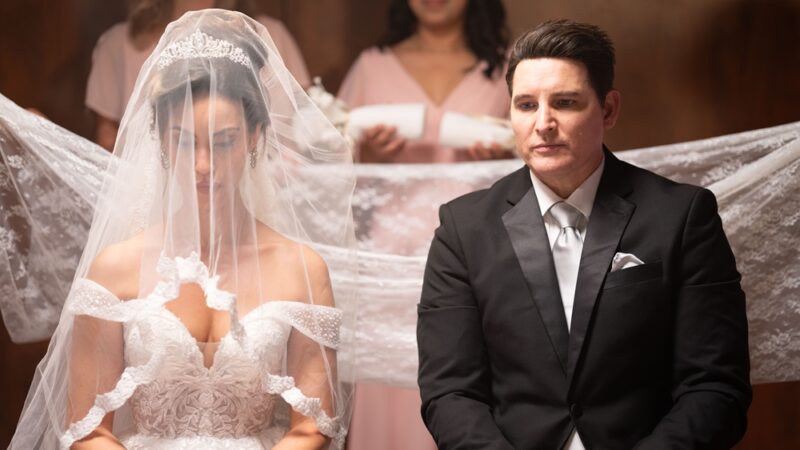
Shiva Negar: It was so amazing. We obviously had some rehearsals beforehand, but throughout on set we were constantly communicating, and Peter was so careful with everything. There’s so many loving moments, like the wedding and the beach scene. We had a lot of fun just feeding off each other. But the parts where it was going down a dark path, and it was getting really physical, it was actually quite hard for him to play it, because he was checking (on me) all the time. He even texted me that day we had the kitchen scene, which was really heavy, and he felt so bad. I’ll never forget this, Peter, when you texted and you told me you couldn’t sleep after (that scene). He has sisters and a wife, and he just wanted to make sure I was okay.
We were constantly communicating, but at the same time I didn’t want him to hold back at all in those heightened emotional scenes. I wanted it to be as present and as organic as possible. I told him not to hold back and that I will always tell him if it’s too much. I’m really glad he didn’t. I love being present when I’m playing with my scene partner and going with the feeling and seeing where it goes. I definitely enjoyed the whole of that.
Peter Facinelli: Having a safe environment bred a lot of freedom, and being able to really trust each other helped me and, I think, Shiva just stay really present and know that in these moments that we’re feeling bad, it’s not with each other as actors, but as characters. I was really appreciative working with you, Shiva, because it wasn’t an easy character to play, but you made it feel easy to be able to feel free in those spaces. So, thank you.
As you mentioned, Peter, you made sure everything was okay. When you’re making a film about trauma, empowerment and escape, that demands vulnerability, but also emotional boundaries. Was there a protection for both of you, mentally, whilst filming that dark material? Or was there something that you made sure you did to decompress at the end of the day?
Shiva Negar: I stayed in it throughout the whole (production). When we started, I just dived deeper and deeper into this character and all the details of her background and upbringing. With their relationship I was backtracking how they met, and all the love that was there and shared. I lived in her throughout the whole thing, all the while until we were filming. I didn’t detach myself from the character at all until we wrapped the movie. Even when we wrapped and I was going home, I was still trying to mentally live in (my character’s) world. After we wrapped I took a month off to decompress, and that’s when I said goodbye to the character.
Peter Facinelli: I’d finish the day and I’d feel this guilt and shame of the things that I had to portray, and I would check in with Shiva, as I mentioned. But, you know, her finding that forgiveness and resilience at the end is so inspirational to me when I watch the film, and it’s why I wanted to be a part of it. I don’t have sympathy for my character. I have remorse for him.
Darya’s journey mirrors that of so many women who have rebuilt their lives after loss and violence. What did playing her teach you, Shiva, about resilience, both as an artist and a woman?
Shiva Negar: It’s really important to know how a lot of people think it’s okay to stay in such relationships, and if you’re experiencing emotional abuse and gaslighting, which are two things we really try to show in the film, have empathy and, of course, try to understand all the layers on both sides of what they’ve gone through. At the same time, knowing when it’s time to get out and help yourself. There’s a limit on how much you love your partner and wanting to help each other our, but there is a point where you realise that it’s not okay and you shouldn’t be in that situation. That you need to look after yourself and your kids and your family.
I brought a lot of my own personal backstory as an immigrant. Iran is a country that has been under an oppressive, brutal regime for 46 years now, and women are really second class citizens there. They’re oppressed. I was there til I was 7-years-old, and my mom wanted a better life for me and my older sister, and she pushed for my dad to leave. I’ll forever be grateful to my mom, because the life I have now, here, is because of her. I could have easily been one of those girls in Iran who are still protesting, who are still trying to stand up for their fundamental basic rights, and are getting tortured and killed on the street for standing up for their freedom. I try to be very vocal about here as well. So going through that whole journey of escaping and going country to country for a better life, landing in Canada, and having that thick skin…I definitely saw that resilience and strength in Darya.
Is there a scene or moment for both of you that lingers the most? Not necessarily because it was the hardest to film, but because it said something essential about the film’s truth.
Shiva Negar: There’s a lot, but, for me, the ending with the Ayahuasca scene. It was actually a big scene that the producers were debating whether to keep in the film or not, but it was really important for Bella (Bahar Danesh, producer) to keep it. That scene was important.
Peter Facinelli: It’s so hard, because there’s so many scenes that are just very raw and truthful and show the manipulation, the control, and the inner workings of those relationships where they can be kind and they can be controlling. Even the beach scene, where it’s a smaller scene, but he’s drinking, sneaking alcohol on front of his children, and he gets jealous of another man who he thinks is looking at his wife, and then he blames his wife. He tries to take control by telling her how to dress, and then he turns around and plays with his children like nothing happened. She’s left embarrassed, manipulated, confused, and it all happens in one scene.
It was important to show how all of that emotional abuse could happen in just a short amount of time. She’s putting on sunscreen, and then she’s left with the physical abuse of having a shirt thrown in her face, being told that a man looking at her is her fault. He controls her, tells her what to wear, and then he ignores it as he runs off. That, to me, always sticks out as to what trauma does to the kids who witness that and are also left confused. They were hard scenes to play, because you’re leaving such devastation on so many lives.
Shiva Negar: That’s what I love about the film. That it opens a window into someone’s life that you wouldn’t necessarily see. You’ll hear about a murder, or something, on the news, and it doesn’t create empathy. This way of storytelling really resonates with people more, and that’s one of the things that I, as an actor, am really passionate about. To tell these human stories.
Deadly Vows is now available On Digital and On Demand in the United States.
