

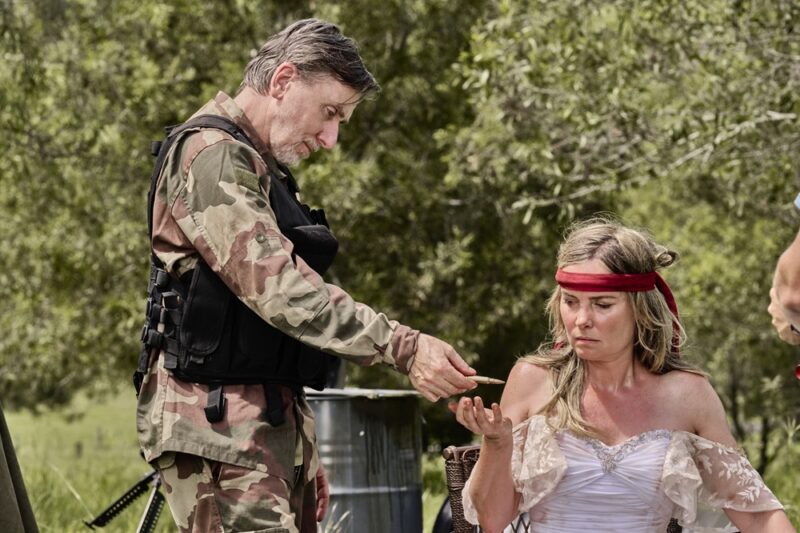
Pressure settles in early and never lets up. What begins as a quiet, isolated life on a remote Australian farm quickly tightens into something far more dangerous in the lean, nerve-wracking thriller Seven Snipers. At the centre is Kris “Voodoo Child” Hendricks (Radha Mitchell), a former elite sniper who has spent years trying to outrun her past – until it comes crashing back on her daughter’s sixteenth birthday in the form of a ruthless warlord known only as The Dragon (Tim Roth).
As the farmhouse transforms from sanctuary to battleground, the film trades spectacle for sustained tension, grounding its action in character, silence, and the ever-present threat of violence. In conversation with our Peter Gray ahead of the film’s release this week (you can read our review here), director Sandra Sciberras unpacks how that sense of controlled pressure shaped every frame – from the stillness of a sniper’s gaze to the emotional fracture between a mother and daughter forced to confront the truth.
You’ve described the film as operating on controlled pressure from the very first frame. Was there a specific moment in the script where you realised tension – rather than action – would be your primary storytelling tool?
Honestly, from the beginning. It was always about finding that fine line. Take the moment early on when the car pulls up – (Radha Mitchell’s character is) having this dialogue with her kid, but you can feel that she’s clocked the car. That’s where it clicked for me. Tension was the main thing to focus on, and the action had to sit within that. From the moment (Ryan Kwanten’s) character turns up, that sense of pressure is there.
Sniper films are often about precision and spectacle, but here you seem more interested in the elasticity of time – the waiting before something happens. How do you direct stillness so that it feels active rather than inert?
You listen to the heartbeat – like you’re listening to someone who could die at any moment. If you immerse yourself in that space, if you hear the breathing and understand what’s at stake, it becomes incredibly intense. For me, that’s where tension lives. It’s not just about action – it’s about the story, about being in that moment with characters who could die at any second. That’s high-stakes filmmaking.
I also appreciated that the cast feels genuinely expendable. You think you know how these films go, and then suddenly you don’t know who’s going to survive.
Thank you – that’s great to hear.
And going back to what you said about Radha Mitchell – seeing an actress like her in this space is fantastic.
That comes from the script. Andrew (O’Keefe) wrote an incredible character, and I was just lucky Radha said yes. She was perfect.
The sniper world is so internal. How do you translate that interiority visually without leaning too heavily on exposition? Is it framing, sound, performance – or a combination of all of the above?
It’s a combination. What fascinates me about snipers is that they go against the grain – they’re quiet, internal, patient. And yet what they do is incredibly brutal. That contradiction is the key. So it’s about immersion. When the actors are in that space, you have to be there with them – observing, staying calm, not overcomplicating it. It’s about watching through the scope, waiting. And knowing that whatever happens next won’t be good.
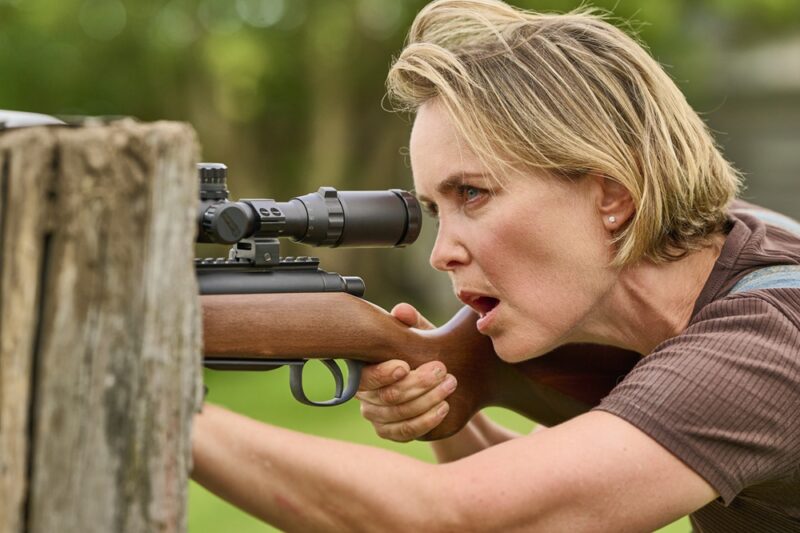
The environment feels like a character too. The farmhouse shifts from refuge to battleground – when did you start thinking of it that way?
Probably the moment the helicopter arrives. That’s when it stops being a home. One of the characters even says, “This is a bad place now,” and I love that line. The house was always a bit broken – it was never really finished. That made me question why. And the answer is, it was never meant to be a home. It was a fortress. That ties into the mother-daughter dynamic as well.
You shot on location in unpredictable conditions – how much did the environment reshape the film in real time?
A lot! It was hot, dirty – we had bugs everywhere, actors in ghillie suits overheating. But we embraced it. We recorded everything – the insects, the atmosphere – and built that into the film. The rain, for example, just happened to come during the scene we needed it for. It poured for three days, and then stopped. On a small film, you don’t get to recreate that – you just use what you get.
At its core, this is a story about a daughter discovering who her mother really is. Did you approach that reveal as something gradual, or as a rupture?
For the mother, it’s gradual. The moment she realises (Tim Roth’s character’s) come – that’s when her world fractures. But she doesn’t fall apart straight away. She steps up. She takes action. It’s only over time that you see the vulnerability underneath. That push and pull – that’s the heartbeat of the film.
The film suggests that trauma isn’t something you leave behind – it’s something that finds you. Was it important that the past feels inevitable?
Absolutely. It’s a force of nature. (Radha’s character) always knew this day would come. That’s why she’s living in isolation, in what’s essentially a fortress. The daughter doesn’t understand that yet – but there’s a reason she’s been taught things like archery. There’s a kind of quiet mythology in their relationship that I really love.
You’ve cited films like Sicario and The Hurt Locker as touchstones. How did you balance realism with cinematic tension?
It comes down to character. Those films are so powerful because of the people at their centre and the intensity around them. My budget was probably their catering budget (laughs), but we focused on that same principle. Stay with the characters, stay in their headspace. Let the camera move with them, then pull back into stillness. It’s about finding that rhythm.
I’m just thinking, let’s get Emily Blunt’s Sicario character and Radha Mitchell teaming up together…
(Laughs) And throw in Tilda Swinton or something…
Seven Snipers is screening in Australian theatres from April 30th, 2026.
