

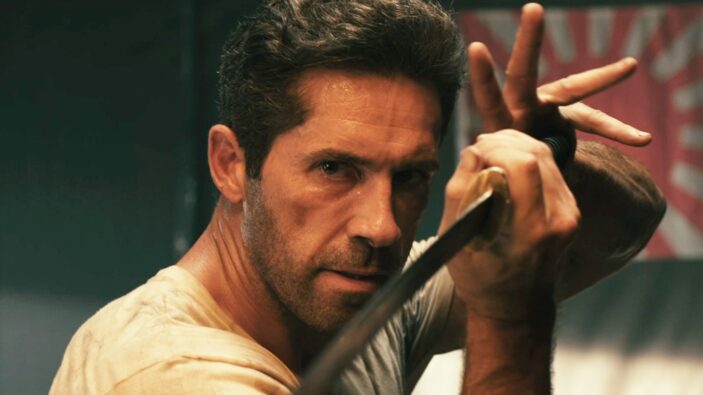
Directed by Louis Mandylor and written by and starring Scott Adkins, Prisoner of War tells the story of a soldier captured by the Japanese and held in a Philippine POW camp. Before the entire colony embarks upon the Bataan Death March, Wright and his fellow prisoners are forced to compete in brutal death matches for the entertainment of their captors. Adkins puts in a career best performance as the man who may be able to save them all.
As the film becomes available in the United States and soon releases in Australia, Peter Gray spoke with Adkins about the creative relationship he’s formed with his former co-star-turned-director, Australian Louis Mandylor, what he felt was necessary when telling such a story, and how even an injury wasn’t going to disrupt production.
So many war films and action films lean on the spectacle, but Prisoner of War feels built around intimacy. You have that hand to hand combat, which feels less showy, and tying into that psychology of survival. What were the conversations that you and Louis had early on about finding the right tone for the film?
Well, Louis is great at stripping away all the cheese and the things that feel false. I experienced this with him on the Debt Collector movies, we’d be rehearsing our scenes and, you know, some things don’t necessarily work. He would pick up on that. I could tell that he’d be a good director from those conversations on those movies, working with him as an actor. He keeps it grounded. As an actor, what’s your job? Your job is to find the truth in the scene, and (Louis) is a great actor. So if it’s not working, you just find a way to get rid of it.
There were some things in the script that needed to be dealt with once you’re on set, and once you have the whole thing built, some things don’t necessarily work. It’s not about trying to stick to the script. It’s sticking to the reality and the truth of the situation. And once you know the tone of the movie and what you’re going for, the action needs to suit the tone. You can’t just start doing a load of kung-fu and Hong Kong-style kicks. You have to stick to the gritty nature of what we’re trying to do. And that’s what we did.
Having worked with Louis before, were there any lessons you learned from previous collaborations that carried into this? Or things you knew you wanted to do differently?
Nothing to do differently. Just wanted to tell the story. If anything was different, it’s that I play a bit of an upper-class Brit, which I haven’t done before. But it’s just about trying to be truthful in the scenes and tell a good story.
This is someone who’s constantly pushed to his breaking point, physically and spiritually. Would you say that was the hardest part of embodying that kind of endurance?
Yeah, fight scenes are always hard. The hardest thing was that I actually pulled my hamstring on this one on the first day of shooting, and then it’s like, “Okay, it’s going to be miserable for the rest of the shoot now.” With the running and everything, it was trying to readjust the schedule so that the fighting was a bit later so I could heal. But you’re making a film over the course of four weeks, and you need more than that to properly heal, so it was the most difficult thing on this (set). It’s always difficult when you get a bad injury, (but) the train doesn’t stop moving. I can’t get away. I just got to get through it.
And you created the story. Was there something that drew you specifically to this battle and the POW experience as a backdrop? Something personal? Or was it just a fascination with more untold war stories?
I just had this idea knocking around in my head for ages. There’s a lot of these prisoner of war camps, and a lot of soldiers, and I’m aware of budgets that I get to work with, so I felt like we couldn’t achieve something like Bridge On The River Kwai, which is such an epic film. I wanted something more like The Deer Hunter, where it’s a few guys behind enemy lines in this extreme situation trying to survive. I love those films where it’s men against the elements and the struggle of the human spirit. Obviously, we put martial arts in there, because it’s me. And finding a way to have a British character know martial arts in the 40s, we came up with him being the son of a businessman from Hong Kong. When his father dies, he grows up on the streets of Hong Kong, obsessed with martial arts, learning it, and then going back to fight for his country and joining the RAF.
I feel like war stories so often confront the best and worst of humanity. Was there something that you personally took away from the film about resilience at all?
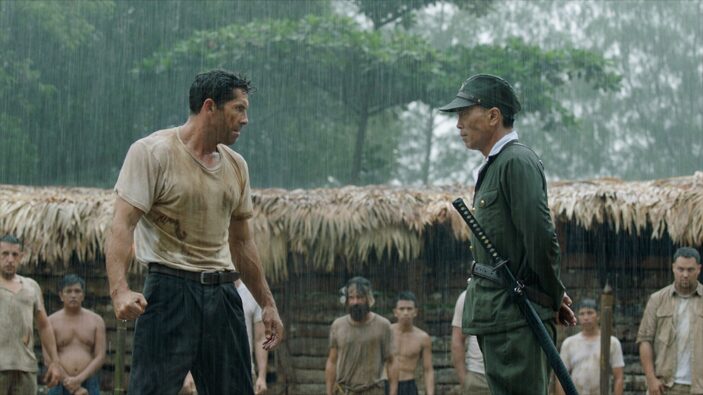
I learned more from just dealing with a torn hamstring than with the script. The script taught me everything I needed to know. But it’s tricky, because you’re dealing with the realities of the situation. The Japanese were pretty brutal with what they did in those camps. That’s just the reality of what it was. But you don’t want to have every character be irredeemable, so it was important to me to have, within the Japanese cast, different elements. We have one character who doesn’t agree with the way the prisoners are being treated, and he’s kind of trying to help them as much as he can, without being done for treason. Then the second in command, he’s really brutal and just a horrible piece of shit. You really want to see him get his comeuppance at the end. And then the main Japanese General, he’s a complicated character in many ways. You see his vulnerability in some ways, and you see him being brutal and horrible to others. So we played with that a lot. We didn’t want to be disrespectful, I suppose.
Going off that, when you’re putting this film together, you want it to be respectful and have that sense of realism, but at the same time you’re making an action movie. There’s that sense of escapism. Did you find as you were constructing the story that one element was taking over more than the other, and then you had to pull back? How did you find that balance of wanting some real, but escapist at the same time?
We wanted that martial arts element, which is obviously escapism. Does it make sense that this Japanese soldier would have his own prisoner of war camp, and the men that are supporting him, he’s training them in karate? I mean, it’s a bit of a stretch, but that is what we need. We have to try and make sure that this is believable enough, and once we go with that, does it make sense that my character isn’t just immediately killed? Because then we haven’t got a film either. So you do your best to, while writing the script, say, “Okay, we’re buying this. Is this going to work?” You never really know until you’ve seen the first edit of the film put together. But I think we achieved it. Of course, there’s an element of, “Would this really happen?” I think a lot of people’s thoughts from watching the trailer were “How does this white guy know martial arts in the 1940s?” So, I hope we sorted that one out.
I mean, from the beginning where you stab a guy in the head and then flip him over, I was absolutely on board! It’s always so refreshing to see action done as physically as possible, because it really brought me back to the action movies of the 80s and 90s that I grew up with, with Van Damme and Stallone, where these guys could actually take a punch. Going back to Louis and your relationship, is there something unique to you about the creative partnership that you’ve created together?
What we find is that, and we found this with the Debt Collector films, when we’re acting together, we’re completely on the same page. It’s not difficult. There’s no discussion. We just agree with everything. It’s easy being directed by him, because I’m not questioning what he’s doing, thinking “I wouldn’t do it this way.”
Is there a fight sequence you look back on here that you’re most proud of?
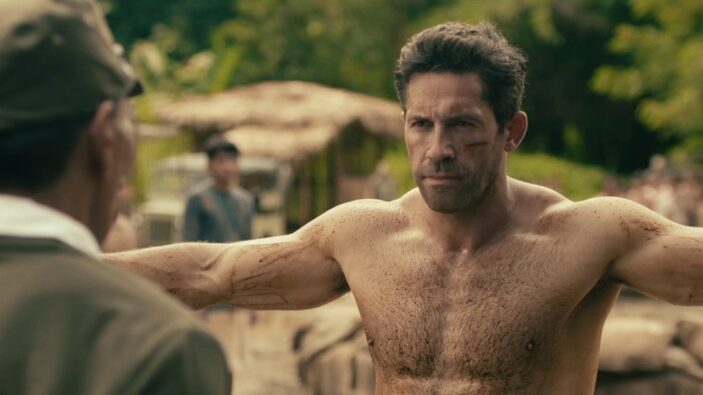
I’ll be honest, I like the sword fight at the end. I think it’s pretty technical, and it’s cool what we did. That fight fits the tone of the movie. It’s gritty, it’s not as flashy. I’ve done flashier things in the past, which I’m probably more proud of, in a way, because it’s more elaborate and intense, (but) it’s a different type of movie. The action needs to suit the tone of the film that you’re making, and because of the hamstring industry, it probably lent into that even more, because I wasn’t quite where I wanted to be, put it that way. I don’t think it takes away from the movie (though), I think it’s one of my best movies, next to Universal Soldier (Day of Reckoning). I was completely destroyed on that film! I had an ACL tear. I could hardly walk. But you wouldn’t know it by watching it.
Well I obviously had no idea, so you absolutely executed it to perfection. But as you said, the action really suited the story. I think I was expecting something much flashier, so it was a really nice change to see a film like this be brought down with as much grit as possible. So hates off to you and Louis, because it’s a thrill to see action done this way.
Thanks, Peter. I appreciate that. I’m right there with you. I grew up on those movies too, and that’s what I want to see, and I hope that’s what I’m bringing.
Prisoner of War is now available on VOD in the United States. It will be released on DVD for rental or purchase in Australia on October 1st, 2025.
