
A white-knuckle ride through one of America’s deadliest wildfires, The Lost Bus is the real-life story of a wayward school bus driver and a dedicated teacher who battled the elements to save 22 children from a terrifying inferno.
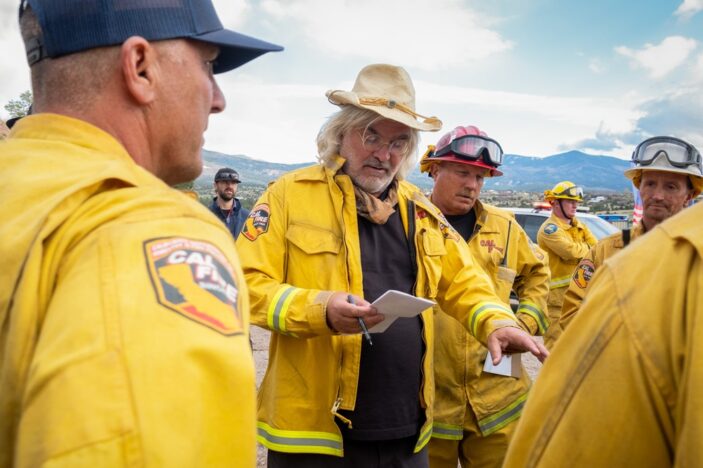
Starring Academy Award winner Matthew McConaughey and Academy Award nominee America Ferrera, The Lost Bus – a grand reminder of the human spirit and valuing the one life we have to live (you can read our review here) – is currently screening as part of this year’s Toronto International Film Festival, before arriving on Apple TV+ in October, and out of the festival this year Peter Gray was invited to chat with director Paul Greengrass, talking to the filmmaker about tackling the reality of the film’s story.
Paul, given your background in journalism, I’m wondering if that shaped your approach in capturing the reality of the campfire in the film?
I think it does. I was never a print journalist. I worked on a documentary program in Britain, that’s where I started when I came out of college. But it was a leading edge of journalism married with a sort of documentary filmmaking. So to make documentaries in the way, you’re out in the world and you’re experiencing the world. And my 20s were all about going to difficult places and trying to bring back films and those experiences. The program that I worked for was called World in Action, and I’ve never forgotten it, because it felt like I was shown the world in action. You go out and you’re going to troubled places and places of conflict, and it teaches you what the world looks like when it’s in conflict. You see it up close, as any good journalist or documentary maker should, so you never forget those foundational experiences.
You also never forget what it’s like to try and document those with cameras, which is about observing and capturing the moments of reality as you see them. Obviously as a filmmaker, as a teenager, I’d always dreamt of making movies, so, in a way, going to make documentaries by the time I was in my late 20s, I was really caught in a contradiction, or a paradox, because I’d worked in reality. I started in television drama and very small, low budget films, but I was essentially creating reality. How do you make sense of those two instincts? It was difficult for me. I struggled to make that marriage. I think it probably took me the thick end of 10 years, really, before I found a style and a way of being true to where I’d come from, whilst also making the films that I saw in my mind.
So, to answer your question, those instincts – journalistic and documentary – for what reality feels like, what it looks like, how to capture it, have stayed with me all my filmmaking life. And obviously with (The Lost Bus), it was at the heart of what I wanted to do, to create the reality of what it must have been like to be in the middle of an event like that. And the reason was quite simple, because it was the story of those people in that fire at that time, and that was the job, to try and render that as realistically as possible, but also on a sort of cinematic level. I remember thinking when (producers) Jason (Blum) and Jamie (Lee Curtis) first talked about the project, that if I could make that work, I could cinematically get at something much bigger, which is our burning world. The characters are facing that fire, but we’re all basically on that bus today. Aren’t we? That’s why I wanted the film to reflect stories of characters. All the intersecting storylines in that film are all about characters grappling with, “Have they left it too late?” That’s the story of our world today. I think.
Did you feel a responsibility, not only to the original book and the original experience of the people in Paradise who were impacted by the fires, but in making the film and during the editing process, obviously there was another wave of even more devastating fires in California…Do you feel a responsibility now that the film is out?
I think you do. I mean, I’ve made a fair number of films that are drawn from, as it were, real events, one way or another. You’ve always got to have a sense of responsibility, both to the events as they were or are, whatever you want to say, but also to the impact of your film in the real world. That’s why it’s a compelling place to make movies in that space. If I can put it that way. If you’re lucky, if you get (the films) right, everybody comes together and it works. Your films speak to a bigger truth. Obviously I can’t judge this film, because I made it, but you’d be a better judge, but I remember thinking at the end, we were literally two weeks off the end of finishing this film, we were on the stage mixing when the Los Angeles fires broke out, and that was obviously shocking and surreal and dreadful. Billy Goldenberg, who cut the film so beautifully, he had to race back because he nearly lost his family. He nearly lost his house. It was reality. It broke across the film, if I could put it that way. The films speaks to a particular time and place and characters, but somewhere I hope it speaks to those truths. I think it does, but you’d be a better judge than me.
The Lost Bus is screening as part of this year’s Toronto International Film Festival, running between September 4th and 14th, 2025. For more information on the festival, head to the official site here.
The Lost Bus is scheduled to release globally on Apple TV+ on October 3rd, 2025.
