
As global politics becomes increasingly shaped by disinformation, media manipulation and the battle to control public narratives, Olivier Assayas‘ latest film, The Wizard of the Kremlin, arrives with unsettling relevance. Adapted from Giuliano da Empoli’s bestselling novel, the political drama charts the rise of Vladimir Putin through the eyes of the enigmatic strategist who helps engineer his public image, offering a chilling examination of how power is built, maintained and normalised.
For Assayas, however, the film was never intended to be a partisan statement. Instead, the acclaimed French filmmaker was interested in exploring politics itself – how its machinery evolves, how propaganda continually reinvents itself, and why the pursuit of power remains driven by the same timeless instincts despite the changing technologies used to achieve it.
Speaking with our Peter Gray ahead of the film’s national release, Assayas reflects on adapting a story while history was still unfolding, why The Wizard of the Kremlin became more relevant the longer it took to make, and how the fictional digital nightmare he imagined in Demonlover has, in many ways, become the world we now inhabit.
With this movie, I found one of the most unsettling ideas to be that authoritarianism isn’t sustained by monsters alone, but by intelligent, cultured people who convince themselves they’re simply doing their job. Do you think that’s ultimately what the The Wizard of the Kremlin is warning us about?
There are so many answers to that question. Ultimately, the reason I made this film – and what really interested me about Giuliano da Empoli’s book – is that, from time to time, the world changes. Our values change, the algorithms change, and suddenly you have to rewire your entire conception of what politics are and where individuals fit within them.
I think we’re living through one of those transformational moments right now. So many things are happening that would have seemed unbelievable just a few years ago. I wasn’t trying to make complete sense of it, and I don’t think Giuliano’s book pretends to either, because the chips haven’t all fallen yet.
What interested me was making a film about politics in the middle of that chaos – not how politics functioned yesterday or the day before, but how they function today. At the same time, I wanted to show that, as strange as the world might seem, there’s still something universal and timeless about politics. At its core, it’s always been driven by very primal urges: how to gain power, and then how to hold onto it.
And the way power is gained and maintained is through a whole range of tools. Propaganda, fake news, the manipulation of information – those have become central to how politics operates today. I thought the book captured that remarkably well, (but) what interested me wasn’t making a political film. I don’t think the world is short of political films – there are millions of them. I wanted to make a film about politics instead. A film that explores how politics actually functions in this moment, rather than simply taking a political position.
I’m not sure if that completely answers your question (laughs), but hopefully it answers part of it.
I wanted to ask about you being both a critic and a filmmaker, because Baranov begins as an artist before becoming an architect of political narratives. Did making this film ever make you question the relationship between art and propaganda, and where that line can quietly begin to blur?
I can only really speak from my own experience and the way I grew up. I came of age in the 1980s, and if you look at it historically, the dominant leftist movements in Europe had largely come to an end by the mid-1970s. In many ways they had been consumed by terrorism, rejected by the public, and that chapter of European political thought had closed.
Then came punk rock. Suddenly you weren’t bound by Marxist dialectics anymore. It became a different kind of rebellion – one that belonged to that particular moment. That’s the environment I grew up in, and a lot of my friends embraced what punk represented: pushing back against the established order.
But gradually, during the Reagan years, that rebellion shifted. People realised the doors were suddenly open, modern capitalism was there for the taking, and many of them embraced it. Television then became the dominant medium, and with it came a new way of shaping and influencing public opinion. From there you move into reality television, and eventually reality television begins to shape politics itself.
So when I looked at what happened later in Russia through the strategies of Vladimir Putin and the FSB, there was something that felt strangely familiar to me. I don’t claim to know Russia well – I’ve only been there a couple of times – but I recognised the underlying logic. It felt like an accelerated version of something I had already witnessed firsthand growing up.
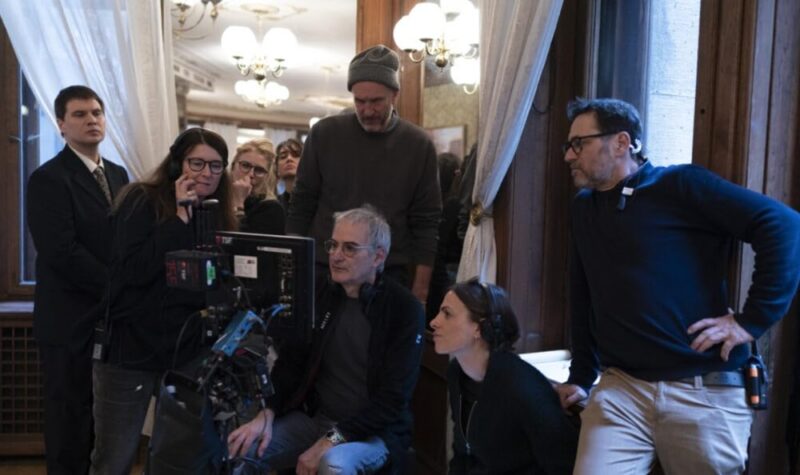
Talking about history, I feel like we often imagine history being shaped by grand moments. Your film suggests it can happen through conversations in offices. When you were researching this story, did anything surprise you about how ordinary the machinery of power actually is?
I think the machinery of power is actually very bureaucratic. In many ways it’s quite mundane – it’s a day-to-day job. But what constantly evolves is the way propaganda is used. There are aspects of politics that never really change, particularly the relationship between individuals and power. But if you want to hold onto power, you need propaganda. You need media manipulation. The methods are always changing because people aren’t supposed to realise they’re being manipulated. The entire logic of political control has to keep reinventing itself.
At that particular moment, it was being reinvented through the perverse use of the internet. Today it’s everywhere, but during the early Putin years that was the moment when politicians realised the internet could take propaganda a step further. They figured out how to use it, and it worked. Unfortunately, I think it’s become an incredibly effective tool for many terrible politicians around the world. What interested me was capturing that moment – that transformational point where political power and technology came together in an entirely new way.
I know that you’ve mentioned wanting to stay rigorously faithful even while adapting the novel. Did you ever reach a point where reality itself felt more unbelievable than fiction?
Non-stop! That was my biggest concern throughout the process. The challenge was that I was making a film about something unfolding in the present. These weren’t historical events that had reached a conclusion – they were still evolving. I kept thinking, “What if reality changes faster than the screenplay?”
I was committing to a film about events that began more than a decade ago, but they’re still ongoing. The war in Ukraine is still happening, and many of the political dynamics that emerged during the final years of Yeltsin and the early Putin era are still with us. They’re constantly evolving, constantly taking new forms. I genuinely worried that the world would change in a way that completely contradicted what Giuliano da Empoli had written in his novel. Part of me actually hoped that would happen, because it would have meant the end of the Putin era, the end of the war in Ukraine, and the end of so many terrible things that are still happening.
I really thought there was a possibility that history would overtake us – that events would move on and make the story we were trying to tell irrelevant. But the opposite happened. As time passed, not only did that fail to happen, it increasingly felt as though what The Wizard of the Kremlin was describing was proving to be true. Making a film takes years. Between Giuliano’s novel and the finished film there’s an enormous amount of time spent researching, developing, financing, casting and shooting. By the time we reached the end of that process, I was surprised to find that the more time had passed, the more our portrayal of modern Russian politics seemed not only to hold up, but to become even more relevant.
Your films have often explored people searching for identity in periods of cultural change, and this feels like the first time you’ve examined what happens when an entire nation is searching for one. Did that make this story feel different from anything you’ve directed before?
With every film I make, I try to do something I haven’t done before – something that feels different from the work that’s come before it. I’ve explored politics in various ways throughout my career, particularly contemporary politics, in films like Carlos and Wasp Network. But interestingly, the film I found myself thinking about most while making The Wizard of the Kremlin wasn’t either of those.
It was Demonlover. I made that film at the beginning of the 21st century, and it explored what I saw as the dark side of the internet. What struck me while making The Wizard of the Kremlin was how much the world had begun to resemble the one I had imagined back then. The strangest feeling throughout this process was realising that the fantasy world of Demonlover had, in many ways, invaded the real world.
The Wizard of the Kremlin is now screening in Australian theatres.
