
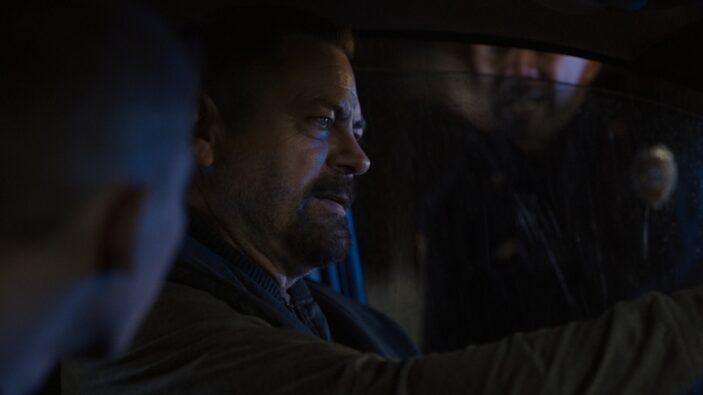
Inspired by true events, Sovereign stars Nick Offerman as Jerry Kane, a radicalised “sovereign citizen” who, with his 16-year-old son Joseph (Jacob Tremblay), gunned down two West Memphis police officers in 2010, sparking a deadly manhunt.
Directed by Christian Swegal, and also starring Dennis Quaid, Nancy Travis and Martha Plimpton, Sovereign draws chilling parallels to recent world events, examining how radical beliefs can escalate into deadly action and the ongoing threat of ideological extremism.
As the film (you can read our review here) arrives to rent or own on all digital platforms, our Peter Gray was ever so fortunate to speak with Offerman in depth about what drew him to the role, finding an understanding with his character’s views, and how his own labour work has kept him grounded as both an actor and a human.
This film looks at quite a terrifyingly real moment in Australian history. I feel like the sovereign movement is something wildly misunderstood. What drew you to the story and how did you approach portraying a man who’s so steeped in the distrust of authority, but you don’t want to dehumanize him at the same time?
I’m frustrated as someone who participates in the aspiring world of medicinal storytelling. Like, if every movie could be an Ava DuVernay movie, that would solve a lot of social ill. We would get a perfect movie that would erase homophobia, you know? That’s why I went to theatre school, and I think that’s why a lot of people get into the business, is because we want to hold up a mirror to society to help us heal ourselves in some way or another. And that can be with stupid laughter, or with dramatic work like this. So in the current climate of the world, and certainly America, I feel like the populace has been duped into shaking our fists at each other online. Everyone’s like, “That’s outrageous.” Whatever it is, you name it, it’s outrageous.
So I have to get online and give my hot take, and by now, it’s all such an exercise in futility. No one is gaining or losing ground with all of this vitriolic bipartisanship. For years now, I’ve been saying, “Hey, you shouldn’t elect a rapist.” That should always be the case. You should be prosecuted for your crimes and not get away with them in an authoritarian way. That’s just factual. It’s not arguing over an interpretation of the bible, or something. But I’ve long since given up on the fist shaking, and instead just say, “I’m going to try and do my best to participate in work that doesn’t separate us.” And I love the last couple movies that Alex Garland did, Civil War and Warfare. I find them to be really powerful anti-war movies, because they don’t pick a side or weigh in in any way on our current events. All they do is present some warfare as a cautionary tale, and I find them both gut-wrenchingly moving. And I find them so successful in that where it’s like, here’s 12 of our kids that we sent to Iraq, and here’s a day in their life. This is what we’re doing when we pay for and engage in these wars.
In the same way, by the same token, when I read the beautiful script for Sovereign by Christian Swegel, who also directed the movie, and it’s debut feature, and I think he should absolutely be getting awards attention. It’s a beautiful piece of filmmaking. So moving. So delicately wrought. When I read it, I just thought, “I have to do this.” It humanizes this guy and this movement, and we have a lot of that in both of our countries, certainly a lot more in my country, but I’ve been keeping up with the tragic sovereign citizen story going on in Australia right now. But all of the insane mass shooting in America, and all of the conspiracy theories, like extreme groups, that are being shared…I think at base, to simplify it, it’s that thing of, “Who hurt you?” What father figure did you lack? Or who made you feel bad about your masculinity to the point where you find others and group together and think, “Hey, we can get lots of guns and feel really strong and tough, and we can kid ourselves that somehow we can make our lives happier through violence.” All of which are terrible fallacies that are being sold to so many people. So when I read (Sovereign), and I’m laughing because this hasn’t been brief for you, but I just thought this really humanizes an example of one of these people who I don’t think are all born villains.
They’re the victims of the oppressive parts of our government, our institutions, our banks, our insurance companies, predatory lenders…all of these companies are in place to take advantage when people get dealt a bad hand of cards. I just really saw myself in Jerry Kane. I thought with a few wrong turns or unlucky draws from the deck, that could be me. And by trying to humanize this guy and tell his story with empathy, and again the script so beautifully illustrates these three different fathers and sons, and so focusing in on “How are we raising our sons?” and “What message do we want to give our young men,” all that made this something I absolutely had to do. And I’m so glad I did. I’m so proud of the work in this film.
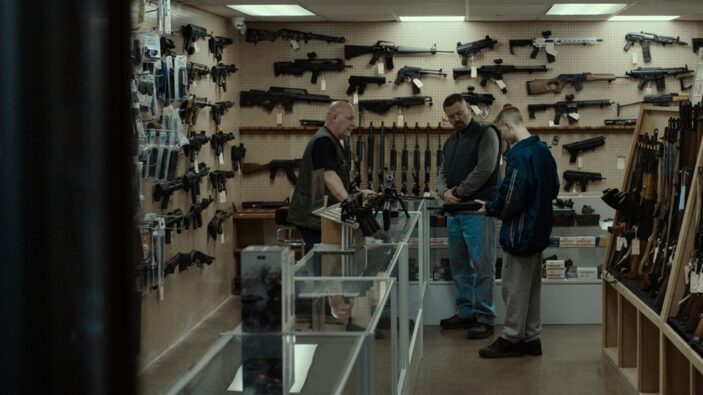
You absolutely should feel proud. The relationship between Jerry and Joseph, it’s almost this tragic love story as much as it this crime narrative. How did you and Jacob navigate that balance between paternal tenderness and ideological toxicity?
When something is that effective, it’s got to be on the page first. If it’s not in the script, you can’t fabricate something like that. Believe me, I’ve tried. Jacob Tremblay is so talented. He is such a powerful young actor. I think he just turned 19 yesterday? Working with Jacob was so dreamy, because we understood that was the soul of the script, that they love each other. They both want to be good men. Jerry wants to be a good dad. And part of the conflict is that his dad has told him that (the government) are lying to you, and it’s so self defeating. And when Jerry starts to actually make money, he says, “Well, I’m not going to give it to the bank, because they’re liars.” He can’t even, even when he succeeds, he can’t help but shoot himself in the foot. But both of these guys just want to be good men. They love each other. They have a beautiful father/son relationship. But Jacob so masterfully portrays being torn between beginning to understand the world around him as a young adult, and realizing that his dad’s not right. But at the same time wanting to please his dad and wanting to aspire to be like his dad. We’re both serving a couple different masters in the film, ultimately to our demise.
And the story very much hinges on fathers passing down beliefs to their son. As someone who has spoken about mentorship and legacy, how did this project challenge you? How did it challenge your thoughts on what you had handed down to the next generation?
It’s a big part of the subject matter for me, because I have these excellent parents who instilled in me a great set of values. I aspire to the values my mom and dad gave me, and I can proudly say that I live up to their work ethic. Right or wrong. Flawed or not. I always try my goddamn hardest, and sometimes I succeed and sometimes I don’t. But they taught me, as long as you are honest and try your hardest, no one can fault you. The rest of the messaging that we get from the consumerist world says that maybe there’s some shortcuts, and maybe you don’t have to be honest, and you can end up President of the United States if you know how to cheat successfully. We’re taught that’s a way to succeed.
But, you know, the party in charge of our country right now has won every branch of the government, and they’re so angry because they’re realising that doesn’t make them men. It doesn’t make them good. It doesn’t make them winners. They understand that their victories are pyrrhic and hollow. But, for me, it’s not just fathers and sons. Masculinity is an important part of the conversation, but it’s generally incumbent upon us to expect of each other civility and decency. That’s what the American experiment is about. It’s a country where everyone gets the same shot. Everyone gets the same rights, everyone gets the same respect. And we’ve made wonderful advances over the years, but obviously we’re still shitting the bed floridly in many ways. And so any conversation that I can be a part of where we look at what we are passing to our young people with masculinity, but even more generally, just with empathy. What lessons are we teaching young people?
I’m so grateful that I had such a good mom and dad and other teachers in my life that I can just say, “Well, you got to have a great work ethic. I think you should know how to make things with your hands, and you got to have good manners.” Nothing will ever be solved with violence. No matter how much you want to punch somebody in the nose, or worse, take a deep breath, because we’re still going to be sharing this acre or this town or this country. Ultimately, we need to find solutions. No matter how much of an asshole you think I am, or I think you are, we still got to say, “All right, I agree we’re assholes. Let’s sit down and have a sandwich and figure how us asshole can divvy up natural resources.”
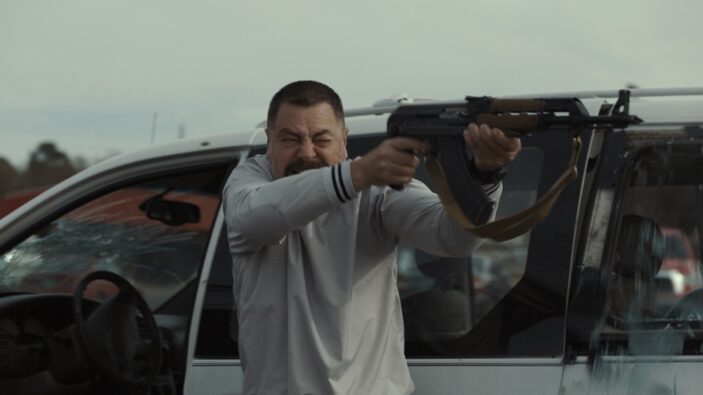
You’ve spoken about working with your hands. Do you think that humility and that sense of labour has kept your acting honest as well?
I mean, I live with a goddess of entertainment. I live with a paragon of beauty who’s a Broadway star and she’s the best actor and singer and dancer. Her taste, the way she dresses, she’s incredible at everything, and so I live with a constant reminder of my shortcomings. It’s great because it keeps me honest. I also own a mirror, and so I understand that’s where my humility is based, where I’m like, “Alright, I’ve been given this particular toolbox, and I’m just going to do the best I can with what I’ve been given.” I never feel like when I shoot a three-pointer (that) I see it go through the net. I may bank one off the backboard, but I am aware that I score points. You know what I mean? With my work, whether it’s a book or a movie, I read it or I see it, and I just see what I could do better. Next time, I’m like, “Okay, people are enjoying this enough that I’ll consider it successful.” But I can’t wait to get back in there, because I just saw how I can do it better. I think that’s a disposition that goes hand in hand with making things with my hands. When I make things in the shop, for example, there’s a rule that with any project you go in knowing you’re going to fuck up some wood. No matter what we’re making, you’re going to screw up the first couple tries. So you get extra, cheap wood for the first couple tries. It’s a great life analogy where whatever you attempt, you have to understand you’re going to refine it and keep working at it. It’s going to take patience and discipline if you want to achieve mastery in anything. I just approach all my projects the same, whether it’s acting or building a table.
It’s one of those things where I have a choice. Either I let it get to me, like let all the ugliness in the world get to me and become a member of the bad side. Which I would just classify as those that are destroying. There are those that are legitimately trying to help and be productive and creative, and I want to be counted among them. I’m not 100% successful. I definitely could say something snarky, or do things that aren’t Buddhist. Things that aren’t helpful. And I could think, “Okay, that was a little shitty,” but overall I’d give myself a pretty decent grade in my attempts to help and come down on the side of empathy. For example, speaking politically, any piece of shit that’s in power in all parts of the world right now. Even them, I understand that I care about them, and I want them to have health care, and I don’t wish pain on them. That’s a huge qualifying difference. A lot of the people with public voices are openly wishing pain on other groups of people. If your party or your belief system in any way is saying we should hate any group of people, you might want to reconsider what team you’re batting for.
Ultimately, I’m an optimist. I come from good people. I strive to be good people. I interviewed Conan O’Brien for my second book, “Gumption”, and I explored 21 great Americans throughout history, ending with Conan. I asked him, “Do you ever want to throw in the towel?” Things are so bleak, and this is before the first Trump presidency, right? So shit was about to get a whole lot bleaker, but even then Conan said, “You know what? Look at history. This shit used to be so much worse.” It’s slow. It takes a long time. But we are trudging toward decency bit by bit. When I was a kid, gay marriage was a laughable dream. Even conversations about LGBTQ rights or issues, just having to be considered a legitimate life category, or human category, was unheard of. So these conversations will evolve. Things will be taken too far and pulled back. But I’m very grateful that I am able to participate in the messaging of “Let’s not be violent to each other.” I think that’s a pretty good jumping off point.
Having such optimism is really the best way to be. We have gone through so much, and as much as it’s a one step forward, two steps back kind of thing, we have to look at how far we have come. And with Sovereign, I’m so glad we get to see this side of you. You have such incredible versatility, so truly thank you so much for your time.
Well, thank you. That’s a really nice thing to say, and I appreciate it. I love getting to learn more and more, and before we get kicked out of here, I just want to wrap up with what we were talking about. I want to bring it back to Sovereign, because what is so beautiful about this movie is that there are these fathers and sons who all engage with violence first as the answer. They all start with the fist. You get in trouble, you strike first, and we see in the movie how that works out. Spoiler alert, it doesn’t work out in a very nice way. At the end of the film Dennis Quaid has that moment out in the yard, which even just saying it I’m about to start crying, but he looks up at the stars and it’s just like that whole movie leads up to that tiny speck of hope. He has countenanced all the stories of the movie, and he now has it on his shoulders. So, to me, the end of the movie, and it’s why I think it’s so beautiful, is that he looks up and thinks, “Shit, should we maybe think in a different way?” That’s what the movie says to me. I’m really grateful to be of service to that beautiful film and I really appreciate you talking to me about it.
Sovereign is now available to rent and/or buy digitally.
