

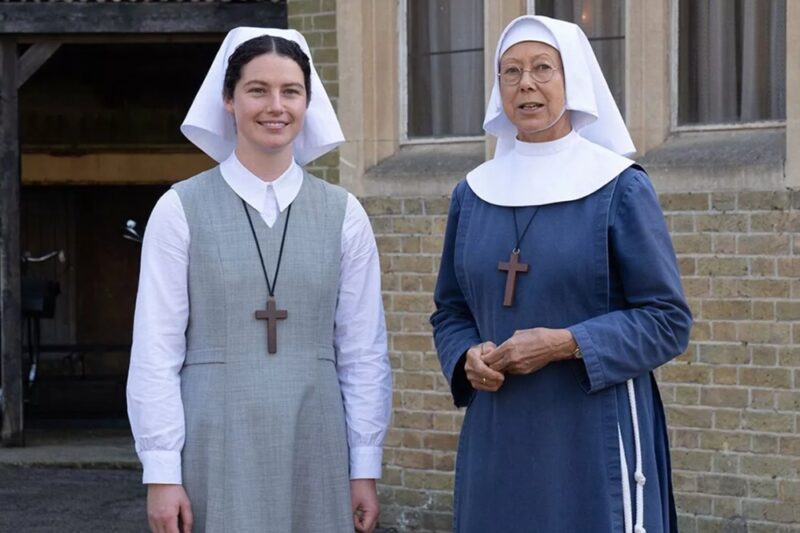
For more than a decade, Call the Midwife has made a virtue of quiet heroism – finding revolution not just in the streets, but in delivery rooms, kitchens, and moments of unspoken care. As the multi-award-winning drama returns with its Christmas special and the forthcoming Series 15, Poplar enters 1971: a year of upheaval and awakening, with Women’s Lib gaining momentum and the nurses of Nonnatus House negotiating a changing world alongside cases that test them physically, morally, and emotionally. Amid bra burnings and medical emergencies, Molly Vevers has slipped into the show’s finely tuned rhythm with a performance defined less by volume than conviction. When our Peter Gray spoke to her, they talked about her character’s quietly radical nature, and what it feels like to step into a series where the heartbeat is already so deeply established, yet still open to change.
You joined Call the Midwife as it’s already deeply established a rhythm. How did you feel stepping into something so beloved without shrinking yourself, or disrupting that rhythm?
It was definitely daunting. When I got the job, I was buzzing, obviously. But then I think the next thought is kind of, “Oh, God, I actually have to (join the show)!” It’s always scary when you have a new job. Any job you’re going to learn everything, but when it’s something like this that is so established and so loved, and they’ve all been working together for, like, 15 years or so, you’re nervous of your place in that group. I had to go to set for my recall audition, and they were filming at the time, and it was quite nerve wracking, obviously. I didn’t have the job then, but I remember thinking how it was such a lovely work place and “I would like to work here.” And then I was also thinking, “If I don’t get to work here, I just got to see what I won’t get to do.” I went back for a costume fitting, and everybody was really welcoming and warm, and as soon as I started, I felt really welcomed.
Was there a scene were Catherine surprised you? Where she made a choice that you hadn’t expected when you first read the script?
Yeah, there’s a few. I suppose it’s interesting, because when series 15 starts, (Catherine) has just qualified as a fully-fledged midwife, so she can finally, for the first time, go out on her own to cases and deal with things without being observed. So with all of these cases, it’s interesting for me to see how she responds to everything. Her first few cases that she deals with on her own are really traumatic and dramatic. In episode one there’s a severely premature baby that’s delivered, and it’s just about seeing how she deals with emergencies and really steps up. That’s not to say she doesn’t find it challenging, but she’s so brilliant with the mothers, and she’s able to process things on a medical level. I also think she’s a good listener and very warm. It’s nice in that sense. It’s almost like with each script you get to learn, “Oh, this is how she is in this kind of crisis.” You don’t know how things are going to be mapped out until you get the script.
Season 15 shows the women burning bras and demanding autonomy. Catherine chooses between obedience and restraint, in some ways. Did you feel that those two paths ever collide inside of her? That maybe she wants to step out a little more than she can?
Yeah, definitely. It’s probably quite subtle if you’re watching the episode, but there’s a moment where the group are discussing the women’s lib movement, and different characters are saying that they’ve heard about it. Asking where it came from? Catherine pipes up quite merrily and says, “Oh, yeah, women’s lib has been a thing for years. My granny worked in a factory in Scotland, and she’d be out on the march.” It’s quite a fun scene, because there’s a sense that Sister Julienne (Jenny Agutter) has got half-an-eye on Catherine, thinking, “Hmm, is she getting into this whole idea?” It’s really interesting.
Quietly radical, you could say.
Yeah, I think so.
I know the Catherine gives up her birth name. Did that feel like a symbolic shedding when you were playing her? Have you thought about what she loses and gains in that act of getting ride of her name?
Yeah, I think I found that decision she made at the end of series 14 endlessly fascinating. I read lots of books about that, and I watched a documentary about young women of a similar age who were making the decision to go and join a much more…how would you describe it? They don’t speak to anyone, basically. I think I just found that sacrifice really fascinating. It’s also really painful for (Catherine), because through that process she knows that she’s going to lose the relationship that she has with her family, with her dad, although we do get a little bit of a reprieve at the end of the series where here dad says that he actually did pay for her sister to come to her vows. I think it’s a testament to how strongly she feels about her faith.
Being estranged from her family, it’s not because the family is cruel, it’s more that they don’t understand her choice, which almost more painful than outright conflict. Is that difficult to play?
Yeah, I think so. There’s certainly a sense up until the final episode (of series 14) of where Catherine just didn’t really understand why (her family) felt as strongly as they did. I think it’s what you’re saying, it might be easier if there was a big blow-up argument and there’s anger there. Sometimes that’s easier to walk away (from), because you can direct that anger somewhere. Whereas when it’s just left…I think that is more painful and more sad.
And you mentioned earlier about if she wasn’t a nun, there’s a whole other life that Catherine could be going on to. Do you ever think about that alternate life and if it haunts her at all?
I do think there’s moments of that. The Women’s Lib is a good example of where we see a hint of, “Oh, in another life…” and in the Christmas episode, for example, the older generation go to Hong Kong, and the younger generation in Poplar organise a boozy Christmas party. There’s a scene where they’re asking for permission from Sister Monica Jones, and I’m absolutely buzzing when she says yes, but then I don’t get to go because I’m being a nun (laughs). I do think in those moments, it’s interesting to think about going to have a drink and a dance.
Do you ever think about if Sister Catherine dropped into 2025 for a day, what would scandalize her first? Smartphones or social media?
I’ve never thought about that. I’m now just imagining like Sister Catherine encountering TikTok, or something (laughs). I don’t think of all the Call the Midwife characters she’d be the most scandalized, because I think she has lived a little bit of a life before the sisters. I suppose any of them with modern technology though…like a QR code? (Laughs).
You’ve said you’re a super fan of the show too. Is there a Call the Midwife moment that hits differently once you were inside the story?
Well, I’m a super fan now, but when I first got the job, I’d obviously heard of the show, but I’d never watched it in its entirety. So when I got the job I had a month or so before I started filming, so in that month I watched maybe two or three episodes a day, whilst I’m eating lunch or learning my lines. I think I got to series eight by the time I started. That’s quite good going for a month! When I started I was a super fan, which made me more nervous. There were lots of moments that once I’d seen them I’d bring them up to Linda (Bassett) or Jenny (Agutter), and I’d be like, “Oh remember this in series five?”
And growing up watching your parents perform, do you think that early sense of community theatre mirrors what Call the Midwife has become for viewers in any way?
Yeah, I suppose. I used to watch them do different plays and musicals, and I can remember being younger and watching the amdram society, and all the politics of that and different community members, watching who got a big part and who doesn’t. There’s quite a similarity between that and the world of Call the Midwife. The feeling of communities coming together, and even people who might not normally work together pooling together for a greater cause. But I used to watch them in a lot of shows. My mum was also a singer. She gigged in different bands, and was even in an ABBA tribute band. That was definitely an interest to me, although I’m not as good a singer as her at all.
Call the Midwife 2025 Christmas Special premieres exclusively on BritBox from Saturday 27th December, 2025. Call the Midwife series 15 will air on BritBox from January 13th, 2026.
