
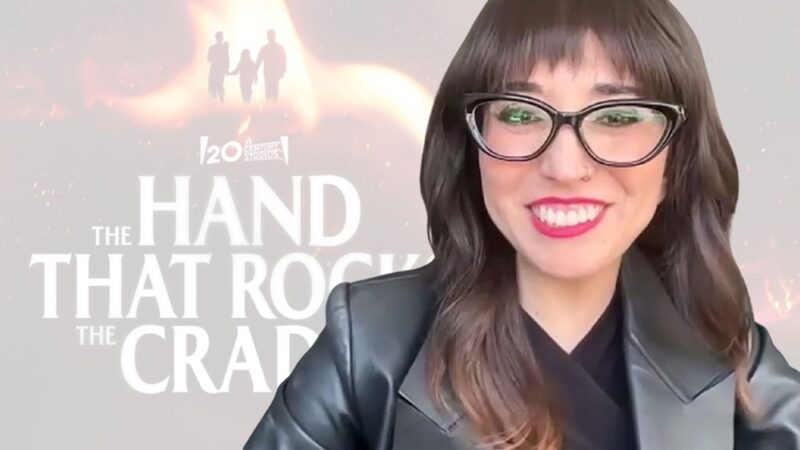
One of the most defining thrillers of the 1990s, The Hand That Rocks the Cradle terrified a whole generation into second-guessing who they invite into their home. With the release of the 2025 reimagining, clearly a lesson hasn’t been learned, as a new progeny will learn “the help” have other plans for your supposed domestic bliss.
Starring Mary Elizabeth Winstead as successful real estate attorney Caitlin Morales, and Maika Monroe as Polly Murphy, a woman struggling to keep her head above water and in desperate need of a job, who is then invited into Caitlin’s home as her nanny, director Michelle Garza Cervera brings her unique genre sensibility to a classic tale of a mother suspecting her confidant is not the person she claims to be.
As the thriller arrives in time for the Halloween season on Hulu, Peter Gray spoke with the filmmaker about how her Mexican supernatural genre debut assisted her, how collaborative her lead actresses were, and the specific visual language she injected into the narrative.
The original The Hand That Rocks the Cradle is one of my favourites. I probably saw it when I was far too young, but I was excited to see it being remade. And this is very much a reimagining. It wasn’t at all what I was expecting. There’s a lot more light and shade to the characters, which I really appreciated. So I want to say congratulations, first of all.
Thank you so much, Peter. I’m actually worried about the fans (of the original), so I love to hear you say that. I really hope they give it a chance, to see that we’re trying to do a whole reimagining that honours the original.
The original film is such a quintessential 90s thriller. It was glossy and suburban. I know that you’ve spoken in your work about breaking open genre expectation. How did you approach reimagining a film that is so rooted in this era, but you want to make it resonate with contemporary fears and gender politics? How did you approach reimagining what we know?
First of all, we knew we had a very iconic movie. To honour (that), that’s kind of intimidating. I had to process the whole creating of a new soul for a film, you know? It was a lot of work. It was a pretty collective job. I was there since the first draft of the script, and you start to care so much about a character and what you want to explore, which, in this case, was generational trauma. That’s something I really wanted to talk about in my work, so this was the perfect project to talk about that. And I loved what you were saying about light and shade, because, to me, a big part of the main concept behind this reimagining is to hold two characters that are in the gray areas. That are hard to distinguish as good or evil. Or antagonist and protagonist. I love those blurry lines between them.
After building the characters, we started seeing so many aesthetic things that we could play with, like reflections and distortions. There were so many things that could really serve the theme and our characters, that it got to a point, through collective process, that the movie started asking for its own particularities. That’s when we knew this deserves to exist. It’s not just a remake. It’s really exploring different themes and characters.
You previous film, Huesera: The Bone Woman, explored the terror and transcendence of becoming a mother, and The Hand That Rocks the Cradle deals with the fear of losing that identity to another woman. Did you see this film expanding your exploration of motherhood? Not just biologically, but socially? Did you see those two films speaking to each other?
100%. Honestly, Huesera got me this job, in many ways. I feel like (the studio) could see some of the atmosphere and tone that I built in that movie that could work for this one. More than motherhood, it’s an exploration of identity and a challenge to domesticity. In many ways, I feel like that’s what I’m expanding on. This so-called domestic “ideal” life, many times, holds so much violence and silence and avoidance of the important conversations. To me, it’s an expansion of that challenge, but it’s in another country and another language, so that was challenging for me, as a filmmaker. But I’m very proud that it really came across and that the team surrounding me – and they’ve done so many more movies – they embraced the project with the same curiosity and excitement that I had. This being my second feature, I feel like they were trying to study me and my previous movie and what I like, in order to do the job. I’m very proud.
You should absolutely be proud! You’ve done an incredible job. And you have these two incredibly talented, strong women at the forefront of this. When you’re casting actors like Mary Elizabeth Winstead and Maika Monroe, they have such strong genre identities, how do you harness what audiences expect from them? And then surprise us with something different?
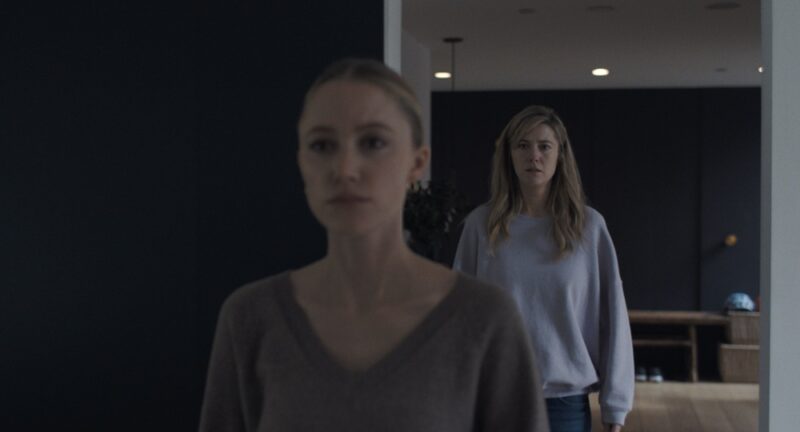
I’m a huge fan of both of them. I can’t believe I’m working with these two incredible actresses that I’ve admired for so long. And they’re both scream queens! A good actress for horror is hard to find, because they have to reach those intense, extreme levels of violence, but I think both Mary and Maika hold this elegant way of holding so many emotions. They’re perfect actresses, and they work in a way that is so specific, so layered, bur very different. They both really created back stories and so many layers of identity to their characters. They were also so aligned in terms of chemistry and magnetism. I feel like they both hold this storytelling between them. It’s all very contained eye movements, and I think that’s something very interesting that they both held that tone. It was perfect for us wanting to create a mirror aspect. Or a reflection between them.
It was quite an interesting change that there isn’t a clear “villain” between Mary Elizabeth Winstead and Maika Monroe, when you look at the dynamic…
That’s really what we wanted. That’s exactly what we wanted. I feel that was designed to feel for both characters. It was cool and challenging, and I wanted to do that in a thriller.
Was there a specific scene where your understanding of these characters shifted once the camera rolled? Did Mary or Maika do something that changed your perception of the characters?
Let me think. There’s several scenes that happened (where) I kept having goosebumps. Of course, the scene in the kitchen. That conversation is just so mind-blowing. I mean, on the page, I knew it was a very challenging scene, because there’s a lot going on, and it’s just two people having a conversation. But then they add so many layers, to the point that in post-production, I was like, “This doesn’t need music.” You would think it would need a lot of things around it, but it’s just them, and it’s because of what they did in the moment. It’s mind-blowing.
Mary and Maika brought so many questions to me that altered the script before we shot. They had so many ideas for their characters. Like, Maika asked, “Why shouldn’t it be winter?” And that was such a great idea that we ended up with that amazing Christmas tree moment. Those are the kind of things that I love. That creative process. Someone that you really trust and admire so much throws an idea, and suddenly you have your cinematographer going crazy with it, and the sound team, and the composer. That’s what is so amazing about doing movies.
The domestic thriller is such a visual genre. It’s always immaculate houses and there’s always that tension. What kind of visual language did you use? The colours of the house speaks to that chilly feeling you spoke of. Was there any visual language you wanted to speak with this film?
I had an incredible cinematographer, Jo Willems, and then our production designer, Kay Lee, they were just so incredible. They built from understanding the character and the emotionality of the scenes, and the symbols that came from the script. For example, the whole thing with mirrors. They needed to find a house that was full of glass. And they brought more mirrors inside. And thinking so much of reflections, we had the element of fire (too). So if you watch the movie with that lens, it’s all around. There’s so many elements of the fire colour palette, like the colours inside the house. There was also a sense of coldness, as you’re saying. It’s supposed to be a safe, domestic, beautiful, harmonious place, but there’s something there that is off. And I love how this force comes in to challenge all of that.
And this may sound so obvious, but it was important for me to have a whole thing going on with hands in the movie. To me, there was a very interesting play about control. Like a game of who’s controlling who? There’s that cool moment where Caitlin (Mary Elizabeth Winstead’s character) is holding the baby with these bloody hands, and it’s this symbol that this motherhood is falling apart. There were so many symbols that actually were very meaningful for the themes of the film.
The Hand That Rocks the Cradle is available to stream on Hulu from October 22nd, 2025.
