
The Conjuring: Last Rites delivers another thrilling chapter of the iconic Conjuring cinematic universe.
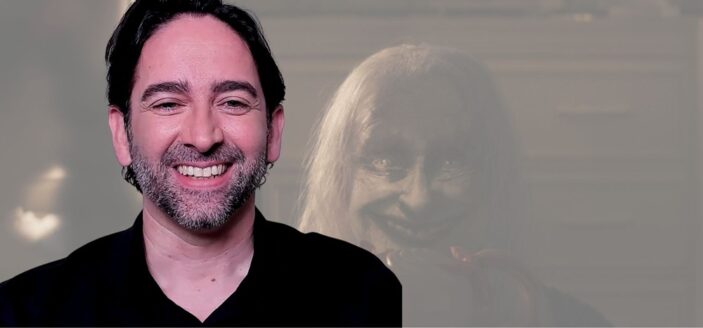
Vera Farmiga and Patrick Wilson return as Lorraine and Ed Warren in a powerful and spine-chilling addition to the global box office-breaking franchise, directed by Michael Chaves, who has helmed such Conjuring cinematic universe titles as The Curse of La Llorona, The Conjuring: The Devil Made Me Do It, and The Nun II.
As the film prepares to terrify audiences for one final time, Peter Gray spoke with the director about executing the perfect scare, the benefits of Google Slides on set, and what the finality of the movie meant from a technical standpoint.
I spoke to you for The Nun II a couple years back, and I remember you described loving the balance between feeling in good hands and feeling you’re in the hands of a madman. I’m wondering where on that spectrum do you feel Last Rites sits, and how do you personally calibrate the tipping point so the audiences feel safe enough to follow you? But also shocked enough to keep their guard down?
I love that. I love when you hear something that you said that you have recollection (of). I’m like, that kind of sounds like something I would say. So much of it comes down to the character. I think that’s what people love about the series. They love the Warrens, and they love even the secondary families that help. They love these characters, and I think that feeling of being in good hands is really connected to the emotional core of the movie.
I think the madman part of it, that was probably thinking that, in good stories, you want to take these characters that you love and you just put them through the ringer. You want to put them through these terrible events, and I think what’s so great with Ed and Lorraine is these are characters that people have fallen in love with over a dozen years. When you’re telling a final chapter, it’s going to come loaded with a lot of fears and expectations about what’s going to happen to Ed and Lorraine. And that was something I was really excited to leverage.
The madman quote came mainly from the fact that I thanked you for the demon goat in The Nun II. And with this film, there’s jump scares, there’s gradual scares, like the hand on someone’s shoulder and the phone cord sequence. Is there a way of storyboarding scares, or writing scares, where, for you, you find it easy in terms of execution? How difficult is it to pull off a scare?
I think that, sometimes, some scares that you storyboard, you know exactly what’s going to work well in them. One of the things that James (Wan, producer) encouraged early on (making) (The Curse of) La Llorona is being receptive to the environment. Because I think sometimes, and I think it’s honestly a great lesson for directing in every capacity, is when you come in with a really good plan, you get the script as great as it can be, you get the storyboards as great as they can be, when you arrive on the day, you (still) need to be open and receptive to the possibilities.
Sometimes in a dramatic scene, it might be something that an actor is doing that you don’t expect, (but) with scares, it’s being open to other possibilities within the location. The set might be built in a way that you’re expecting to play in it one way, but then when you get on set you’re realising if you turn it and you’re looking down a (different) way, or you look down the hallway and you can see the little girls as they’re coming out from behind something…it’s just about being open all the way through. That’s a James Wan lesson.
You’ve helmed three very different flavours of The Conjuring universe films. Were there any storytelling muscles for you that you developed on those other films that you were able to flex with Last Rites?
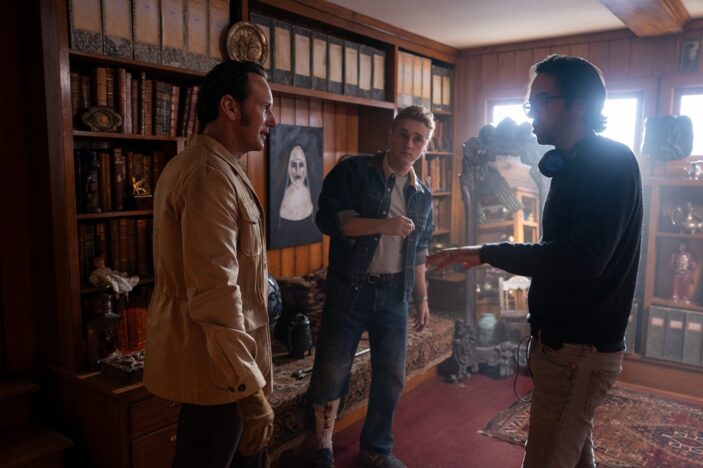
I think it’s just the process of making a movie. The less romantic answer is learning how to steer the ship and just manage. So much of (this) is talking to me and talking to the actors. Who you don’t get to talk are the hundreds of amazing people that are there making the movie, and it’s corralling everybody in a shared vision and trying to get them all kind of marching in the right direction. I come from working in commercials, and you don’t really appreciate that because it’s kind of a smaller scale. When you get onto a movie, the big muscle that I’ve developed is just learning how to get that unified, shared vision. I actually use Google Slides all the time. I did for The Nun II and this one. I basically made the whole movie in Google Slides, and so everyone has a link and it’s always updating as we’re going through prep and into production. So you’re seeing the location it’s going to be in, you’ve seen the wardrobe, and it’s just getting everyone on the same page. There’s honestly nothing better than that.
There’s obviously a finality to this. Without giving anything way, the ending was a lovely addition, with those familiar faces. Given the emotional weight to this story, knowing this is the final entry, does that affect pacing, tone, even shot choices at all?
One of the things I really wanted to try was letting shots linger. Just from a simplicity standpoint, it was kind of a challenge that I would do with my DP, Eli (Born), is whenever we’d look at a scene, we would always challenge ourselves, even if you knew there was going to be a bunch of coverage, there was always the question of, “How could we do this on one shot, and not in a showy one shot where you’re moving all around? But is there a way to stage it all in the most elegant way?”
Sometimes, there would be scenes that actually could just develop that way, and there’s obviously the classic Conjuring (here), where you’re coming in with a family and you’re getting a tour of the house. That’s kind of what everyone identifies as the “classic Conjuring“, but we were trying to explore that in other respects, where you were living in the shot and living in the scene as long as possible. And it was a fun exercise. When you’re not cutting and you’re allowed to live with the actors in the moment, it really connects you in a nice way. It’s also easier to make these types of movies when you have a long list of coverage and you get to be like, “Oh, medium close up, close up, insert it.” You can sometimes drown in that and lose focus on what the whole scene is about. When you can design in these moments, I like it. I’ve really enjoyed it.
The Conjuring: Last Rites is screening in Australian theatres from September 4th, 2025, before opening in the United States on September 5th.
