
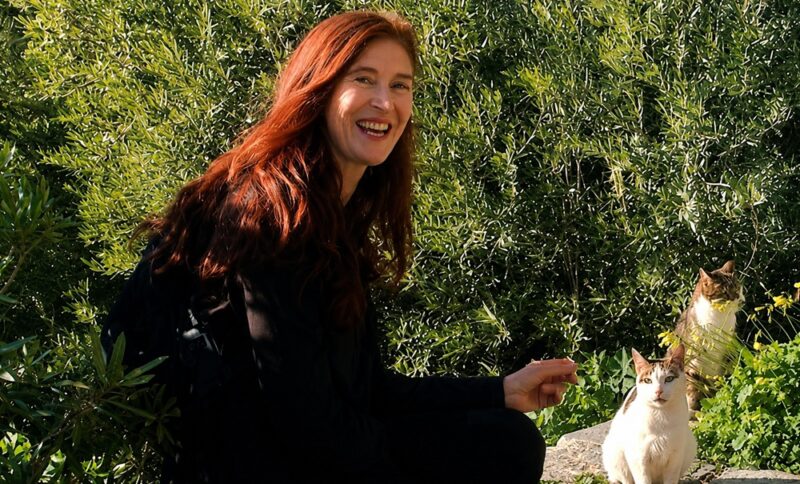
There are countless documentaries that ask audiences to feel outrage. Acropolis Cats & Other Wondrous Animals, the latest film from award-winning Australian documentarian Mary Zournazi, instead asks something far more radical: that we choose tenderness. Beginning among the stray cats of Athens before expanding across Greece, Australia and beyond, the film explores the fragile bond between humans and animals, quietly evolving into a profound meditation on compassion, forgiveness and the kind of species we hope to become.
Ahead of its world premiere at the Melbourne Documentary Film Festival, our Peter Gray spoke with Zournazi about why empathy is a practice rather than an instinct, the philosophy hidden within abandoned animals, the influence of Agnes Varda and Wim Wenders, and why the smallest acts of care may ultimately be our greatest expression of peace.
One of the things that struck me with the film is that it obviously begins with stray cats, but almost by the end it feels like it’s almost asking what kind of species human beings want to become. At what point during the making did you realise you weren’t really making a film about cats anymore?
That’s a really great question, because underlying the film was this question of what’s wrong with our species, generally speaking. The starting point was finding those moments of tenderness and connection between humans and animals, and as the film progressed, I met different people and different animals, which naturally broadened the scope. But that central question was always there, and it was a serious one. So although it’s a lovely film about animals – and I hope audiences really embrace it, because there’s a lot of love in it – it is asking deeper questions about us as humans, our role in the world, and the small ways we might make a difference.
I know you’ve described the film as being about tenderness. I feel like that’s a word we don’t hear very often in documentaries – particularly those dealing with a crisis. Do you think tenderness is something we have to actively practice? Or is it something we only rediscover after we’ve experienced loss ourselves?
I think we have to actively practise it. That’s a really interesting way of framing it too. What I found with Cats…, and with my other films too, is that people are already doing it. They’re already showing kindness and tenderness despite all odds. One of the people in the film, Yiannis, is homeless, and the care and love he has for his cats is so admirable. Yet nobody really sees him. People avoid him because he’s homeless, even though he’s right there in the heart of the old city in Athens. His compassion is a practice. I don’t think it’s only something that comes after loss – although people who’ve experienced loss often feel it more acutely – I think it’s something all of us can practice.
One of the things that struck me is that the abandoned animals never ask why they’ve been abandoned. They simply continue trying to trust. I wonder whether watching that resilience change the way you think about forgiveness in human relationships?
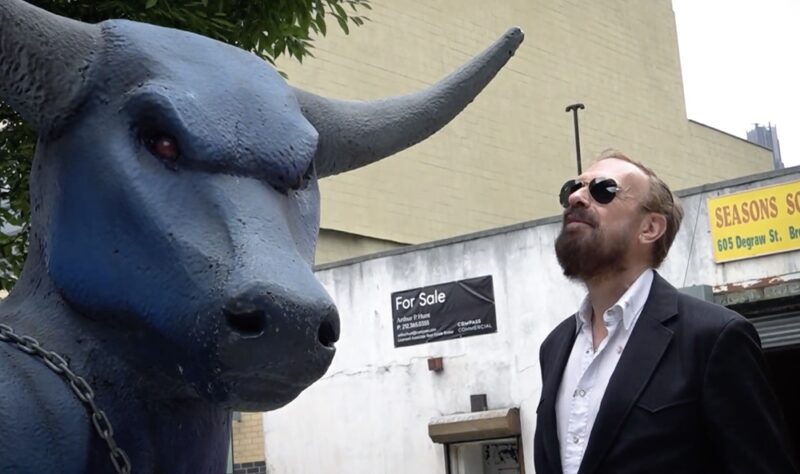
Yes, again, such a great question. Forgiveness is such a hard thing, isn’t it? I struggle with it all the time. Even in our everyday encounters, how do you forgive somebody who’s been really terrible? But there’s a character in the film, Dorothy the Cow, who is wonderful. I met her purely by accident. She’d been a dairy farm animal, so her whole body had become distorted, but she was never cruel to humans. She was simply gentle, offering what she could as a cow. I think it’s a twofold thing for humans. We need to ask the big political questions – why is this happening, and how do we make changes? But often those changes are very small, and they build over time. It comes down to learning how to forgive. That’s why I say, “Maybe only cows go to heaven.” It’s a bit of a pun, but there’s something in animals we could learn from. I don’t want to anthropomorphise them, because that’s a danger, but as we say in the film, we have to have empathy. Animals offer us a different kind of intelligence.
And because the documentary connects animals with COVID, war, and climate crisis without making those ideas feel abstract, were you consciously trying to show how that compassion is indivisible? The way we treat animals and the way we treat each other ultimately comes from the same moral instinct…
Yeah, the short answer is yes, I think so. We do have that drive as humans, and animals have it too, albeit in a different way. But your question is interesting because, when I was making the film, there were moments in the voiceover where I went much deeper into philosophical ideas about war, identity and so on. It just didn’t work – it weighed the film down. So it became about finding the right balance and rhythm to let those deeper questions come through without being too dogmatic. I wanted the audience to come to those ideas themselves and ask their own questions. In a way, the film is a conversation with the audience. I’m offering what I’ve experienced and what I think, but it’s ultimately up to them to engage with whichever aspects resonate, and you hope they do.
I feel like there are countless documentaries that ask audience to feel outrage. Yours is so much more interested in asking audiences to feel empathy. Was that always the intentional creative choice from the outset?
Yeah, absolutely. All of my films are about that, and I’ve learnt a lot from Wim Wenders. We worked together on a book about peace, and I think it’s about being attuned to finding a different starting point. Of course, you have to be outraged, but for me that outrage can come through a different way of storytelling because it allows more people to connect. If you alienate an audience around an issue, they’ll switch off. Life is already overwhelming enough – it’s constant, constant, constant. So I think it’s really important as filmmakers to find different starting points and gentler ways of telling stories that are just as powerful. They can have the same impact; it’s simply a different way of exploring these ideas, in my view.
And having returned to Athens after the pandemic, were you surprised by how much you had changed? Rather than how much the city has changed?
I think both had changed. Even though I’d changed a lot, as I think we all did, what we’re experiencing now is, in many ways, the aftermath of trauma. But I also found the city had changed because of the increase in tourism and the acceleration of that feeling that everyone could just go wild again. There’s a really dark undercurrent to it, though. The city itself benefits to a certain extent, and some people gain economically, but many of the locals don’t. That’s a harsh reality, and it’s a harsh reality for anyone who’s been displaced. That question sits within the film as well.
You’ve written extensively about peace throughout your career. Watching this film I wondered whether you’ve come to think that peace isn’t really negotiated between governments first? It begins in the tiny everyday acts of care we extend to living things that can offer us nothing in return.
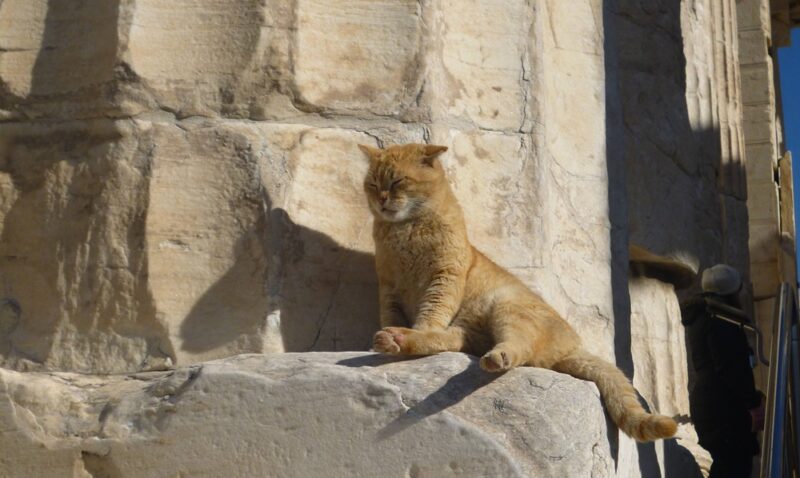
Yeah, totally. Peace has nothing to do with those kinds of strategies. It has to do with our own disposition and the way we try to navigate the world more justly, not through an ideological position where we do something because we expect to get something back. Sometimes there is no reciprocity, and that doesn’t matter. Being good can be difficult because you don’t always receive anything in return. Animals often give something back through their emotional lives, but sometimes they don’t, especially if they’re frightened. That was the case with Peg, the cat I met at the end of the film. She was terrified, but when I held her, she would purr. I later learnt that’s one way cats can express comfort or gratitude. Animals communicate in different ways, and I think they have their own way of expressing peace, or at least that sense of connection and bonding.
Throughout the film, the animals aren’t just being observed, they almost become witnesses to human history. In making this documentary, did it make you wonder how differently history might look if it were told from an animal’s perspective instead of a human one?
Yeah, well actually, there’s a great philosopher, Michel Serres, who wanted to create a kind of museum of perspectives from all different animals, even insects. The world would look completely different from each of those points of view, and I think that’s a really important idea for us to hold onto right now – that the world can look so different depending on your perspective. Animals are definitely witnesses, but they also have their own personalities. They’re very present in who they are. Markos the Pelican certainly had a strong personality and was a wonderful character for me.
Well, looking at Marcus the Pelican, because the title of the film uses the word wondrous. It’s such a hopeful word for a film dealing with abandonment. What does wonder allow us to see that pity never can?
Wonder allows us curiosity, I think. And to ask questions. And to not feel above anybody or something, and therefore I know what I would do for you. Yeah, wonder gives us that potential.
As you mentioned before, you learnt something new when you were holding the cat. Because there are moments where the cats seem completely indifferent to the chaos surrounding them – almost like they’re existing outside politics and economics – did spending time with them alter your own relationship with anxiety or uncertainty?
It’s really about learning to not be human-centered. Once you let go a bit of that, you find that you’re in the world with all of these other thing, and you’d like to respect them and the details of that.
The film is obviously deeply personal without ever becoming autobiographical. How did you decide how much of your own emotional journey belonged in the documentary?
I’ve always been inspired by Agnes Varda and her work. She once said that she always saw herself as part of the work, and that really resonated with me. That’s how I’ve approached all of my films, but it became especially clear in My Rembetika Blues, about the Greek blues, and in this film. I’m simply part of making the story available, helping to craft something that allows audiences to come along for the journey. The personal element is important, but it’s always about finding the balance of what the story needs from me and what it doesn’t. In that sense, I’m a character too.
Philosophically, I feel like we often think compassion means helping those who are vulnerable, but the film made me wonder whether compassion also requires ourselves to be vulnerable enough to receive comfort from another species?
Yes!
Did making the film change your understanding of vulnerability?
Yeah, absolutely, and it’s a good question to think through even more. I don’t think compassion always has to be directed outward; it also has to be extended to yourself. What you’re suggesting is about giving yourself the integrity to say, “Here is a communication, a relationship, that is offering me something I can’t contain within my own worldview.” That, in itself, is an act of respect and compassion. So yes, it’s a really lovely question, because it offers a different way of thinking about that ethical role.
From a filmmaker perspective, I feel like documentaries often involve deciding where to point the camera. This film almost feels like an exercise in deciding where to place your attention…
Yes. Yes, yes, totally. That point. It’s really different where you point. Your distinction is great. That’s why I love filming. I think making a fiction film – which is where I’m heading shortly – it’s different because I’ll need a camera person. I can’t do everything myself. But that ability to be behind the camera, just yourself, meeting people or meeting animals, it gives a bit more of a rhythm and a relationship to that attention, as opposed to it being an interview.
The crew and setting up can make people uncomfortable for interviews. I think with people who are just everyday people…I love the movement of the camera. I wouldn’t claim to be a cinematographer, but I have that feel. I like the feel of that relationship.
The way you’ve filmed this, you’re very much our eyes into the story. We’re going along with you. It makes for a much more personal experience.
Yeah, and a really good friend of mine, who’s actually in the film, Christos Tsiolkas, gave me some wonderful advice when I was making Dogs of Democracy. I was struggling to find that balance and work out how to structure the story, and he said, “Go and read Dante’s Inferno. Look at how he’s telling the story. He’s taking your hand and walking you through this hell.” I’ve always held onto that. Filmmaking is about taking an audience by the hand and guiding them through an experience. You’re doing it through editing, music, and all these different cinematic tools to help people feel something. And I think feeling is one of the most beautiful things about cinema.
Living with these stories for so long, what now gives you hope? Is it humanity itself, or is it the quiet relationships between humans and animals that continue to exist despite everything?
I think the latter. The quiet between human and animals, and what we can do, what’s possible, and that we really need to find those spaces again. That’s why, in a sense, having a bit more concentration and ability to enter a story and take some time with it, I think is so important.
And just quickly before letting you go, I want to ask a geeky movie question. Was there a film, a filmmaker, a documentary…something that birthed the spark for you in terms of, “I want to make documentaries?”
I’d actually been making radio documentaries for Radio National for a long time – another lifetime ago, really. Then I went to Paris to meet Agnes Varda because I wanted to make a film about her. But Agnes was the kind of filmmaker who preferred making films about herself, so she said, “Look, we could do something, but not right now.” That was wonderful in its own way. From Paris I went to Athens, and that’s where I first encountered the stray dogs.
I remember thinking, “Well, if I can’t make a film essay about Agnes Varda, maybe I can make one about these dogs.” In a way, her refusal redirected me towards filmmaking. From that point on, I just fell in love with it. I love filmmaking – it’s such a wonderful thing to do. Of course, it’s always constrained by money and all sorts of practical realities, but when you can make a film, and when it comes together, it’s a wonderful thing to share with people.
That’s a nice play on when someone tells you can’t do something, you’re like, “Well, I’m going to do it!”
(Laughs) It’s kind of like that. Not consciously, but that’s what it ended up being, for sure.
Acropolis Cats & Other Wondrous Animals will screen on July 11th, 2026 at Cinema Nova as part of this year’s Melbourne Documentary Film Festival (July 1st – 31st), as well as alongside Zournazi’s previous two films Dogs of Democracy and My Rembetika Blues as part of her ‘Greek Trilogy’, in a special retrospective of her work on July 13th at Henkel Street Cinema. For more information and ticket availability head to the official site here.
