

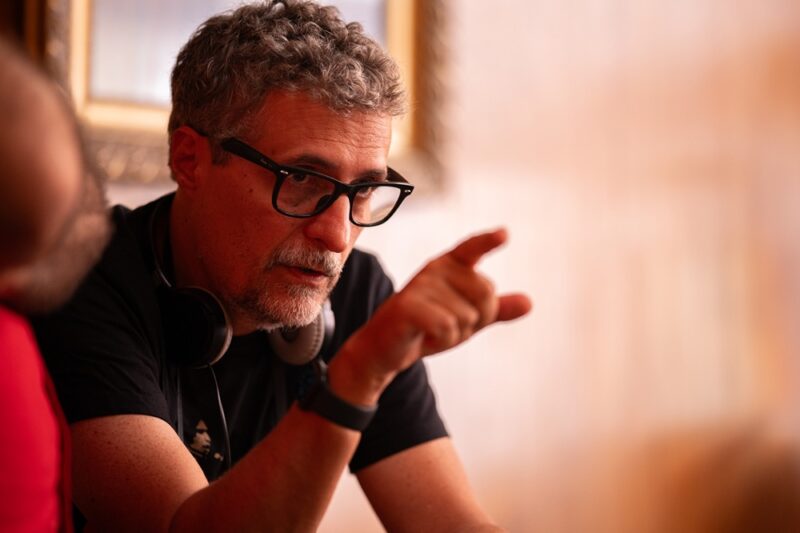
Brazilian filmmaker Kleber Mendonça Filho has never been interested in subtle allegory when reality itself is this confrontational. With The Secret Agent, his latest politically charged thriller set during the final years of Brazil’s military dictatorship, the director once again fuses genre storytelling with cultural memory, paranoia and moral urgency.
In a conversation with our Peter Gray, Mendonça Filho discusses excavating national trauma through suspense, the dangers of nostalgia, and why cinema remains one of the most powerful tools for reckoning with history.
Your background as a film critic feels present in your work, not through overt references, but in the way your films seem to converse with cinema history itself. Did that critical voice shape the genre or tropes of The Secret Agent?
It’s always a fair question, but also a difficult one to answer. It’s like asking whether someone who works in a library and reads all the time automatically becomes a good writer. Maybe, but critics are not always right. My critic side could easily give my filmmaker side the wrong advice. What I know is that when I write a scene, I have to want to shoot it. I’ve never had a scene where a production assistant says, “Tomorrow we shoot that scene,” and I think, “Oh no, not that one.” That can’t happen. The pleasure of writing and shooting is essential.
References don’t come first. It’s never, “I want to do a De Palma sequence.” It’s more that a feeling reminds me of something, maybe Blow Out, and even then, you shouldn’t go back and trace it. Films live inside you. They become part of your emotional or even muscular memory, and they emerge naturally. But it should never feel like pastiche.
There are moments in the film that feel playful or surreal – the Jaws reference, the dismembered leg – alongside very serious political themes. Was Spielberg an influence at all?
Mentioning Jaws is very straightforward for me. It was a massive cultural phenomenon of the 1970s, and it’s still a powerful film. Recife also has a real history of shark attacks, so the connection was almost inevitable. I don’t think there are visual references to Jaws in the film, but as a pop-cultural marker, it timestamps the era. For me, Jaws and The Exorcist define the 1970s. Close Encounters of the Third Kind defines 1978 in my own life, a time connected to my family and my mother’s health. Those memories give you energy and authenticity as a storyteller, and I think audiences can feel that texture, even if they can’t quite name it.
Did you see the film as a way of reflecting on Brazil’s past to better understand the present?
I’m pessimistic about history. Humanity walks in circles. We learn, then we forget, and then we repeat the same violence. When I’m Still Here was released in Brazil, young people reacted with shock at what the dictatorship had done. That disturbed me. It’s like French teenagers discovering the guillotine for the first time. While editing The Secret Agent, it became very clear how closely the film connects to the present – Bolsonaro in Brazil, what’s happening in the United States, even the attack on universities and scientific institutions. These patterns repeat themselves.
Do you see the film functioning as both a national reckoning and a universal allegory?
I hope it’s universal, like all my films. Brazilians are naturally more equipped to decode certain elements, but I didn’t “code” the film intentionally. Culture and language shape interpretation everywhere. An Australian film will always resonate most deeply in Australia, but I think The Secret Agent travels well.
Wagner Moura’s character feels like a classic film hero, but without the usual violence. How did you approach that?
I wanted him to be a classic hero who never pulls a gun. He even says it in the film: no guns. Violence is often too easy in cinema. I wanted someone deeply relatable – a father, resourceful, respectful, human. Under oppressive systems, those who do everything right often pay the highest price. I kept thinking of an old Soviet saying while writing: no good deed goes unpunished.
Sound and music play a huge role in creating atmosphere. How did you approach that?
Music is very dear to me. It can take years to find the right pieces. Some are written into the script, others appear during shooting or editing. Once a piece is in the film, it’s there forever. You must never regret it. Certain elements, like the police vehicle or a particular song from 1975 that carries us through several key scenes, are characters in their own right. Working in Paris on the mix, spending days inside that music – it was a beautiful process.
What do you hope lingers with audiences after the film ends?
I hope people leave with a strong experience, something honest about life in the world. The world is violent, but it’s also full of love. I respect films that are completely bleak, but life isn’t monochrome. This film is bleak, violent, tender, vibrant, and, to my surprise, sometimes funny. I even found myself laughing at moments during the Cannes premiere. If people feel something strong, something complex, then the film has done its job.
The Secret Agent is screening in Australian theatres from January 22nd, 2026.
