
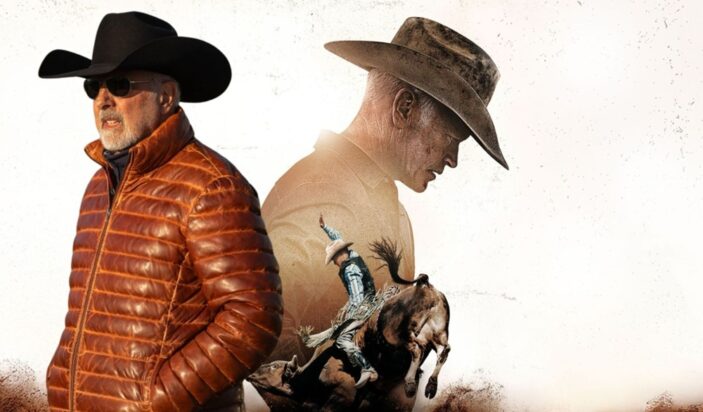
Facing his own painful past and the fears of his family in order to save his grandson, a retired rodeo legend (Neal McDonough) enters a high-stakes bull-riding competition as the oldest contestant ever. Along the way, he reconciles old wounds with his estranged daughter and proves that true courage is found in the fight for family.
From acclaimed director Jon Avnet (Fried Green Tomatoes, Up Close & Personal), The Last Rodeo is a wholesome, faith-based drama about the power of one’s own convictions and what we’ll do for those we love. As it is now available in Australia on Digital platforms, Peter Gray spoke with director Avnet about what resonated with him most when conceiving the story, his authentic approach to the faith element, and approaching location as a character that’s just as important as those portrayed by his actors.
Before getting to The Last Rodeo, I just want to quickly mention Up Close & Personal. It was one of the first films I remember crying in, and I just think Michelle Pfeiffer is the most divine person.
Thank you. She’s pretty special, and a pleasure to work with. And it was good that the film turned out well, and that it resonates with you.
With The Last Rodeo, the thing I liked is that it’s as much about reconciliation and faith as it is about the physicality of bull riding. When you were first conceiving the story, what resonated with you the most? Was it the adrenaline of the sport, or the emotional stakes of the family?
I felt like the emotional stakes would make the action much more powerful. I was attracted to the father/daughter story and, as you said, the reconciliation, or the possibility of reconciliation, and also the friendship between Charlie and Joe, because it’s my observation that mourning is a very imperfect process at best, and there are very few guides for most of us as to how to do it. And in Joe’s case, I felt it had become a kind of selfish, almost narcissistic exercise, where he excludes everybody. He had experienced loss and pain, and it was painful for him to come out of that, to give up and rejoin his family and his friends. I thought that was powerful.
The film deals with themes of legacy and what we pass down and what we make amends for. As a director, how do you translate something that’s so internal into a cinematic language that so often doesn’t rely on dialogue?
It depends on who your horses are, who your actors are, and I’ve worked with Neal for a long time. I felt that he was very, very good at expressing things non-verbally. Even the opening two shots of him in the bowl, I felt like it was meant to set to the stage for something “man versus animal.” You might be able to kill them, but you’re not going to beat them in a competition. That’s our hubris, right? We know in the story that he’s motivated by his family, but there’s also that personal element of, what you said, legacy. A lot of times, athletes and competitors, when they leave their sport they’re like Odysseus in The Odyssey. They’re lost. I’m very interested to see what Christopher Nolan will do with (The Odyssey). But it’s about being back in the saddle where he wants to be. He’s willing to endure ridiculous pain, not just for his family, but for that sense of getting back his self. He didn’t go out on the best note, and more often than not, going out is not a good note to begin with.
Faith is a thread in the story. But it’s treated in this very grounded, personal way. How do you ensure that it feels authentic, rather than didactic?
That’s the trick. I liked what Neal had written and had given to me. Neal’s a very religious person, and I don’t think I could have done a story about a religious person having faith (without him). It was like a hat on a hat. What happened was (his character) was angry at God and lost his faith, and so it didn’t matter that his friend, who he had abandoned, still had faith. He’s going to maintain his anger and his isolation as best he could, but he couldn’t, given the context of those circumstances. So what I wanted was something that was an earned experience. To me, one of the moments I felt very strongly about and that I felt worked was when (the community) do the GoFundMe (campaign). He’s such a private person, so when he walks in for that last ride and there’s 17,000 people cheering for him, and all of a sudden they take their hats off and they’re praying for his grandson…that’s pretty powerful. In many ways, what you want is an actor to be there, to do what we do in life, which is we sort of hold back. We withhold. But that was pretty overwhelming. Again, it felt to me that made his coming (back) to faith an earned experience.
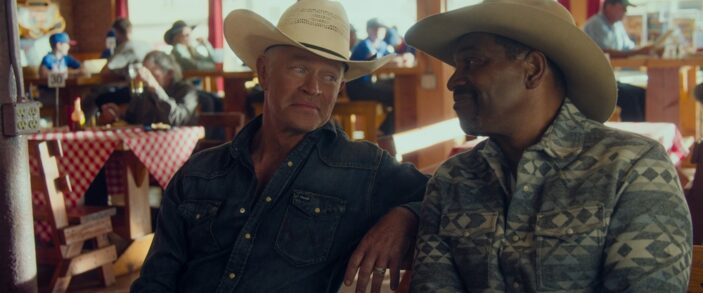
There’s always such a vivid sense of place in your films, too. Do you approach location as a character?
It’s a very interesting question, because you want to make it specific, and in order to be specific, it has to be rooted in place. It was important to me to shoot in Texas and Oklahoma. I had a little bit of a fight with the financiers, actually, to make sure that the Texas unit got what I wanted, because I wanted that sense of the wide open, endless world there. Even just a trip to Dallas, which is a major metropolitan area, is completely different than the world that Joe has isolated himself in, which in and of itself has isolation, but it has the potential for friendship and intimacy.
Talking about The Last Rodeo and mentioning Up Close & Personal, there’s this throughline for your characters of them redefining themselves later in life. Is that a theme you’re consistently drawn to? Or is it only noticed in hindsight?
I think it’s more in hindsight. What I’m interest in is people being alive when they’re alive, and there’s a tendency, especially as you get older, and even more so if you have a family, that they’re not necessarily doing the things that make them who they are. (Up Close & Personal) has that element, because Michelle (Pfeiffer) brings out in (Robert) Redford the desire to be who he was. Not a mentor, but a newsman. I’m fairly myopic in terms of trying to do that, and probably a little megalomaniacal, because it’s so hard to capture that personal (feeling).
It’s funny, on Fried Green Tomatoes, my production designer, Barbara Ling, who just won the Oscar for working on Quentin’s last movie (Once Upon a Time…In Hollywood), was very interested in the verticals of the small town. And so she was looking for that element, and with the exception of one scene, when Mary Stuart (Masterson) gets the honey for Mary-Louise (Parker) and the tree had been struck by lightning in the middle of nowhere. It’s a very intimate scene in a very large area.
Your films really explore those connections across generations. Do you think the conversations between younger and older actors have evolved in cinema since you began your career?
I haven’t thought about that. The thing that I do feel is that elders have a real value in society, and, to an extent in American society, they’ve been somewhat significantly devalued. And the wisdom that comes from their experience has been ignored. Not really so much in politics, curiously enough, because Biden was old and Trump is kind of old, so it’s almost different than in the world where your mother and your grandmother lived in the same house with the kids. It was just part of it. Or in a Chinese society, where there’s this veneration of elders. and I think that’s a very nice thing.
I’m very attracted, in (Fried Green) Tomatoes, to the Jessica Tandy story and how her character really enervated Kathy Bates’s character, who was a lost Southern housewife. There wasn’t a lot of wisdom coming down there, but there’s respect, love and nurturing. You’re nurtured by your parents, (but) do you nurture them? Is that a natural changing of the guard? It’s powerful and moving to me.
And the thing about bull riding is that it’s all about holding for eight seconds. Looking at your career, have you had an “eight seconds” moment where you just had to hang on and trust yourself?
Well, it’s like that frequently, because what makes things really rich is the personal aspect. And for my films, I’m the filter, because (of) my heart, my soul, my spirit. You want to be able to touch with your instincts, and, at the same time, you want to be able to listen to and hear the actors, which is relatively easy to me, but also listen to the crew. When you’re under a lot of pressure, it’s harder, and I think in some ways I’ve gotten better at that process.
The Last Rodeo is now available to rent and/or buy on Digital through Apple TV, Prime Video, YouTube, Google TV and Fetch TV.
