

When How To Make A Killing hits screens, audiences meet Becket Redfellow, a charmingly ruthless heir-in-waiting determined to reclaim the fortune his estranged, high-society family denied him at birth. Disowned and raised in the working-class world of New York, Becket (Glen Powell) will stop at nothing – and kill anyone in his way – to secure the Redfellow legacy.
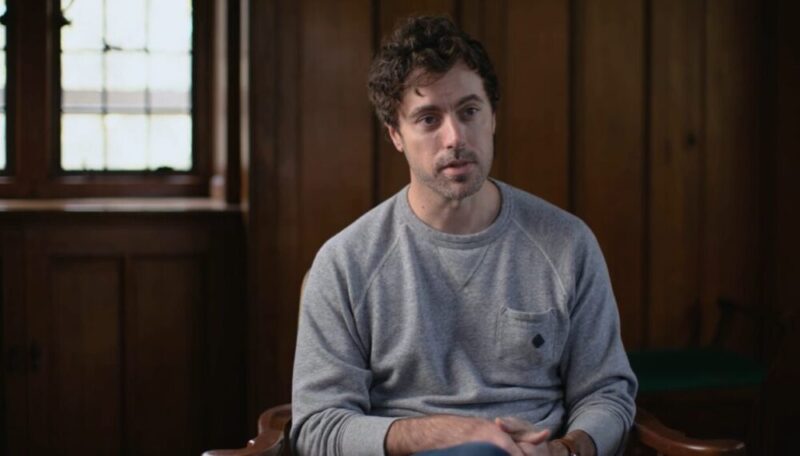
Our Peter Gray spoke with director John Patton Ford, whose bold and darkly comedic vision brings this morally twisted caper to life, to talk about how a script written nearly a decade ago transformed into a story of greed, ambition, and the darkly hilarious extremes one man will go to claim what’s “rightfully” his. From casting Glen Powell at a pivotal moment in his career to balancing humor with shocking audacity, Ford shares how he brought his transgressive, original voice to the screen – and why audiences are ready for it.
From what I understand, the script dates back to around 2014 and even landed on the Black List. I’m curious – how did it evolve from that early draft into the film we’re seeing now?
Oh man, there’s not enough time to tell the full story. There were so many ups and downs. I wrote the original draft a long time ago. It was basically an American reimagining of Kind Hearts and Coronets. I didn’t write it to direct it, I wrote it as a writing sample to try and get work. The script kind of floated around. Different directors were attached at different points. Other writers came on. Meanwhile, I wasn’t seen as a director – I was mostly unemployed and trying to survive.
Then after I made Emily the Criminal, StudioCanal reached out. They somehow had the rights to that old script and asked if I wanted to direct it. It had never occurred to me. I assumed someone else would make it. At first, I hesitated. It felt like someone handing you clothes you wore years ago and asking if you wanted to put them back on for a couple of years. You’re like, “I don’t know if I still want to wear that.” But the more I thought about it, the more I realized it represented a version of myself – more bombastic, more transgressive – that I don’t necessarily access anymore. Making the film felt like honoring that earlier, slightly unhinged creative energy.
That energy definitely comes through. I love that the film balances dark comedy with sharp social commentary. There’s a real mean streak to it – and I mean that as a compliment. We’re following someone doing objectively terrible things, yet we’re on his side the whole time. How did working with Glen Powell shape Beckett? I saw he described this as a role he needed at this stage in his career.
That’s interesting – I haven’t spoken to him about that specifically, but it makes sense. When we first met in fall 2023, he was just starting to really take off. Twisters hadn’t come out yet. Hit Man hadn’t come out. There was a lot of buzz about his potential, but it was still that calm-before-the-storm moment. He’s very aware of how he looks and sounds – that it’s easy to slot him into “handsome leading man” roles. I think he wanted to show there was more range there. Luckily, this role gave him that opportunity.
On my side, getting a second film made is hard. Emily the Criminal wasn’t some huge blockbuster – it was a small indie. To make something like this, you need a bigger budget, and that means attaching an actor with real visibility. That’s not easy. It has to be the right person creatively, not just commercially. I remember the two of us having lunch and basically shaking hands on it – this was the right moment for both of us. We could help each other.
Looking at Emily the Criminal and now How To Make A Killing, what do you see as the through line in your storytelling? How has your perspective evolved?
I’m still figuring that out. But I think what I’ve learned is to trust that audiences are ready to be challenged. When you’re making a movie – especially when there’s money involved – there’s a temptation to play it safe. To soften edges. To pull back. But the real risk isn’t being too bold. The real risk is not being bold enough.
Both of my films center on anti-heroes – morally complicated people. And I’ve realized audiences are more than ready for that. They’re smarter than studios sometimes give them credit for. I think I’m learning to lean into that instead of retreating from it.
Your films navigate comedy in morally uncomfortable spaces. Do you think laughter can be dangerous in cinema – or is it essential?
I had a teacher in film school who said every sophisticated film contains comedy. Not because you need to “win” the audience, but because humor provides perspective. It undercuts things. It illuminates them. Some of the most serious films ever made are full of humor. Watch the first 30 minutes of Schindler’s List – there are real laughs in there. And it’s not just to lighten the mood. It reveals character. It sharpens the tragedy. Humor can expose something in a way that playing everything straight never could.
There’s something deeply intelligent about allowing an audience to laugh – especially in uncomfortable situations.
That’s such a good point. You rewatch films as an adult and suddenly see the humor layered into things you once thought were purely dramatic. It’s almost like laughter becomes a way of processing the horror.
Exactly. It’s illuminating. It forces you to see the absurdity or the greed or the hypocrisy more clearly.
I remember seeing Emily the Criminal at Sundance and feeling like it had such a distinct voice. And now with this, you’re giving Glen Powell space to explore something darker and more layered – almost in that American Psycho mode of impossibly charismatic but morally hollow. It feels like a bold step forward for both of you.
In a landscape dominated by spectacle, this is just 100 minutes of sharp, intelligent cinema. I’m really grateful you made it.
That’s very kind of you. Thank you.
How To Make A Killing is screening in theatres in the United States from February 20th, 2026, before opening in Australia on March 5th.
