
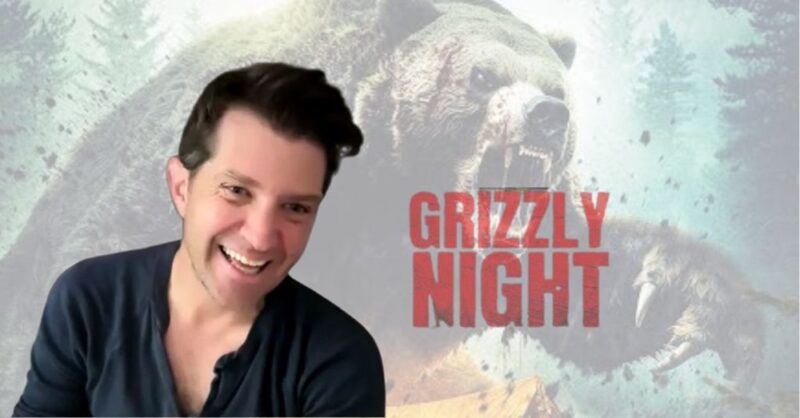
In 1967, two grizzly bear attacks nine miles apart shattered the illusion that America’s national parks were a perfectly managed wilderness. Nearly six decades later, Grizzly Night revisits that harrowing evening with a human-first lens – less creature feature, more reckoning with faith, fear and fragility.
Directed by first-time feature filmmaker Burke Doeren and written by Katrina Mathewson and Tanner Bean, the survival thriller dramatises the infamous “Night of the Grizzlies,” the tragedy that permanently reshaped wildlife management policy in the United States. While the film stars Brec Bassinger, Jack Griffo, Charles Esten and Oded Fehr, it also finds emotional grounding in a quieter, more introspective figure: Father Connolly, played by Joel Johnstone.
Best known to many as the fast-talking, sharp-edged Archie in The Marvelous Mrs. Maisel, Johnstone takes a markedly different turn here. His Father Connolly is a man in personal crisis long before nature intervenes – a priest wrestling with doubt who finds himself pulled into a search party as chaos unfolds across Glacier National Park. Where audiences might expect adrenaline and spectacle, Grizzly Night instead leans into moral reckoning and communal survival.
When our Peter Gray spoke with Johnstone, what became clear was that he never approached the film as a thriller. For him, it was always an ensemble drama about conviction under pressure. With limited historical information available about the real-life priest he portrays, Johnstone constructed his own emotional backstory – one rooted in wavering faith and reluctant rediscovery. The bear may be the catalyst, but the performance is anchored in something more human: the idea that belief, once fractured, can be rebuilt in the darkest of circumstances.
Over the course of their conversation, the two spoke about embodying a man willing to risk death for his faith, the unexpected parallels between comedy and survival drama, filming in the unsettling stillness of 3:30am mountain forests, and why playing serial killers might be less alarming than it sounds. What emerges – much like Grizzly Night itself – is a portrait not of spectacle, but of sincerity.
Below, Joel Johnstone opens up about faith, fear, and finding emotional truth in the wilderness.
I spoke to Lauren a few weeks ago and it was great getting the actor-producer perspective from her. I told her I went into the film expecting something closer to a creature feature – like a lot of people might – but instead it’s a much more serious, dramatic piece. It really takes you somewhere unexpected. Because the story is rooted in the real “Night of the Grizzlies,” a tragedy that reshaped national park policy, does working with something that isn’t folklore but real trauma change how you approach a character emotionally?
It’s a great question. For me, the short answer is no. There is a sense of responsibility when you’re playing someone historical. In this case, though, there was very sparse information about the priest I played. So you find whatever fragments you can and stitch the rest together. But ultimately, it’s always about the relationships. Whether the story is fictional or real, it has to feel real to me. If I don’t make it real for myself, then I’m just filling space. And I never saw this as a thriller or creature feature. It felt like an ensemble drama. Our search party storyline – that was its own ensemble piece. We really bonded as actors. I loved working with them and would do it again in a heartbeat.
Given there wasn’t much information about Father Connolly, did you build a private backstory for him – something that shaped how he reacts under pressure?
I did. I’m an open book, I’ll share it. There was so little known beyond that night, so I needed something to anchor into. For me, it became a story of faith. He’s a man of faith, obviously – but why would he risk his life like that? The backstory I created – and this isn’t historical, just my own stitching – was that he was about to leave the priesthood. He had lost his faith and had come to this place to make a decision about changing course. Then these events happen, and they ultimately renew his belief. He finds his way back to hope and to the path he was questioning.
Because he’s operating in crisis – a situation that strips people down to their core – what did you decide he believes about faith when survival instinct kicks in?
For this guy, faith overrides everything. To die in pursuit of that faith would supersede his fear. I don’t think there was hesitation in him about risking his own life. That conviction was the spine of the character for me.
Audiences know you as Archie in The Marvelous Mrs. Maisel – fast-talking, sharp, emotionally messy. Comedy and survival thrillers both depend on timing. Is there more overlap between those genres than people assume?
Absolutely. I’ve never believed comedy can exist without drama, and I don’t think drama works without levity. I have a writer friend who says, “The tree of comedy only grows as tall as the roots of drama grow deep.” I love that. I quote it all the time. You need both. Otherwise it’s not interesting.
After playing someone like Archie, did you have to consciously deprogram that rhythm to play someone as grounded and restrained as Father Connolly?
No. That rhythm in Maisel came from the writing. It was candy – we just had to unwrap it. This script was much more subdued on the page. The character was soft-spoken. That’s baked into the writing and the preparation. I’ve played verbose characters a lot, but I’ve also played people who aren’t alpha, who aren’t type-A neurotics. This just required a different energy.
The film is set in the 1960s – a very specific cultural moment. Did you think about what Father Connolly represents in terms of masculinity or authority in that era?
Honestly, I didn’t approach it in those terms, though now you’re making me want to go back and redo everything! Maybe in the sequel (laughs). I saw him as a man in personal crisis. Someone about to change his life until the world changes him first. Nature intervenes. He rediscovers something he thought he’d lost. That was the emotional arc that mattered to me.
Lauren mentioned the real bear footage and how the animal had its own schedule. Even if you’re not directly interacting with it, when you’re reacting to something partially unseen, how do you make fear specific rather than generalized?
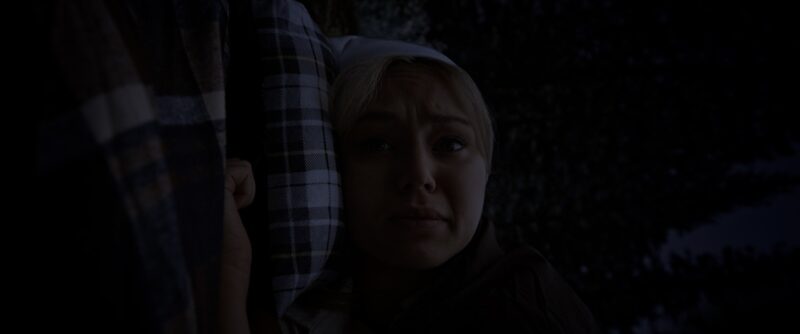
Great question. One of my pet peeves is actors just playing a vague “state”- like fear. It has to be specific. You have to know exactly what you’re afraid of. We never had scenes directly involving the bear, but we were filming at 9,000 feet in the forest at 3:30 in the morning. That’s inherently unsettling. We’d joke, “What if we’re making a bear movie and an actual bear shows up?” It didn’t happen, but that thought is in the back of your mind. The location itself had its own creep factor built in.
And I loved that we weren’t on a stage. It was all real. I’d do it again in a heartbeat.
Survival stories force characters to confront mortality bluntly. Did this film change your relationship with fear at all?
I have phobias – just not the ones you’d expect. I’m not afraid of heights or animals. But old houses? Creaky floors? Vintage clocks? No thank you. That’s my grizzly chasing me. Snakes and spiders, sure – I don’t want them in my home – but they don’t terrify me.
You’ve played astronauts, priests, medical examiners, comic relief, even serial killers. Is there a through line in the kinds of characters you’re drawn to?
Joel: I realized recently I’ve played five or six serial killers. Which sounds alarming. But usually they’re cast as unsuspecting types – the guy you’d pass on the street. Maybe I fall into that category.
It’s almost a weird compliment – you’re so approachable you could be a serial killer.
Exactly. Open the floorboards and let’s see what’s going on (laughs).
When you think back to your teenage self doing summer theatre at Northwestern – would you recognise the career you’ve built?
Wow, Northwestern, how did you know about that?
I’m just good at research.
Yeah, good for you. Yeah, I was such an action-movie kid. I wanted to be a Jedi, Indiana Jones, one of the Goonies. That’s what I watched and that’s what I wanted. Spielberg, Lucas, Tony Scott, Zemeckis – that was the dream. I didn’t see myself doing as much comedy as I do now. Action movies were everything. And honestly, if anyone’s listening – I still want that.
I saw Batman Returns when I was seven. That probably explains a lot about me.
That’s Catwoman, right?
Michelle Pfeiffer changed my world.
That’ll do it.
I see a lot of films for my job – around 80 already this year – and this one genuinely surprised me. It feels original in a way that isn’t always common right now.
That means a lot. Lauren, Burke (Doeren, director) – I didn’t even realise he was a first-time director while we were filming. He was that confident. Lauren wore so many hats and carried it all so well. They made something special. They should be proud.
You can tell when people genuinely care about what they’re making. That comes across here.
Absolutely.
Grizzly Night is now available on Digital and On Demand in the United States, the UK and Ireland. It will be available on Digital and on DVD in Australia from April 8th, 2026.
