

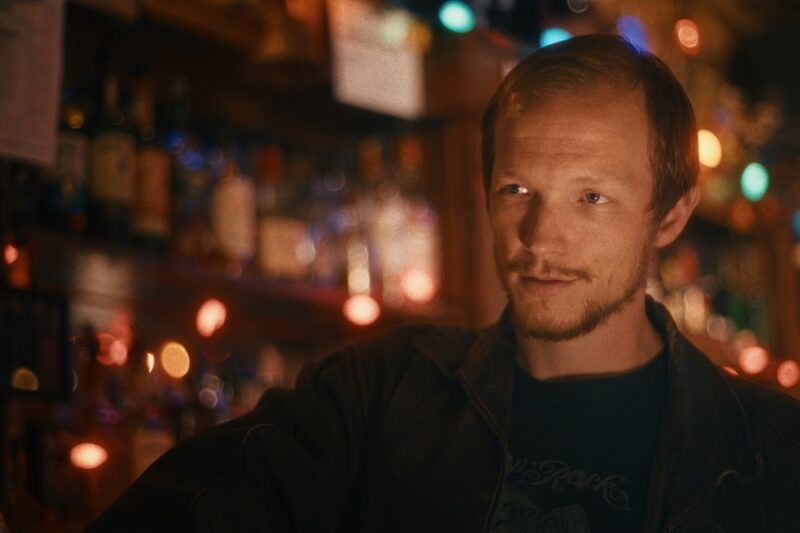
Jefferson White brings a quietly lived-in warmth to Drink and Be Merry, starring as Chet, a beleaguered bartender holding together a struggling New York dive bar in the days leading up to Christmas 2019. Stuck in a state of extended arrested development, Chet spends his nights caring for a group of misanthropic, aging regulars who have nowhere else to go and depend on him for far more than just another round—while privately nurturing a naïve hope that this Christmas might still offer something resembling magic. It’s a tender, human performance that understands bars as places of refuge, confession, and unspoken community.
White has steadily become one of the most compelling character actors of his generation. Best known for his breakout role as Jimmy Hurdstrom on Yellowstone, he has been a cornerstone of Taylor Sheridan’s modern Western from its pilot, bringing raw vulnerability and emotional depth to one of television’s most culturally resonant series. His recent film work includes a riveting turn as a frontline war journalist in Alex Garland’s Civil War opposite Kirsten Dunst, and a memorable appearance in William Oldroyd’s Eileen alongside Anne Hathaway and Shea Whigham.
In conversation, White reflects on the hard-earned wisdom that comes from standing behind a bar, the character actors who shaped his sensibilities as a performer, and why setting Drink and Be Merry in 2019 gives it the bittersweet feeling of “the last Christmas” before the world irrevocably changed.
It’s interesting watching this film, as its 2019 Christmas setting almost feels like “the last Christmas” in a way. It was on the cusp of a change we didn’t know was coming. I wanted to ask if that affected the context of playing Chet? He has no idea what’s coming, but did it come into your thought process at all?
Yeah, it’s a fascinating little slice of history. It’s a Christmas movie in a dive bar at Christmas, before COVID. It’s a moment in history. It’s kind of the end of an era and the beginning of a new one, and as an actor, I don’t really think of it as my job. But the film’s director, Adam Volerich, was keenly aware of that and really tried to create this simultaneous feeling of nostalgia and this older world at the same time. It’s like colliding the new world that’s right around the corner. He was really trying to heighten that juxtaposition.
Before getting into the deep questions, I wanted to ask about one of the little moments in the film I really loved. Chet has the photo of Eric Stoltz, and he’s asking the patrons if they know who that is. For you, personally, is there an actor that may be considered obscure or not as well known by all, that you think is a great actor and more people need to know who they are?
Oh yeah. I started getting really interested in film around the time of Boardwalk Empire. If you watch that show, it has this ensemble case of the best character actors in history. Shea Whigham, Michael Shannon, Steve Buscemi, Stephen Graham…there’s so many. Stephen Root, Michael K. Williams, there’s so many guys that pop up in that show who are exactly the kind of actor that people who love movies and TV wouldn’t necessarily know by name, but they just make so many great things. For me, in particular, Shea Whigham is somebody I’ve loved for years and years, and I recently got to work with him and it was such a funny, surreal experience. Stephen Root, I loved Office Space when I was a kid, so that was really special for me. It’s like I’ve got a Kill Bill list and I’m working my way through the cast of Boardwalk Empire (laughs). I love Guy Ritchie’s Lock, Stock…, so I’ve been obsessed with Stephen Graham for a long time.
Surely, it would be one of those difficult things to not ask about Stephen Root’s “stapler” from Office Space?
Oh, really hard. You got to try hard to be cool about it (laughs). You wait until the job is done, and then you say, “Hey, I’m a big fan.”
And Chet spends his days serving people who rely on him. He’s emotional labour that they don’t know how to name. Did playing him change the way that you view service workers and the invisible emotional work they do?
Yeah, in a funny way it went both ways (for me), because I worked in restaurants for a long time, so I had more experience with that side of the equation. I think the film is really seeking to humanize both sides of that equation, because the bartender is my age. Well, everyone making the movie is my age. It’s one generation, you know? We all feel a little bit more like Chet than we do these older regulars at the bar. I think the other side of the equation, it was very humanizing for me. It’s these guys you see everywhere. These older men who aren’t necessarily very expressive, but underneath the surface they have these rich lives. These full, complicated, emotional lives.
It was a bit of a reminder for me to make an effort to engage with people that are older than me, who I might otherwise think of as just customers. I’m really used to working in the service industry, and I think more like that. Those people are very human to me, because I worked with them for years. All my friends work in the service industry. It was more the people who come in and eat at the restaurant. What’s their story? You know?
The barflies almost feel like the ghosts of New York that’s vanishing. Do you find yourself thinking about gentrification, disappearing third acts, and who gets left behind in this changing New York?
I live in the changing New York, and in a way I have to acknowledge I am the changing New York. I’m a transplant from Iowa. I moved here 12 years ago, and it’s important that the call to action is to really engage with your community and participate in the city, rather than building an alternative, new economy on top of it. This (film) was a really good call to go into these places, these local institutions. It’s a bit of a love letter to local businesses, because this bar where we filmed is a real bar called the Ale ‘N’ Wich, which is a 50-year-old bar in New Brunswick, New Jersey. It’s this old bar in a college town. That’s a pretty impressive feat. This film has a bit of an elegiac tone for this kind of older generation of men, a kind of repressed man, who are disappearing and drinking themselves to death in front of our very noses.
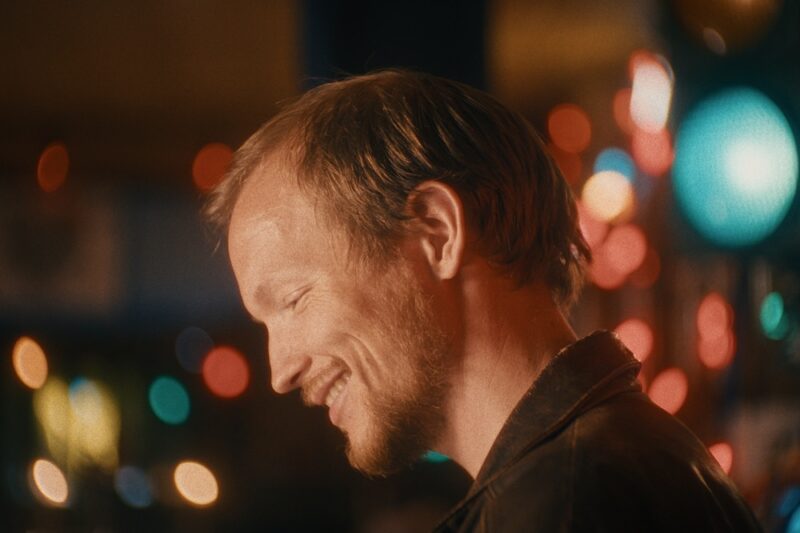
I read about the production kind of lived in this infinite night. Blacking out the windows, and staying in the bar for these long stretches of time. Did that isolation affect your performance? Or did the space genuinely feel like a refuge or a trap? Or was it a little bit of both?
That’s a very astute observation. Yeah, both. You’re exactly right. That’s really the effect it has. You’re kind of locked in this bar together, and the movie, conveniently, is about these people that are stuck in this bar together. It is their refuge from the world. So there’s this really nice synergy between the process of making the film and the narrative of the film. As an actor, a lot of our job is looking for opportunities. Looking for those synergies. You can take advantage of them, rather than having to invent something. You’re looking for the ways in which the real experience lines up with the narrative. Those sensory experiences are such a gift. The smell of a place like that and the very specific kind of atmosphere of a 50-year-old bar. That’s a gift if you allow yourself to accept it and say, “Okay, great, here we are.”
Chet is someone who has never really asked himself what he actually wants. As Jefferson, how do you approach a character that hasn’t developed a sense of self? Do you build the man who he might become? Or do you strip him down to what he’s afraid to admit?
That’s a really great question. I think I feel like my favourite kind of acting and my favourite performances are always our layers, right? It’s like the character feels one way and he’s saying something different, or he thinks he feels there’s a deep, deep truth. Then there’s his own understanding of himself. And then there’s the self that he presents to the world. I think, for Chet, that understanding of himself is quite stunted. It’s quite underdeveloped. And then what he presents to the world is not a very good mask. He’s not that good at hiding how he really feels. He’s not that good a performer in those scenes with Sophie Zucker, the young woman (Maeve) he sort of has a relationship over the course of the film.
You see him fail to keep the mask up, to a fault. His great sin in that relationship is that the first time they sleep together, the one time they sleep together, he’s basically like, “I love you and I think about you all the time.” She makes him imagine a world where a better life is possible. The mask is flimsy, and what comes out are his real feelings. They kind of jump to the forefront as soon as anybody shows him any real kindness, you know? So a character whose mask is slipping, from scene to scene, it’s a fun action to play this guy who’s not quite in control of what he’s showing the world.
It was one of those performances that’s very much based in stillness, but the kind of stillness where there’s so much internal acting going on. You can see he’s almost trying to keep up a facade. It was interesting to watch you project nothing, but so much at the same time.
Oh, thanks for saying that, man. It’s interesting, because a bartender is a performer. You’re behind that bar, kind of dancing and singing for these regulars, to a certain extent. A lot of times what the customers want is for the bartender to listen. A lot of his job is to sit there and try really hard to give these guys what they want from him, even if it’s confusing or mysterious or they don’t really know. It’s also a character where so much of his sense of self is based on what other people want him, or need him, to be. That’s interesting too, because it leads to quite a jumbled and confused sense of self.
Bartenders almost become accidental therapists in a lot of ways. Did you pick up any bartender wisdom during filming? Or any questionable barfly advice?
(Laughs) It’s all pretty questionable in this movie. I mean, one of the great treats of this was that we had an amazing cast. I produced this film, my buddy Adam directed it, and we’ve worked together for years and years. One of our great triumphs here was we were lucky that we called in a lot of favours with these great actors that we’ve known for years. We always said, “Boy, I hope one day we get to put these guys in a movie,” and a lot of them showed up. One of the other real gifts throughout the whole process was like, “Hey, my job is just to sit here and listen to an incredibly interesting character actor.” They were really coming in and doing a lot of the heavy lifting. They came in and expressed their inner lives. So much of Chet’s job is just to listen and say, “And how does that make you feel?” As you said, the bartender is often their therapist. It was just nice to have this rotating ensemble of great actors that make listening fun.
The film is ultimately about people who stay too long in places that are a comfort to them. As an artist, whether it’s metaphorical or literal, is there a “bar” that you’ve stayed in for far too long? And what pushed you to finally step out of that comfort space?
It’s a great question. I mean, yeah, you’re right that the movie’s about this space that’s uncomfortable, but it’s familiar. Chet isn’t happy and he feels himself kind of shrinking over time. The scarier thing is to step into the unknown and take risks. He’s afraid to go to this acting class, because he’s worried he’s going to look fucking stupid, right? I would say, for me, the kind of extended metaphor of that is I’ve been an actor for years, and so much of being an actor is purely mercenary. You sit and you hope the phone rings. That can sometimes be really difficult. It can be months. Sometimes you’re sitting there, unemployed, anxious, asking if the phone is ever going to ring again. Making this movie with my friends represents a broader effort to seize control of our own destinies and go out and take risks. Making a movie like this, an independent movie with my friends, is kind of a risk. This is my version of going to that acting class. You can fall on your face. People can think you look silly or dumb, and you’ll survive. And I’ll do more producing, and this is kind of an early step in that journey. Working on this film represented my version of going out of the bar and really trying to step into what I want to do with my life and who I want to do it with.
Drink and Be Merry is now available on Digital and On-Demand platforms, Blu-Ray, and DVD in the United States.
