
The story we know, but told not as we’ve seen it before.
Coming only a few months after Disney’s controversial musical live-action adaptation, Snow White is given a dark, violent makeover in The Death of Snow White, director Jason Brooks‘s unique take on a classic, with a decidedly gory twist.
In the film, Snow White, hunted by her wicked stepmother, must overcome the horrors of the dark forest and make unlikely friends with 7 murderous dwarves.
As the film arrives on digital platforms, Peter Gray spoke with creator Brooks about adapting such a classic tale in this manner, and actress Chelsea Edmundson about throwing herself wholeheartedly into the role of the The Evil Queen.
I love horror in all its forms, however it decides to present itself. Before getting to The Death of Snow White, I wanted to ask both of you, is there a gateway horror movie for you? Something that got you into the genre?
Jason Brooks: For me, it was the original Halloween when I was eight-years-old. Just being over at someone’s house during that night and had a babysitter up watching it. I couldn’t sleep. Came out to the living room, and she let me watch it with her. That was my gateway.
Chelsea Edmundson: My gateway was a little bit of a baby stuff in comparison (laughs). Mine was Gremlins. I think I was 5. It terrified me.
Jason, I want to ask you first, did you draw on any specific fairy tale adaptations, folklore or other horror films as creative references in crafting this version of Snow White?
Jason Brooks: Honestly, no. We went into this just kind of going back to the roots of the Grimm Brothers fairy tale. The short story. And thought about what are the beats we want to hit and to make sure that we tell and hit those little milestones and markers in the movie. Then fill in the blanks, like what hasn’t been told? What do we want to know more about? Like, the kiss. Can it have a deeper meaning than just some guy randomly coming out of nowhere and kissing her awake? Why would he do that? I wanted to explore more and create more of a lore and story behind some of these things. We didn’t really go anywhere for inspiration, other than that our own needs and wants to know more.
It is interesting that you look at the basis of these children’s fairy tales and they’re all quite dark. It’s funny how we’ve made them lighter for children over the years, but now we’re seeing how messed up they can be. I have to say Chelsea, your Queen is terrifying in the best way possible. There’s this tragic fragility beneath her cruelty. Did you find a way to connect with her humanity? Or did you treat her as more a mythic evil?
Chelsea Edmundson: Well, I think that humanity is the part that’s just Chelsea that you can’t really all the way scrub off, if that makes sense. I don’t think women end up like the Evil Queen all by themselves. Things happen to them to make them like that. I would often think about maybe why she was the way she was. There’s a constantly evolving thing in my mind that I never really decided on. I was never like, “This is what happened to her,” I just thought about what could have happened to her. Maybe it was this or that. But mostly I just had so much fun being bad.
You can tell you’re having a great time. I just want to quickly mention a certain line delivery of yours. When you tell your handmaidens “Leave”, it really brought me to Meryl Streep telling the driver in The Devil Wears Prada to “Go” at the end. I was very much here for that delivery.
Chelsea Edmundson: Thank you! I love little, bitchy things like that. Anjelica Huston in Ever After was a huge inspiration for me. She’s so iconic in that, and I feel like not enough people have seen that movie. I like little, throwaway, bitchy things.
Did you find there was a moment during filming where you both kind of went, “Oh, have we gone too far?”
Jason Brooks: I didn’t feel that way. There were times where we had, due to time and availability and stuff, that we wish we could go further. Spend more time X, Y, Z, to really emphasize it. There were moments I wanted to push further.
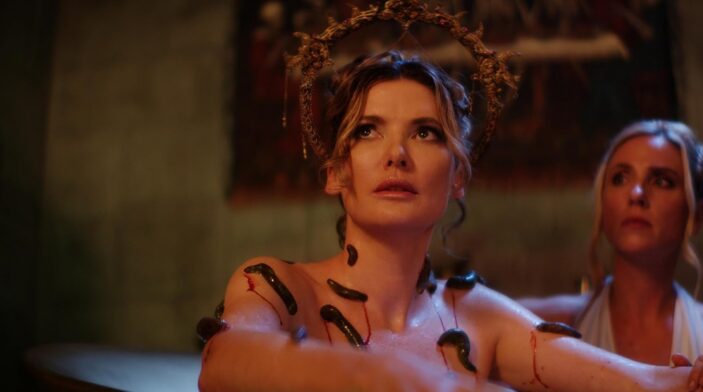
I’m just going to say “The Butterfly” was fantastic! It really didn’t hold anything back on that effect. It was almost like the whole film had been building to that. If that’s you not going far, I’d love to see what you could do. When it comes to horror, the more practical, the better I think. And Jason, you’re an effects artist as well, so do you see fear as something that should be earned through a story? Or can it purely come from violent impact?
Jason Brooks: Oh, it’s both. I think fear is more earned with build up and everything like that, and the kind of gross and practical effects are more the cringe moments of, “I don’t want to look,” which I see people do in some viewings. People looking through their fingers. They don’t want to watch. That’s what they’re afraid of. There’s an instinctual thing that says, “I can’t look at spiders. I can’t look at snakes. I can’t look at blood. I can’t look at fingernails or eyeballs.” So we play with that, and that kind of tension building where we know what’s about to happen, and then, yep, it does. But yeah, the practical effects are our lifeblood. That’s what we love to do. We love to take it as far as we can.
Chelsea Edmundson: That’s something that I should have taken further. I have a regret. I should have eaten a bigger bug. I had to eat a big, and it was like an episode of Fear Factor for me. It was disintegrating in my mouth, like all its little legs and pieces were in my mouth. And because they’re dried, and I didn’t know that, so as soon as Jason yells “Cut”, I was wiping my mouth and stuff. But for camera, I wish it would have been this one with a horn. I was freaked out by it, like, “Anything but that one.” But now, if I could have somehow overcame my mental fear, that would have looked really good on camera. So, I have that regret.
I love that. It does take a lot for me to cringe, but that hand moment? My god that was visceral! And then you pick the severed hand up and pat him on the head, it was so great. It had such a sense of humour about itself, which I think is so important. And with this version of Snow White, it’s not just about innocent, but survival and transformation. I feel like horror represents female characters so well, and it allows them to evolve in ways that other genres don’t. For the both of you, do you have a feeling as to why horror seems to be the genre that does present such strong female characterisation?
Jason Brooks: I think that there’s something about innocence and purity overcoming evil. And good versus evil. Good winning and power and victory coming from an unlikely source. You think that the big monster is going to kill the weak, small girl, and when she overcomes that, you’re rooting for her to win. What I love about (this movie) was empowering Snow White, and not in a way where she’s going to come out with swords and start fighting. She’s truly Snow White until the end and she doesn’t have to kill people. She doesn’t have to use brute stuff to overcome things. That’s not her arc. Her arc is becoming more of herself, and learning how the world is at the same time. She doesn’t have this false view of what life is. What I love is the woman winning, not by putting a sword in her hand, but using her intelligence and her kindness as the weapon.
Chelsea Edmundson: I think horror is also the most welcoming genre to new actors. I think that’s why we see so many actors that have these huge careers, when you look back on what they’ve done, they’ve started in horror. That’s certainly been the case for me. The first movie I did was a horror/action movie, and then I did, like, five horror movies after that. I just kept going. I’m still doing them. I never get tired of it, because every role I’ve played in horror is very different. I don’t know if I’ve just gotten lucky that way, or if that’s the case for a lot of women, but I feel really lucky, because I think if I wasn’t in the horror genre as much as I am, I think I probably would have been very typecast.
If I audition for comedy, I’m auditioning for a lot of the same thing, you know? I’m really grateful, because the horror films I’ve done are starting to help me be able to audition for more complex, interesting characters in all genres, because I’ve shown what I can do. I just think that’s the great thing about the genre. If any young actors are starting out, don’t stick your nose up at horror, because it’s a great genre to be in. Like you said, sometimes it’s the best female roles, and you could get the best part of your life in a horror movie. This has been my favourite role to play, so far.
The Death of Snow White is now available to rent on Digital Platforms.
