
There’s a fine line between connection and performance – and Alphabet Lane walks it with a quietly unnerving confidence. What begins as a joke between two isolated lovers spirals into something far stranger, as invented friends start to feel more real than the relationship they were meant to save. Darkly funny, subtly unsettling, and unexpectedly romantic, the film taps into that fragile space where imagination fills the gaps reality can’t.
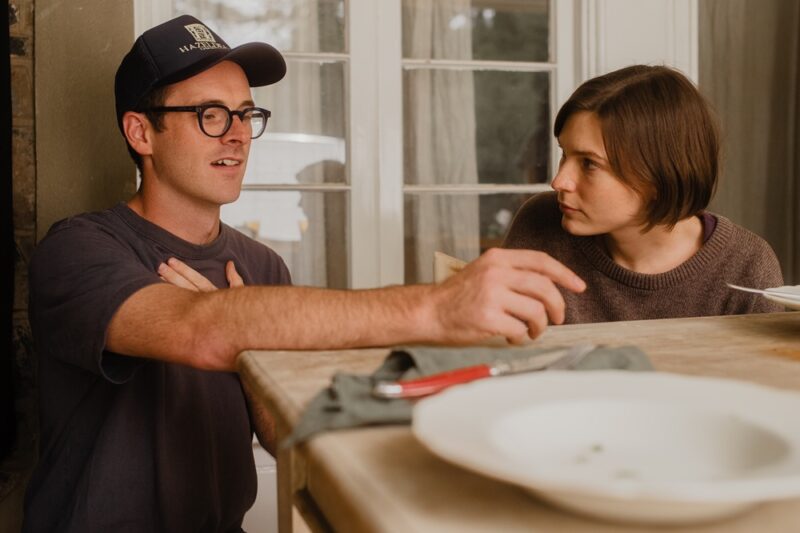
Our Peter Gray sat down with writer/director James Litchfield ahead of the film’s release to talk about building a relationship that feels both intimate and performative, the emotional pull of invented lives, and why sometimes the most revealing stories are the ones that leave just enough unsaid.
I loved that idea of invented people evolving into something emotionally real. Do Joe and Michelle represent something specific thematically, or were they always just coping mechanisms?
They definitely begin as coping mechanisms, but as the story develops, they take on a life of their own. It’s less about them symbolising one fixed idea and more about how they evolve alongside the relationship.
Was it always a love story to you, or did it begin more as an exploration of isolation and identity?
It was always rooted in relationships. The initial idea actually came from observing couples who have a “third thing” – like a pet – that they use to communicate indirectly with each other. That creative dynamic was really interesting to me. Then writing it during COVID naturally brought in themes of isolation and closeness.
Tonally, it’s such a balancing act – very funny, but also unsettling. Did you ever worry about leaning too far one way?
It was definitely about feeling it out. I had a sense of what I wanted it to feel like and just kept chasing that. The key was to keep it surprising while still feeling truthful.
The relationship feels almost performed at times – like they’re acting out what a relationship should be. Was that intentional?
Yeah, I think they’re both chasing an idea of what their relationship should be, and they have a complicated relationship with that ideal. That tension naturally makes things feel performative.
Did you build much backstory with the actors? Because when we meet them, they already feel slightly fractured.
We did a lot of work around that – exercises, conversations about how they got there. The script didn’t really change, but it helped build a shared understanding and rapport between them.
Was it difficult for the actors to balance familiarity with that sense of distance?
It was important that they felt believable as a couple who could embark on this creative venture together. We spent a lot of time together, which helped build that dynamic, even within a tricky moment in their relationship.
When the “real” Michelle appears, it raises interesting ethical questions. Did you ever consider exploring that more directly?
I think it was important to leave space for the audience. Rather than resolving everything, I wanted people to bring their own interpretations. That openness makes it feel more alive.
Festival audiences seem to really engage with that kind of ambiguity. Did you notice that in reactions?
Definitely. It’s been great hearing people bring very personal interpretations to it. That’s kind of the goal – for it to resonate in different ways.
The setting is beautiful but also cold and isolating – it feels like a reflection of their internal state. Was that deliberate?
Yeah, the landscape has that duality. It’s visually stunning but also harsh and distant, which mirrors what they’re going through.
I kept thinking they’re almost orbiting each other rather than fully connecting – like there’s a bigger conversation they’re avoiding.
That’s a really interesting way to put it. There’s definitely something they’re not addressing directly, and this imagined world becomes a way of filling that gap.
From a filmmaking perspective, what got you into this in the first place? Was there a defining film for you?
I’d already been making films, but seeing Burning really opened something up for me in terms of what cinema could do.
And now, do you feel like you’re discovering your voice as a filmmaker?
I think so. I’m still figuring it out, but I’m drawn to making things that feel alive and surprising. The next project will probably lean more into genre.
Well, as someone who watches a lot of films, it’s always exciting when something genuinely original comes along. This really demands attention – you can’t half-watch it. If you look away, you miss something. And that’s such a rare thing right now.
That’s great to hear. That was definitely part of the intention – to make something that pulls you in and keeps you engaged.
Alphabet Lane is now screening in Australian theatres.
