
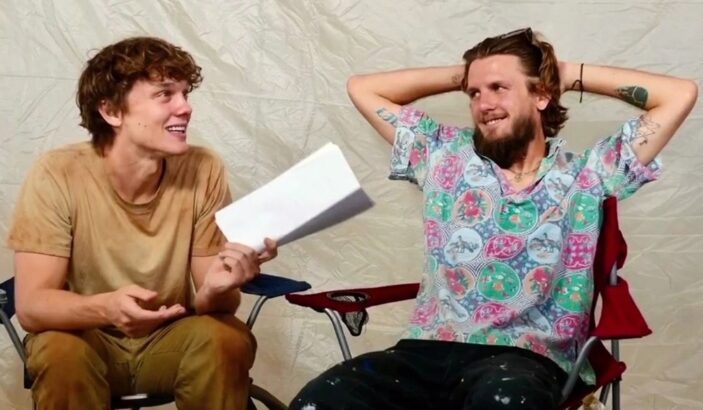
Both rising forces in the film and television industry, expressing their passions for emotional, captivating storytelling, director Spencer King and actor Hunter Doohan have joined for the survivalist drama The Wilderness.
Detailing a group of troubled teenage boys who are kidnapped from their homes and taken deep into the unforgiving Utah desert, where they are forced into a brutal and secretive “Wilderness Therapy” program under the direction of their enigmatic leader, whose motives are from therapeutic, The Wilderness is an at-times devastating examination of when the lines between rehabilitation and manipulation blur.
As the film arrives in theatres across the United States this week, Peter Gray spoke with both King and Doohan, asking about the delicate approach to such a subject, the safe space created on set for the cast and crew, and what it was they learned about themselves and nature in making this film.
The desert setting has this both punishing and purifying notion to it. It’s almost a character in itself. To the both of you, did that isolation affect your roles as director and actor?
Hunter Doohan: It really helped being out there in these real locations. I mean, to not have to do just do that extra layer of pretending…I found it so helpful to drop in out there.
Spencer King: Yeah, and it was really an immersive experience being out there. The cast and I did a backpacking trip the week before, and we really got to understand the elements a little bit more. That it’s a living and breathing environment out there. It’s like our Outback.
With the type of therapy presented in the film, there’s always a morally gray area to navigate. Spencer, how did you approach that in highlighting this type of practice?
Spencer King: It was really important to make it clear that these families are making these really difficult decisions, and they’re sometimes manipulated. That’s why we had the Welcome Video when (Hunter’s character) arrives. Oftentimes, you go to some of these websites and they pitch it in this very rosy way. If you get to understand the industry, there’s a lot of shadiness in it, and a lot of these programs are owned by the same people at the boarding schools that they are trying to funnel the kids to afterwards. There’s not a lot of oversight. Understanding that was important to me.
Hunter, your character is in this push-pull with vulnerability and resistance. How did you approach that emotional honesty when your character is resisting it?
Hunter Doohan: I just found that it was written to be really real. As a character, he’s not trying to show his emotions, even though he’s put in such a harrowing situation. And that just feels like real life to me where people try not to cry. Only actors “try” to cry. It was really fun to play with a a character that’s trying to fight back.

Spencer, you’re balancing realism with cinematic storytelling. When dealing with young people in extreme situations, how do you balance wanting the film to be an escape, but at the same time you’re detailing something very real.
Spencer King: I think that story itself, to people that haven’t been through these projects or these programs, it’s an escape, because it feels so fictional in a lot of ways. And then it’s really just trying to not take those creative leaps and have it be grounded in a lot of truth. That was the way we went, because what these kids go through is sensational enough. We don’t need to throw in any x-factors, you know?
As you mentioned, Hunter, how well it was written. How did you both collaborate on shaping your character? Was it all heavily scripted? Or was it one of those things where you found it during production having conversations?
Hunter Doohan: Oh, it’s heavily scripted. But I was brought into (the film) to play the role of Ed and as a producer, because I originally was just asked to read it as an actor, and then Spencer and I just really clicked. So we would just go back and forth a lot, and Spencer’s just one of the most collaborative directors, probably the most collaborative director I’ve ever worked with, so that was really just a special experience for me. I felt like I got to really mine his real experiences. All of the script is inspired by real (events), and when you talk to a friend for six months, you get all of these details, and as an actor it’s really helpful to just fill in any gaps. Especially at the beginning of the film where Ed is refusing to speak to the counselors, and he’s not allowed to speak to other kids, so to know what he would be really going through was really helpful.
Spencer King: Yeah, the beauty of making an independent film is that it take you forever to get it made, so you’ve got a lot of time to prep it.
And when you’re directing a story like this, that’s so intimate, how do you protect your actors? Especially when they’re going to such deep, emotional spaces?
Spencer King: Yeah, we, as a crew, got really close. The whole team did. We lived on location, and we saw each other over the weekends. We would hang out at night after shooting. Everyone got really comfortable with each other. And when I say everyone, I mean the full team. I think that was a big barrier to cross, because I know, as an actor, and I’m not an actor, but I can imagine as an actor that when you’ve got 30 people within 10 feet of you, and you’re performing the most emotional scene in the movie, it can be difficult. I think that probably benefited you guys, Hunter? I assume…
Hunter Doohan: Yeah, that absolutely did. When you’re working on bigger projects, they’re a bigger cruise. You don’t get the chance to know everybody, but we really got to know everyone and feel comfortable around each other. And then the biggest thing was that Spencer was meeting us right there. Just him telling the story at all was vulnerable. But I often think about when it was going to be a really hard day, either physically or emotionally, he would remind us of the reality of the situation and what it was inspired by. When you have a director that meets you at that level, you don’t feel like it’s just some guy behind a monitor.
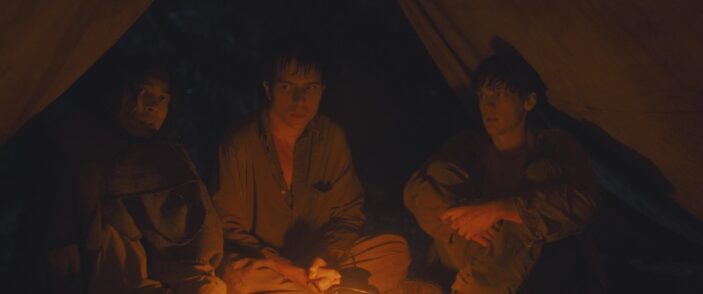
With that comfort and closeness, I would assume that helps both of you take certain risks? Was there a creative risk for you, Spencer, and an emotional risk for you, Hunter, that you felt like you could take because of the atmosphere of the film?
Spencer King: That’s a good question, and I haven’t thought about that. I would say that the actors were so solid that…on an independent film, you’re strapped for time and strapped for coverage as a director, but we were able to get off a certain angle earlier, because everyone was so in it. And their takes were so raw. I would also say that there was a lot of freedom. We all got so comfortable that I was able to throw stuff at the actors that might have been wrong, but they were able to try it. We had an easily dialogue with what did work and what didn’t.
Hunter Doohan: And you get to know and trust someone’s taste too. It’s like, “Okay, I’m willing to try that because it’s bad. You’re not gonna put that in the movie, yeah?” I think in emotionally taking risk, I got to know Spencer really well. And Ed, as a character, is dealing with grief and addiction, which is his way of coping after losing his dad at a young age. I got to talk to Spencer a lot about losing my dad. Usually a director doesn’t really know where you’re pulling from, so to just have that baseline of authenticity and being able to talk about things so plainly was really beautiful.
I lost my father at a young age, so I think that was definitely a window into the film for me. I can imagine that anger and dealing with that grief. And, a nice heavy question to end on, were there any unexpected lessons that you learned about nature or about yourself as a director, as an actor, or as humans going off this film?
Spencer King: To start with nature, just don’t mess with it. I took some backpacking trips out there in preparation and scouting, and there were some times where I got myself into trouble. Something I learned, and I advised everyone, is that if you went the wrong way, it doesn’t matter if you’ve been going the wrong way for three hours, just turn back! Like, there were times I was hiking up ridges, and all of a sudden I realised there’s nowhere to go. Should I take this leap that could be dangerous?
Hunter Doohan: Me, Lamar (Johnson), Aaron (Holliday) and Matt (Gomez Hidaka), us four boys really found our off-screen friendships while we were shooting. We really mirrored these (characters), because we were out there all alone, and it’s really rare to just kind of hit a group of young men being super vulnerable with each other. That was really special. I think that comes through in the story too. The main heart of the story is Ed and Miles’ (Lamar Johnson’s character) friendship. Getting to act with Lamar was such a gift too.
The Wilderness is screening in theatres in the United States from October 17th, 2025.
