
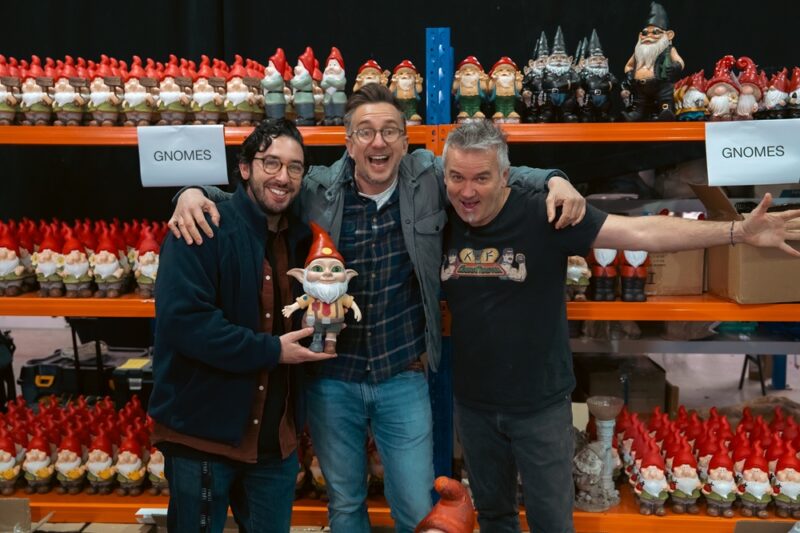
Garden gnomes have long been considered harmless, if somewhat unsettling, fixtures of suburban lawns. But in the delightfully deranged new Australian horror-comedy Gnomes, those innocent-looking ornaments are anything but, as an ancient evil unleashes an army of murderous garden dwellers upon an unsuspecting small town.
Blending the creature-feature chaos of Gremlins with the bloody irreverence of Hot Fuzz, the Stan Original series stars Asa Butterfield and Megan Smart as Arnold and Ellie, two local police officers – and former lovers – forced to put their differences aside when their sleepy community becomes ground zero for a full-blown gnome-apocalypse. Alongside a wonderfully eccentric ensemble of locals, they must navigate increasingly absurd circumstances in a show that embraces its own ridiculousness with gleeful abandon.
For creator Joel Kohn and producer Richard Kelly, however, there’s more to Gnomes than elaborate kills, practical effects and garden ornaments behaving badly. Born from Kohn’s childhood fear of the decorative creatures, the series is an affectionate throwback to the imaginative, occasionally terrifying entertainment of the ’80s and ’90s, when the likes of Round the Twist, Eerie, Indiana and The Dark Crystal weren’t afraid to embrace the strange.
As the series unleashes its particular brand of mayhem, our Peter Gray spoke with Kohn and Kelly about the challenges of balancing horror and comedy, the importance of practical effects, finding the heart beneath the absurdity, and why there’s still tremendous value in entertainment that simply wants to give audiences a good time.
There’s something really liberating about the show because it feels very unashamed in how ridiculous it is. I wonder in an industry where there’s often pressure for everything to feel elevated or prestigious, was there something creatively freeing about making a show that just wants to be as gloriously silly as this?
Joel Kohn: I think this really is a love letter to the stuff we all grew up loving. Myself, Tegan (Higginbotham), Paul (F. Verhoeven), the writers, even Matthias (Hoene), our lead director – we all loved this kind of storytelling, and we felt like we weren’t seeing much of it being made anymore, particularly in Australia. So we saw an opportunity to create something cool that we hadn’t seen in a while. We weren’t necessarily thinking of it as freeing. It was more about making the kind of show we’d love to watch ourselves, something that would appeal to fans of that nostalgic era while still feeling fresh and relevant today. That was really our focus.
Richard Kelly: I think it speaks to us. It wasn’t necessarily a conscious decision, but we realised pretty early on that we were making something quite different and unusual for Australian television. It doesn’t start with a dead girl in a small town – not that there’s anything wrong with that! How many Australian shows start with Nazis? (Laughs)
This is probably more a question for Joel, but I love that there’s this very unsettling nature about garden gnomes, in that we all think they’re harmless and you turn them into killers! Do you remember the moment you first looked at a gnome and thought there’s a horror story here? And how much of the original idea survived the journey to the screen?
Joel Kohn: (Laughs) The concept actually came from my own fear of garden gnomes when I was a kid. I used to stay at my auntie’s house, and she had garden gnomes out the front. The bedroom I slept in overlooked the garden, so five- or six-year-old me would always check before going to bed that they hadn’t moved. You just never know! Not that checking would have stopped them, mind you.
That’s really where the idea came from. I originally partnered with Tegan and Paul to develop it as a web series, but when John (Molloy) and Richard came on board, we realised it had the potential to be a great television show, and it evolved from there. Obviously, the story has grown and changed throughout development, but I think the heart of it has remained pretty consistent. The dysfunctional romantic relationship between Arnold (Asa Butterfield) and Ellie (Megan Smart) has always been central, alongside the silliness and zaniness of killer garden gnomes that are both funny and scary. And I will say, the opening Nazi sequence has been there pretty much from the outset.
That was your non-negotiable!
Richard Kelly: Just as a sidebar, there was an interview from another publication that I wasn’t involved in, but the journalist asked Tegan, “Would you like to speak to the Holocaust narrative in the show?” And we’re just like, ‘What’s that now?” (Laughs).
Joel Kohn: We were more thinking having grown up on Indiana Jones, and that sort of thing…
Richard Kelly: Yeah, that was very much one of our connecting points.
Yeah, I can confidently say I was never thinking about the Holocaust here…
Joel Kohn: As a Jewish filmmaker, definitely not where I was going.
It gave me Gremlins vibes, but also growing up with Australian TV, this very much felt like an R-rated version of Round the Twist. We watched some really messed up stuff as kids.
Joel Kohn: I think shows were a little more like that when I was growing up. God, I sound like such an old man! But there was so much imaginative, slightly scary content for younger and teenage audiences, like Round the Twist, Eerie, Indiana and Are You Afraid of the Dark? Even films like Labyrinth, The Dark Crystal and Gremlins had that balance of darkness and family-friendly fun. There was something really imaginative and playful about those stories, and we wanted to capture that same balance in the feel of our show.
And Richard, I feel like there’s this misconception that comedy, particularly something this outrageous, must somehow be easier than drama. I imagine the logistics of murderous gnomes, practical effects, elaborate deaths…that isn’t straightforward. Was there a point during production where you thought, “Oh, we’ve committed to something completely insane here?”
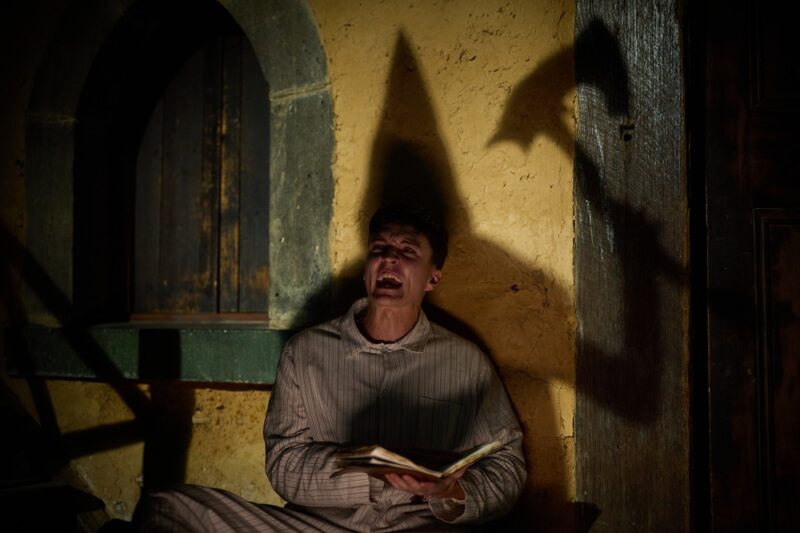
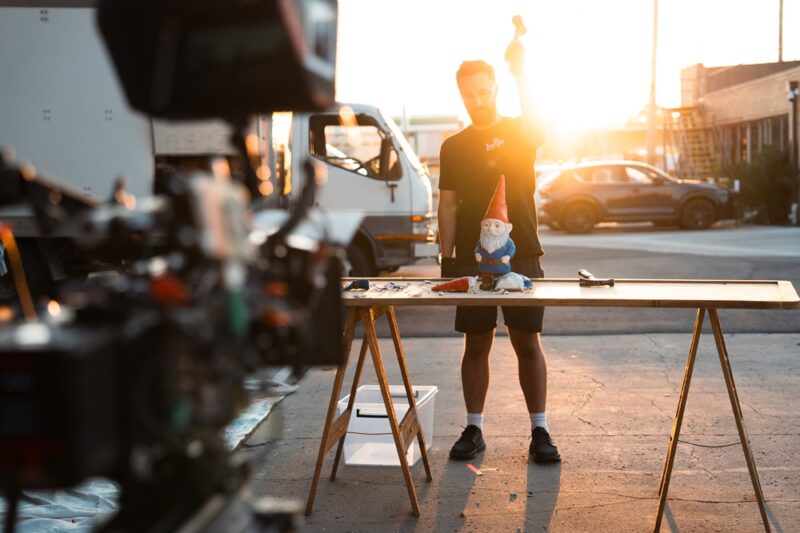
Richard Kelly: (Laughs) It’s funny you should say that. We definitely thought that on several occasions! Throughout development, we talked a lot about wanting to use puppets and practical effects to evoke the feel of films like Gremlins. CGI can look incredible, but there’s something about the texture and tactile nature of practical effects that you can’t quite replicate. It also changes how an actor responds when there’s an actual physical gnome on set, rather than a green ball on a stick.
We really wanted to capture that, but neither John Malloy, my co-producer, nor I had worked on anything involving this level of practical or visual effects before. So there was a real learning curve, and definitely moments when we felt we’d bitten off more than we could chew. Luckily, we had incredible teams in both areas who helped us figure out how to bring it all to life. It was hugely ambitious and certainly wasn’t easy, but we’re so happy with what we’ve achieved.
When you have a concept this wild, I imagine there’s this temptation to keep escalating everything. Do we go bigger deaths? Do we do stranger jokes? Do we up the chaos? For both of you, how do you know when you’ve gone far enough? And was there a moment you had to pull something back because it was distracting from the story rather than serving it?
Joel Kohn: It’s when the producer says, “No, sorry, we can’t do that. We have no money!” Or our partners suggest we might be pushing things a little too far, which thankfully only happened occasionally.
I think balancing comedy and horror is incredibly challenging, particularly when you’re mixing genres and embracing those zanier elements. We looked to influences like Edgar Wright and the Cornetto Trilogy, which handle that balance so well. Throughout development, and even into production, there was this constant push and pull between the comedy, horror and absurdity, figuring out what felt tonally right and what might be going too far.
We all had a strong sense of the tone we wanted. Matthias, our setup director, had experience with comedy horror and brought a great perspective, while Tagan and Paul are hilarious, talented comedy writers. And we’re all horror fans. So it was really an ongoing process of finding that balance. Sometimes we’d push something too far and have to pull it back, but other times, pushing things to the extreme was exactly where the fun came from. I mean, we killed someone with DVDs!
I was about to ask about that scene. And you kill one of the nicest comedians in the process.
Joel Kohn: Luke (McGregor) was wonderful. I’d actually met him once before at a screening of Ghostbusters: Afterlife. He’s part of a Melbourne Ghostbusters fan group, and he turned up with a bunch of friends all dressed as Ghostbusters. So I had a feeling he’d understand exactly what we were trying to do with the show. And he was genuinely excited about being killed off! I think that was part of the appeal for him. We basically told him, “Don’t worry, we’re going to give you a grisly death,” and he was thrilled!
Richard Kelly: I think most of the cast really responded to the tone of the script and just how unusual it was. It’s definitely not the kind of thing that comes across your desk every day. I mean, how often do you read a script where your character gets killed by DVDs?
Going off that, Australian comedy has this wonderful tradition of embracing characters and communities that might be “daggy” or “uncool.” I think Gnomes really understands the affection that exists within that humour. For both of you, do you think Australian storytellers sometimes underestimate how appealing that particular sensibility can be to international audiences?
Joel Kohn: We talked a lot about the importance of community spirit in the story and how that connects to Australian culture. Tegan, one of our writers, grew up in a small regional town, so she really understood that world and the wonderfully daggy collection of characters you encounter growing up in those communities. She brought a lot of that personal experience to the story.
We also loved the idea of throwing together this ragtag group of characters, particularly these small-town cops who are used to nothing ever happening because everyone knows everyone, and suddenly forcing them to confront something completely extraordinary. That idea of ordinary people having to step up in extraordinary circumstances is always an appealing setup, and I think it’s something audiences can really connect with.
Richard Kelly: I think Australian comedy, at its best, really leans into those idiosyncrasies and the oddball nature of its characters. You could say that about comedy from anywhere, really, but there’s something about embracing those quirks and exaggerating them that makes the humour so relatable. Everyone recognises a little bit of themselves in those characters.
Mentioning your ensemble, you have Asa Butterfield, Matt Okine, Megan Smart. And they all have their own individual comic energy that comes together. How much freedom did you find the actors had to find their own rhythm? Were there moments where someone’s interpretation of a character took you both somewhere that you hadn’t anticipated?
Richard Kelly: Absolutely. We’d lived with these scripts for so long throughout development, so when you finally put them in an actor’s hands, it’s amazing to see what they bring to the material. They might pick up on a small detail or deliver a line completely differently to how you’ve always imagined it, but 99% of the time it’s a wonderful surprise. Suddenly, someone like Darren Gilshenan is bringing an entirely new layer to a character who was already hilarious on the page, and you just want to let them run with it. Every member of the cast really brought their own personality and interpretation to their role, and I think that’s what gave the show such a wonderful ensemble feel.
Joel Kohn: We got incredibly lucky, and I’m so grateful for the cast we assembled because the ensemble is crucial to making the show work. Obviously, Asa and Megan are fantastic together, but the surrounding characters need to be just as strong for the show to succeed as a whole.
Darren is a perfect example. He’s such a brilliant comic actor who really makes a character his own. Sometimes he’d make little tweaks to the dialogue while filming, keeping the same idea but adding something that made it distinctly his. Suddenly, he’d made the mayor entirely his own, and that’s exactly what you want from an actor. He’s phenomenal.
I feel like there’s an emotional value of escapism with this show, and it’s very valuable because it’s arriving at a time when so much of what we watch can be confronting or socially conscious. For both of you, do you think there’s a tendency to undervalue entertainment that’s simply designed to give people a half hour of joyful escapism?
Richard Kelly: Yeah, mate, I guess it depends on how you quantify that value. We knew from the outset we weren’t making The West Wing or Succession. We were making entertainment, and that was always the intention. We talked about that a lot, particularly when we were out selling the show. This is fun, it’s silly, and we’re not trying to change the world. We just want to give people a good time.
And I think audiences who connect with it absolutely see the value in that. If you’re tuning into a show about killer garden gnomes, you know what you’re signing up for, and you’re there because you want to go along for that ride.
Joel Kohn: Succession is probably a not the right example because it’s actually really funny, as well as being incredibly smart. But we mean there’s a lot of focus on those highbrow shows, and rightly so, because they’re fantastic. But we were very conscious of wanting to make something that was fun and offered audiences a bit of escapism, while still having plenty of heart. We didn’t want it to be just escapism. We wanted something underneath the silliness that people could genuinely connect with, resonate with and care about.
And just before letting you both go, if you were given the freedom to unless the gnomes onto another quintessential Australian setting, where would you want to send them? A Bunnings sausage sizzle? Parliament House?
Joel Kohn: (Laughs) Where would we send them?
Richard Kelly: I’d love to see the gnomes overrun a major city like Sydney. We could go really big, with hordes of gnomes swarming across the Harbour Bridge or climbing the Opera House. Taking over the Manly ferry would be great, too! It sounds expensive, though, so I don’t know if we’ll ever get there (laughs).
Gnomes is now available to stream on Stan Australia.
