


What happens when the very system you’ve dedicated your life to upholding becomes the one that fails you? It’s a question that sits at the unsettling heart of Furious, the psychological crime thriller from executive producer Liz Meriwether, which follows FBI agent Alice Black (Emmy Rossum) as her pursuit of a calculating female serial killer, Catherine (Lola Petticrew), gradually dismantles everything she thought she understood about justice, morality and herself. But beneath the familiar framework of a cat-and-mouse thriller lies something considerably more intimate: a portrait of a woman who has spent her career fighting for the safety of others while remaining unable to find any sense of security in her own life. As Alice’s increasingly complicated relationship with Catherine begins to blur the distinction between investigator and adversary, the possibility of finding understanding in the most unlikely of places becomes both liberating and terrifying.
Speaking with our Peter Gray as the show earns a second season renewal, Rossum reflected on Alice’s fractured relationship with justice, the unexpected emotional honesty that emerges through deception, and the seductive power of sharing secrets with someone who might understand your darkest impulses better than you understand them yourself. And with the series returning, Rossum also considered the implications of Alice’s provocative final decision, and whether the freedom she’s beginning to discover might ultimately transform her into the very thing she’s spent her life trying to stop.
One of the things that I found really quite heartbreaking about Alice is that she’s so good at protecting other people, but it’s almost as if she doesn’t know what feeling safe looks like for herself. Did you see her journey as learning to reclaim control, or actually learning that she doesn’t always need to be in control to feel safe?
I don’t think Alice believes that she’ll ever be safe. We can see that she doesn’t even feel safe in her own apartment with the doors and windows locked. She can’t even get in the shower, which is the most vulnerable place. I think the journey is from somebody who thinks that they don’t believe they deserve justice, (they) don’t think they can get it for themselves, or maybe not the right kind of person that deserves justice to somebody who believes that maybe justice isn’t working in the traditional sense. And who shifts from believing that you can get justice in the normal channels to maybe you can’t. And if you can’t, what do you do about it?
Looking at the cost of being believed, because what really struck me is that Alice spends her career looking for evidence to prove other people’s suffering. Yet her own experiences are dismissed by the very institution she trusted. Did you feel that her pursuit of Catherine was partly about finally proving something to herself that nobody had been willing to acknowledge?
I think that Alice sees justice being gotten a different way and doesn’t believe that it is the right way. And then, as she finally gets to spend time with Catherine, it’s very confusing because there is a lot of trust and openness, and she can almost – even though she’s lying and pretending to be someone else – tell honest truths about herself within that lie in a way in which, if as herself, she could never say those things out loud. So, it’s almost through the pretending that the truth comes out, and the truth is held and reflected back, and I think she feels community with Catherine in a way.
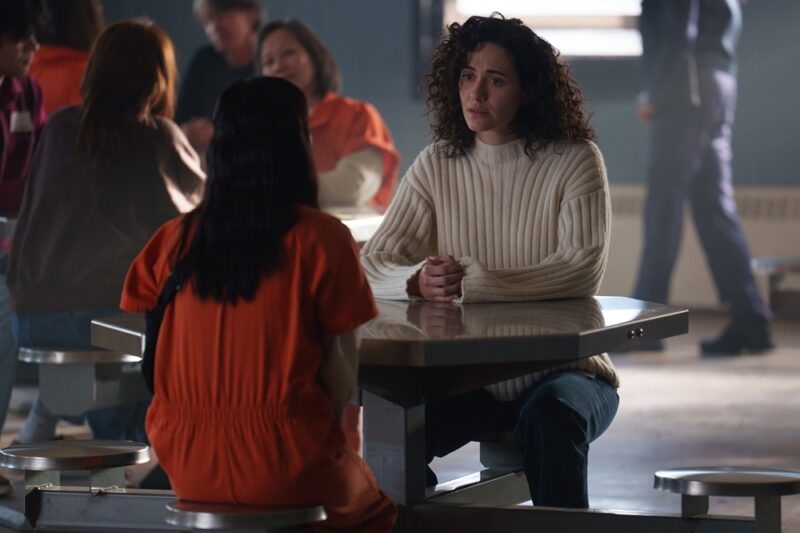
(Alice) is very alone in the world. She seems to not have any connection with her family, even her sister. She’s very estranged from her mother, and she seemingly has no friends and kind of wants it that way. Although she’s desperate for connection with Nora and connection with Danny. She’s also kind of hesitant in those relationships too. And then when she finally gets close to this killer, you see that she is almost feeling like a lightness for a moment. And then in the end, when Catherine says to her, “Have you ever killed someone?” It’s like you’re eating their power, and you have power, and you’re not scared anymore.
I think something starts to awake in her here where she wonders if she wants that, (and) if she doesn’t, has she been white knuckling all long thinking this is the only way, and maybe there’s another way. I think committing that makes her wonder what she’s capable of.
The smile you gave at the end of episode eight…it’s funny because I watched the series, and then it got renewed for Season 2 so I watched it again. I don’t know if you knew there was going to be a continuation, because it did end so perfectly, but I am glad there’s more to explore as that ending opened up so much for Alice. And she makes this choice that ultimately puts her on the outside of the law. Did you interpret that final act as a moment of liberation or something more touching? That she’s becoming the very person she spent the years trying to stop…
I took it to mean that she’s always had secrets, and now she’s got another. And secrets are very intoxicating. When someone else knows your secret, there’s just more sisterhood in that. Although it potentially makes her vulnerable, I think it’s a little terrifying, but also intoxicating to have that power. Now we’ll have to see what she does with knowing that about herself.
Furious is now streaming on Hulu (US) and Hulu on Disney+ (International).
