

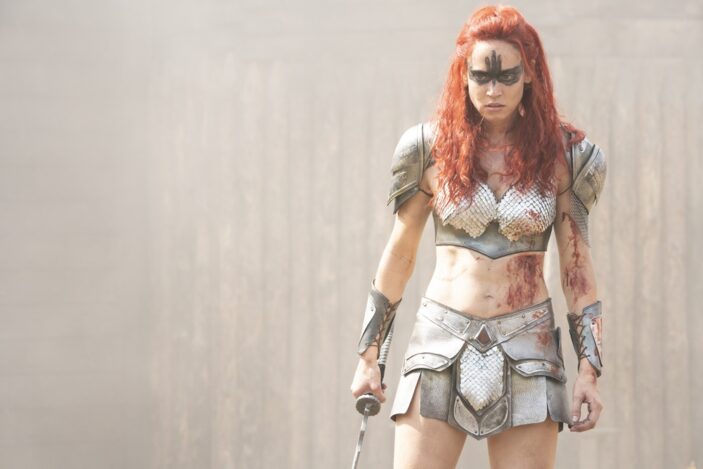
A reinvention of Robert E. Howard’s classic sword-and-sorcery character, Red Sonja is an empowering new action film from director M.J. Bassett (Deathwatch, Rogue), starring Matilda Lutz as the titular warrior, who after being enslaved by an evil tyrant who wishes to destroy her people, finds that she must unite a group of unlikely warriors to face off against Dragan The Magnificent and his deadly bride, Dark Annisia.
As the film screens in select theatres across Australia, and ahead of its Digital American release on August 29th, Peter Gray spoke with both Bassett and Lutz about breaking new narrative ground with the character, when they saw Red Sonja take shape, and what they learned about themselves during production.
With Red Sonja, you’ve eliminated sone of the original elements, like the forced sexual backstory, and you’ve very much reframed the character in this light of existential themes, like survival and even climate allegories. Could you walk me through your process of balancing the respect of the legacy and breaking new narrative ground?
M.J. Bassett: Obviously, I’m a fan of Robert E. Howard, and I know the original Sonja from the short story he wrote (The Shadow of the Vulture), where it’s a completely different Sonja. And then in 1973 Roy Thomas created it for Marvel and gave us the iconic barbarian-woman-in-chains bikini. The problem with that vision, for me, was always it’s clearly a male view of what this character should be. (Which is) Barely clad, giant bosoms, wielding a sword, chopping the heads off snakes. You can do whatever you want with that metaphor, but clearly something was going on.
Fast forward to 2013 when Gail Simone took over the comic run and, we’ll say, reinvented the character. She didn’t want to do the sexual assault backstory. I was never interested (in that). I think sexual violence motivating a woman is not necessarily a powerful thing. Having said that, of course Matilda made a movie where that was a powerful thing, and that’s amazing, right? And that’s one of the reasons I cast (her), because she’s fucking brilliant. But it’s knowing that I didn’t want to make a movie that (where) all we talked about was gender or sexual politics. The fact that Sonja is a woman in this world is of no consequence to me as a storyteller. She’s a person in the world with power and agenda and a trajectory. In the same way that (the character of) Dragan as the villain is a man. But the fact that he’s a man is inconsequential as well. It’s just about people. And once you start introducing like eight people into the world, the whole idea of gender and race becomes meaningless, right? We’re in a fantasy space.
I wanted to do something where I could talk about what I was interested in, which is, essentially, environmental politics and environmental issues. And I am woke, because I believe woke is kindness, and I had no shame about that. I put a powerful person at the heart who was on a journey of discovery and trying to find family, both chosen and her true family, and it became what the story of Sonja was. I take a little bit of what Gail Simone, but I really made my own narrative arc for (Sonja). Some people may dispute and disklike, and others will hopefully embrace.
And Matilda, I know you underwent intense sword training, horseback riding, even archery. I believe you also avoided watching the 1985 film so you could forge your own path. Was there a moment for you, either through training or on set, where you really saw Sonja take shape for you? Something that put things in motion?
Matilda Lutz: I think back and see little videos that we took (on set) and I think, “How did I do that?” I can’t believe it myself, honestly. When I first started the sword training, I remember holding the sword and it was super heavy. And my wrists? I didn’t even know there were muscles in the wrist (laughs). I didn’t know how to swing the sword, but little by little I saw the progress. And it was a slow process. And M.J. wanted to do all the fight scenes in a long take, with no cuts. So I had to learn six, seven sword fighting choreography, and do it all on set. It was empowering to do that. The physical part gave me so much power, and the fact that I got to play someone who’s so unapologetic and doesn’t ask permission to take up space. That was so liberating, because I am apologetic in my life, sometimes, so I got that from Sonja, and it was so wonderful for me.
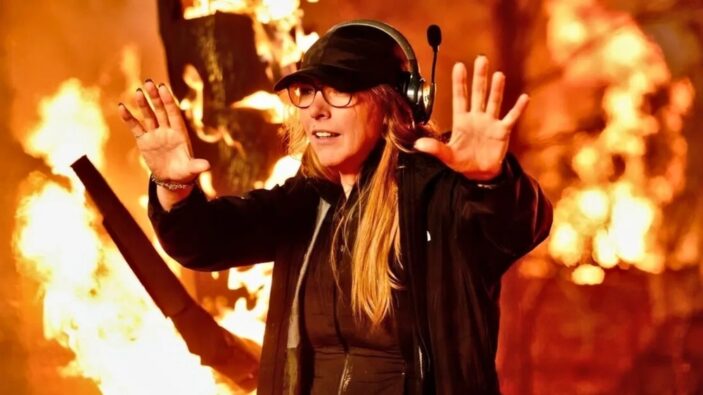
M.J. Bassett: I’m dying to jump in, because she’s not doing herself entire justice. She worked so hard. And there was never a moment where, and she’s bruised and broken and in pain, and at no point did Matilda say she couldn’t do it. She was always Sonja. It was always pushing forward. She was always leading. It’s about leadership. You look to the star of the project, and when you’re in the burning forest in the rain at four o’clock in the morning, and there’s flames all around and 1000s of gallons of cold water pouring down, and she’s like, “Let’s do it again.” And that’s all I can ever ask for. So the physical aspect is something I have so much respect for.
I was going to ask, was there a signature quality that Matilda brought that really elevated Sonja’s humanity and power? Did her vision alter your direction as filming progressed?
M.J. Bassett: Oh, totally. There are things I was looking for in Sonja, so when I first jumped on the project, and I had chased it for a long time, and we had to agree with the studio about it being a low budget, relative to what these kind of movies usually are. And Sonja is the star. The character is the star. So we could look for actors, rather than having to chase a big movie star. With the greatest respect to Matilda, neither of us are giant players in this world. (Her film) Revenge was mentioned early on, and I was told how I needed to see Matilda’s movie. I had seen the movie, and I thought she was amazing. But then you go through the process of, “Okay, I’m going to interview UFC fighters, or some sports models,” just because it’s all about the physicality, initially. But it’s nothing to do with the physicality. It’s entirely a mental thing. And so I wanted somebody who could embody the compassion that I felt for the world. That mattered to me more than the physical stuff. So Matilda trained to be physical, but the compassion and the understanding and the love that she could bring to the screen, and the humour, that’s inherent to her as a person. And that matters because the final scenes of the film aren’t scenes of violence and revenge. They’re scenes of compassion and understanding. That was so important.
Matilda, was there anything that you learned about yourself, either as an actress or a person, in taking on this role as Red Sonja?
Matilda Lutz: I think it’s the fact that she doesn’t ask permission. She speaks her mind. She doesn’t have filters. I love that about her. And even though it was physical, the emotional side to Sonja was so deep. And the fact that she cares so much for a better world and for the animals and forests, and that she really understands how we are all one. I feel that’s such an important message to put out there. Especially right now.
Red Sonja is now screening in select Australian theatres, before releasing on Digital on August 29th, 2025.
