
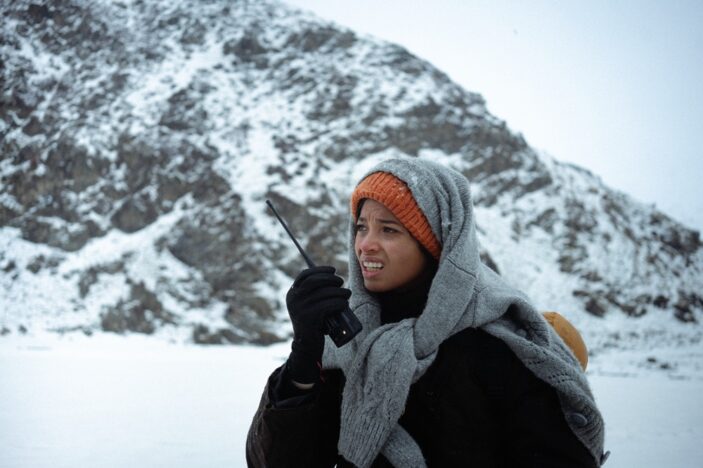
Desperate to save her sister, Abby (Ella Balinska) takes a dangerous job in the remote Georgian wilderness. Stranded in the mountains after her helicopter crashes, she finds hope through a mysterious helper radioing from nearby. As he guides her through the harsh conditions, Abby struggles to survive, and her grip on reality falters until she is faced with an impossible choice.
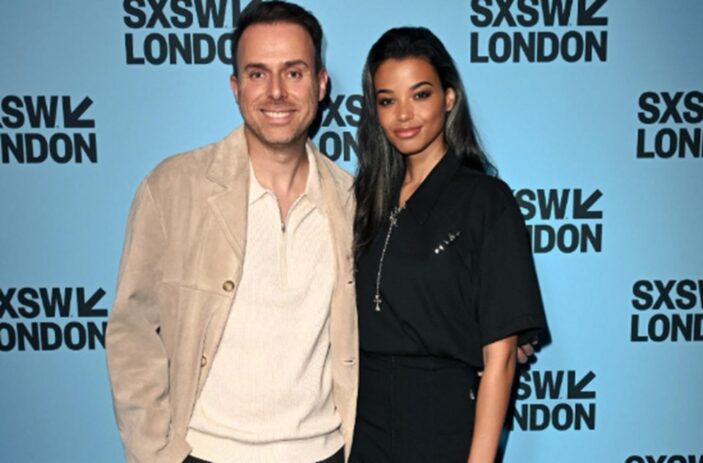
Directed and co-written by Hugo Keijzer, The Occupant is a harrowing survivalist thriller, with a distinct sci-fi edge, that takes a unique look at one’s own determination for survival in the face of torturous nature and lingering grief. Following screenings out of SXSW London this year, the film is set to arrive in both theatres and digitally in the United States on August 8th, and to coincide Peter Gray spoke with both Keijzer and Balinska about the emotional toll filming took on them and what surprised the other during the process.
I’ll ask you first Hugo, Abby’s physical survival is deeply connected to her emotional survival. There’s that desperation for her sister, isolation, the ambiguous helper, we’ll say. As a director, how did you want the landscape and the isolation to reflect her internal state? Did you see the wilderness as an antagonist, a mirror, or something else?
Hugo Keijzer: It’s a very interesting question. I think I always see genre as a really good way to explore human behaviour and the human condition. And with this film, which is essentially a drama about someone coming to the acceptance of something that’s very difficult to accept, how do you externalize that? And how do you take the viewer on board with that journey, that’s not just kind of happening inside somebody’s mind? And you have to externalize that. That’s why having all of these physical challenges and this confrontation with nature and with death really helps break down this character to the point that all that she has left is herself. Basically what you’re watching is a kitchen sink drama. But in this case, we took the kitchen sink and threw it into Georgia, in the snow and ice, because I think that’s the best way to reach a larger audience with a pretty difficult theme.
Sometimes, the whole throwing everything with the kitchen sink works! And it really, really worked with this. I’m going to say Ella, your performance in this is fantastic. So much of this film is you. And this character, she’s not just fighting the elements, she’s fighting time, and guilt, and grief, and her own mind. How did you access that raw desperation, while also maintaining her resilience? Was there a moment for you that was the hardest emotionally to get through?
Ella Balinska: Thank you. It means a lot, you saying that, to be honest with you. I remember the first day that I sat down with Hugo, and we’re in Georgia, and we were like, “Okay, what are we doing?” We were going out in three days to the Caucasus mountains…”Let’s figure this out.” I asked Hugo why he wrote this script, because there’s an emotional truth that I haven’t read in a long time within a script. And Hugo would be able to speak on this much better, more eloquently than I could, but he shared with me a couple of very real truths about the kind of intention behind this story and where it came from.
And that was kind of the moment where I was like, “You know what? We’ve got to just go all in here.” I remember telling him where I was in my life and how I was feeling about stuff, and we’re about to go set across this crazy endeavour. I’m number one on the film, and lead actor means you have to keep high spirits as best as you can and to motivate the crew, but I told Hugo that if I was with him and I was miserable, it’s probably because I’m miserable. No one person wants to be in this situation. But let’s use that. Let’s really not try and pretend to do this whole “performing” thing when you arrive on set. I wanted to be real with him and how I was feeling that day. And how could we channel that into the character? I would be lying if I didn’t say every single day I woke up and was like, “Damn, okay, here we go.” I think that, truthfully, was almost every day. Every day was super hard, regardless of the physicality of it.
The physical side of the Caucasus mountains just depends on how fit you are, to be honest. But the resilience aspect is having to channel these emotions (and) remember why you’re doing it. This character, she’s not saving the world. Most of the time, you have these big plane crashes and helicopter crashes, and they’ve got to save the planet because they’ve got to give a doctor some serum, or something like that. This is a very quiet, humble, quite painful and very real struggle for this character, and she’s not saving the world by any means. And I think because it was so humbling and so truthful and quiet in that nature, that was the element that really grounded everything in that way that you’re describing. It’s so easy to get tropey and be like, “Oh, there’s an avalanche,” (but here) there’s no avalanche moments. Instead it’s emotional avalanche moments, where you suddenly realise what’s going on and what (my character) might have to do and change about her perception. That was quite a long way to say it was just really emotional (laughs).
You’re saying that your character wasn’t saving the world, but she’s saving her world, really. It was really beautiful to see how layered everything is. For the both of you, Ella, was there something that Hugo gave you as a director that unlocked Abby for you? And Hugo, what surprised you the most about the way Ella inhabited Abby for you?
Hugo Keijzer: Because the way that we shot this all on location, which in hindsight maybe not have been the smartest decision, but we somehow felt like we had to do it. We had to really go to these actual places, way up north in the Caucasus mountains in the winter time, and because we shot it at the end of the season, we had to reverse the shooting order almost. We had to start with the biggest stuff on the ice lake and all the really terrible cold stuff where Ella goes into the lake, for example, and then we work our way back to the more emotional family scenes that we shot in Ireland. That gave me the opportunity to work with Ella by really throwing her into these circumstances, and from there slowly peel away and get to the little girl that’s inside Abby that has to come to a decision that will mature her as a person, in a sense.
When it comes to somebody’s inevitable death, everybody’s always focused on survival. But if a person accepts their own death, then something else starts to play (with) what is the meaning of the time that you still can spend together? And that’s a much more intangible truth. To arrive there, I think that was really nice to go through all these layers with Ella, because she is such a gifted actress who, when it comes to the technical side of it, completely blew me away. Shooting in the real snow meant we only had one shot to do it, otherwise we had to move the whole set, like 300 metres to the right. Yeah, we would move the snow continuity! So we talked through the scenes, beat by beat, and one the first (take), she just nails it. I was so thankful that somebody so skilled and so experienced was on this film, and then was able to go on this emotional journey as well.
Ella Balinska: That’s interesting for me to hear. I would say for you, the thing that I really loved and appreciated was the fact that you allowed me to be that technical actor. You allowed me to do my process. Then the bit that I love and hate you for is that the second I’m in the process, and you’re like, “Okay, we’ve got everything we need,” you would then fully push me to the absolute edge of the cliff, metaphorically, of this heightened emotional state. I think there’s a safety that I’ve known on set where it’s just I’ve done my (take) nine times out of 10. The cast would need to go again, or the camera-something, or the lighting-something, and I would just do the same thing again. We wouldn’t do that. We had one shot at doing it. Hugo would push me really hard. Not a lot of directors have the bravery to push, not just another actor, but another human being to really feel those emotions. I think Hugo is a very resourceful director, which is really cool to work with.
The Occupant is available On Digital and screening in select theatres in the United States from August 8th, 2025, before releasing On Digital in Australia and New Zealand on September 3rd.
