

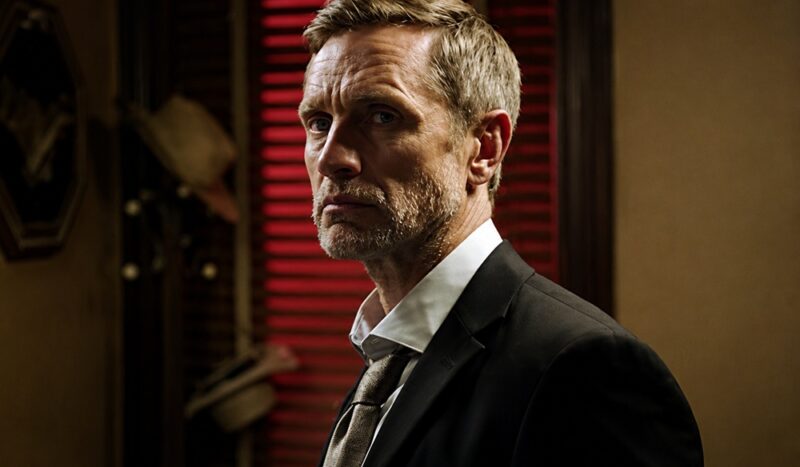
There’s a necessary emotional armour that comes with spending your life staring at the worst things human beings can do. In The Girl in the River, Devon Sawa’s seasoned criminologist has learned to treat death, violence and unimaginable crime as simply part of the job. But when that carefully cultivated detachment is shattered by the loss of his own child, the line between professional discipline and emotional self-preservation becomes increasingly difficult to maintain.
Drawn to a remote town alongside a forensic psychologist (Maggie Grace) to investigate the murder of a young girl and the disappearance of her twin sister, he approaches the case with an unsettling pragmatism: hope can be dangerous, feelings can cloud judgement, and experience has taught him to prepare for the worst.
In conversation with our Peter Gray ahead of the film’s release, Sawa discusses using real-life experience to shape his performance, why he deliberately approached the missing-child investigation with a grim lack of optimism, his fascination with criminology, and why – unlike his character – he has absolutely no plans to walk away from his profession, even if it means playing Santa Claus in a Hallmark movie at 95.
Your character says that business and feelings don’t mix. We know he’s lost a child himself. Did you see that belief as genuine professional discipline, or almost like a mantra that he’s created because he knows what happens if he allows a case involving a child to become personal?
He’s been doing this for so long that he’s almost numb to death, to crime scenes, to blood, to the chaos of what he does…until his son dies. And that’s it. That’s the kind of slap across the face that wakes him up and says to him, “I can’t be involved in this anymore. This is it. I gotta get out.” This particular case is his exit plan, if you will. That how I look at this character.
There’s almost a cruelty in this case finding him, because he’s being asked to remain objective about a murdered child and her missing sister when he knows a version of that grief immediately. How much is he investigating what happened to these girls and how much is he unknowingly confronting his own loss through it?
He’s doing both. He wants to solve this case, and he wants to do it by the books. He wants to do it properly. That’s who he is; that’s in his DNA. He’s driven by the fact that this is going to get him out of where he is, and he’s able to keep the blinders on and just do the job.
When someone has experienced the loss of a child, I imagine there’s a before and after with how much they want to see the world. Did you think about who this man was as a criminologist before that loss and the criminologist he became afterwards?
That’s what I mean when I say that, before the loss of his child, there was a numbness. You look at where Pembroke (Maggie Grace’s character) is right now – she’s very new to it, so she might be taking everything a little more personally and letting it get into her personal life. Whereas he had developed this method of keeping it professional.
The death of your own child is one of the most horrific things to even think about, and he had developed a way of not thinking about that possibility. He could just look at it as a job and a business, as crazy as that sounds. Until his son dies. That’s the straw that breaks the camel’s back. He’s like, “I can’t do this anymore. I gotta go. I gotta go rent snorkels in Hawaii now. That’s what I’m gonna do.”
What interested me about that “business and feelings don’t mix” mentality is that feelings are already there in the room before your character arrives at the case. Is the tension for him less about keeping emotion out and more about convincing everyone, including himself, that he has?
I worked on another movie a long time ago, and about a week before we started, we met a homicide detective who showed us different crime-scene photographs and talked us through them. The way he discussed everything was almost robotic. There was no emotion; it was all very matter-of-fact. I thought about that a lot with this character. He showed us a picture of somebody who had died by suicide, lying on a train track, and we were all like, “Oh my God, this is horrific.” But to him, it was just Monday. “This is what happened Monday. This is what happened Tuesday. This is what happened Wednesday.” He was very stoic about it.
His name was Gary – I remember that – and I tried to emulate Gary as much as I could when thinking about this character. Then I thought, what would happen if Gary’s child was murdered? Suddenly you’re conflicted, because it can’t just be business anymore. This is real now. This death is real. I’ve never really spoken about Gary before (laughs), but he’s really who I thought about – just remembering how stoic and matter-of-fact he was when talking about these horrific incidents.
Gary wasn’t assisting you on Heart Eyes was he?
(Laughs) No, Gary was part of a movie called Endure that I did with Judd Nelson way back in 2008 or 2009. The movie was what it was, but I learned a lot from Gary. He’s a retired homicide detective from Northern Florida – Lakeland, Florida, to be specific. Shout out to Gary!
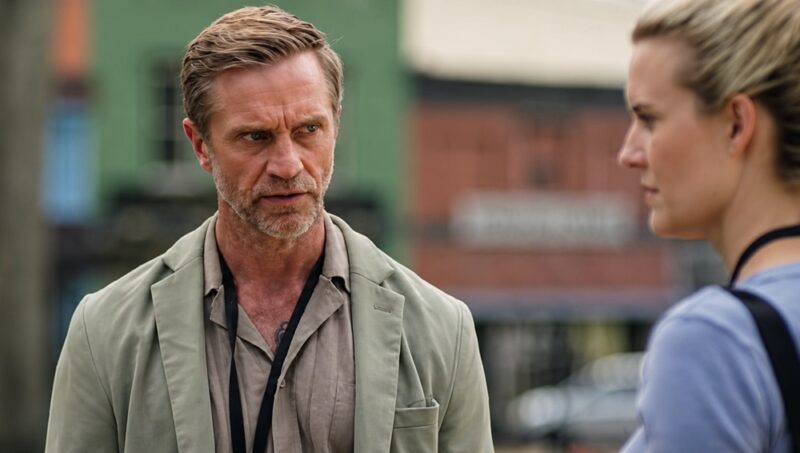
When it comes to these cases, there’s still a sense of hope. When it’s a missing child, there is that hope – however fragile – that they can be found. Whereas a murdered child represents something irreversible. Given your character’s history, do you think those two sides of the case affect him differently?
It’s interesting you should ask that, because I made a conscious choice that he just assumes he’s looking for a dead child. That’s the business of it. That’s statistically what usually happens, so you can’t get too emotionally attached. That’s what he’s trying to relay to Pembroke: statistically, if we find this child, we’re probably going to find them dead, and probably in a horrific way.
And without giving anything away, there’s obviously a certain character that reveals themselves to be behind everything. Was it one of those cases of reading the script where you were surprised as to the reveal? And then you’re almost having to actively not interact with them on screen in a manner that gives anything away?
Yeah, good question. I’ve talked a little bit about this, but one of the things I loved about the script was that, by page 20 or 25, I wanted to flip to the back. I wanted to know if I was right. I didn’t, but I knew right then that if I was that engaged and wanted to see if I’d figured it out, that might translate to audiences and they might be doing the same thing. I watched it with my family, and I remember my son guessing, my wife guessing, and my little girl guessing. One of them got it right.
Your character’s professional requires him to crawl inside the mind of the person responsible. But his history gives him this emotional connection to people left behind. As an actor, which side was important to you? The criminologist trying to understand the perpetrator or the father who understands the devastation?
As an actor, I was more fascinated with the criminologist side of it. I’ve always been a big fan of The Silence of the Lambs, Manhunter, those kinds of books. Especially when Pembroke starts talking about things like, “Your dog bit your shoe,” and how one piece of evidence leads to another – that stuff really fascinates me.
While shooting the movie, I don’t know how audiences are going to respond, but personally I really enjoyed doing that kind of stuff: the interrogations, this evidence leads to that, and that leads to this. It’s also very challenging as an actor because you don’t shoot things in sequence. You have to trust that the director has everything right, because you’re saying lines on day one that relate to something you might shoot much later, and then suddenly you’re jumping back to the beginning. You just have to trust that his blueprint all makes sense, because if it doesn’t, we’re in trouble.
And you’ve obviously been working since you were incredibly young. You understand longevity in a way that I feel few actors really do. When you’re playing someone whose authority comes from decades of experience, are you able to draw upon your own sense of having been around long enough to trust your own instincts?
As far as longevity, there’s a lot of luck involved in this business. There really is no handbook for it. People mention that I’ve been doing this for so long, and I feel very blessed and lucky to still be doing it. But I don’t really look at what I’m doing the same way as what he’s doing, because he genuinely wants out. That’s his goal. He wants out of what he’s doing because it’s eating him alive. Whereas I don’t ever want out of what I’m doing. I hope I’m 95-years-old playing Santa Claus in a Hallmark movie (laughs). I just want to keep doing what I do.
Before letting you go – maybe this will be a bit of a philosophical swing – I wanted to ask, because we like to believe that understanding evil somehow gives us power over it. Having played someone whose entire profession is built around trying to understand why people do terrible things, did this film leave you thinking that understanding someone actually makes them less frightening?
I think the people who do this particular kind of work have a better understanding of it. They’re able to put some sort of science behind why people commit these evil acts. I recently rewatched Manhunter, and the main character looks at everything differently. He almost gets inside their heads to figure out the crimes, and I think that’s what these characters do too. They get into the minds of these psychopaths and try to understand why they do what they do. That’s how they get to the next piece of evidence or figure out how different pieces fit together. They definitely see it differently than those of us who sit around watching crime documentaries on YouTube thinking, “Oh my God, I could do that.” They’re more Gary and less Devon (laughs).
The Girl in the River is in theatres and on Digital in the United States from September 4th, 2026.
