
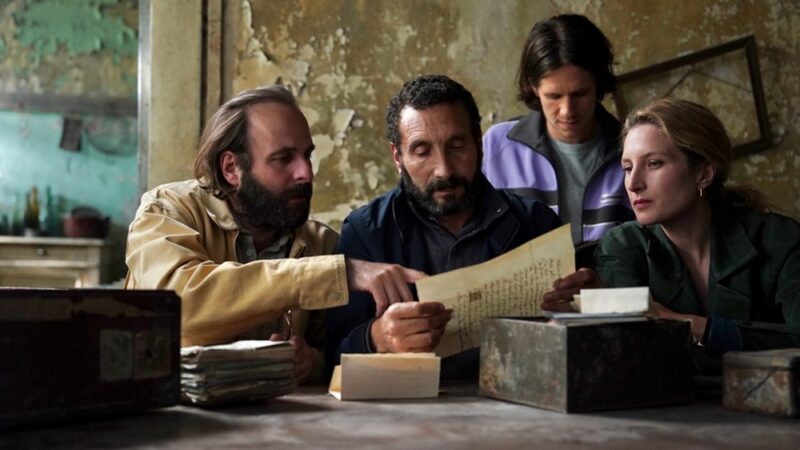
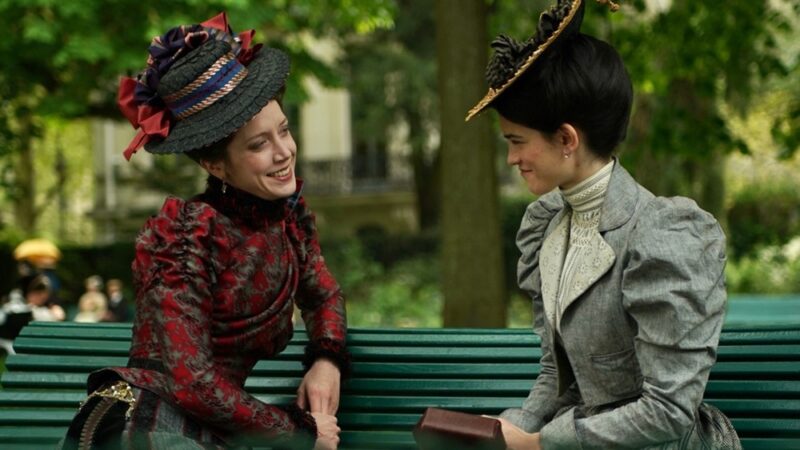
When Cédric Klapisch makes a film about time, he doesn’t treat it as something fixed or distant. Instead, it becomes something fluid – memories bleeding into the present, generations speaking to each other across decades. His latest film, Colours of Time, screening at the Alliance Française French Film Festival, begins with a simple discovery: in 2025, nearly thirty strangers learn they share a single ancestor, a young woman named Adèle Meunier (Suzanne Lindon). When four of them travel to an abandoned house in Normandy that once belonged to her, the past slowly begins to surface. Moving between 2025 and 1895 – when Adèle leaves the countryside for a Paris alive with invention, early photography and the birth of Impressionism – Klapisch crafts a luminous meditation on family, inheritance and the invisible threads that connect generations.
Our Peter Gray spoke with the director about cinema’s unique relationship with time, the emotional legacies we inherit, and how looking back at the past can sometimes help us better understand the present.
I’ll first say congratulations on the film. As someone who loves watching movies, it’s always exciting to see something new. I feel like we don’t get as many original stories these days, so it’s refreshing when something like this comes along. I wanted to ask about the way the film deals with time, memory, and generations. Because the story connects 2024 with 1895 through one family, what do you feel cinema allows us to do with time that history books can’t?
It’s a bit like the difference between documentary and fiction. When you make a documentary about a period, you’re explaining it to people’s brains – you’re telling them what that time was like. Fiction works differently. It doesn’t really go through the brain first; it speaks to something more emotional. You’re asking the audience, “If you could go to that period, what would it feel like?“
So you’re trying to convey emotions and sensations rather than information. A film like this has a part that is very documented – you learn about the history of art or about what was happening in 1895 – but it’s not just historical information. It’s something more experiential.
I guess that leads to another question: what interests you more – the way the past shapes the present, or the way the present reinterprets the past?
It’s really a mixture of both. My co-writer is also a novelist, and he loves Proust. In France, Proust is kind of the champion of mixing time – past, present, and future all together. He says they’re not as separate as we think they are. When you go back in time in a story, you meet people who are thinking about their future. Maybe they want children. Then the grandchildren in the present are thinking about those same people who were imagining the future. It becomes a kind of game with time. We know, rationally, that the past is the past, the present is now, and the future doesn’t exist yet. But in storytelling, you can mix those three things together, and that’s very playful and enjoyable.
Visually, the film feels very distinct between the two eras. There’s almost a different visual language. How did you and your cinematographer, Alexis, approach separating the timelines?
From the beginning, we knew it would be impossible to give 1895 a very digital look. We tried to invent a way of portraying that period through a different image process. We were inspired by the first colour photography, called Autochrome. Strangely enough, it was made using potato starch in real life. The colours from that process are very specific – they’re saturated but also pastel at the same time, which is a very unusual combination. Film stock never really captured that look properly, so we tried to recreate it digitally with colour grading and visual effects. The result is an image that’s in colour, but still feels ancient.
The film also deals a lot with family and inheritance. What do you think we truly inherit from our ancestors? Is it stories, trauma, freedom, illusions?
I think it’s all of that. We inherit many things from our family – not only from our parents, but even from grandparents or earlier generations. Psychoanalysis talks about this idea that you can carry traumas from previous generations without even knowing the story behind them. You might repeat patterns that started long before you were born. When we talk about heritage, we often think about money. But heritage is also values, stories, ways of living. Maybe people in your family divorced a lot, or went through wars, or always lived in the countryside instead of cities. These things shape the values that are passed down. Many people aren’t even aware of how much they inherit in this way, which is why it’s interesting to ask, “Where does it all come from?”
You mentioned writing the script earlier, and the film was shot in places like Normandy and Paris – locations that are saturated with history. Did the locations influence the script as much as the script influenced the locations?
Very much so. The locations influence the script a lot. The film talks about Claude Monet, and we went to many of the places he painted. It’s quite incredible when you realise you’re looking for the same things he looked at, but in a different time. You watch the sea in Normandy, the particular light there – the light is very special in that region. You look at nature across different seasons. And then you go to places like the train station in Paris, the Gare Saint-Lazare, which Monet painted.
At one point, I recreated the exact framing he used in one of his paintings. You’re almost following in his footsteps, trying to understand why he framed something a certain way. Of course, we’re doing it in modern times, with electricity and many things that didn’t exist then. But comparing those moments is fascinating.
Did spending so much time in those spaces change the way you thought about time, art, or legacy?
Yes, it influenced me a lot. I used many photographs and paintings from that period as references, especially from the Impressionists. When you spend that much time looking at the art of another era, you begin to feel like you’re part of a long artistic process. You’re working in your own time, but you’re also inheriting the ways that other artists looked at the world before you.
Your films often explore youth, movement, and modern life. What made you want to look backwards with this one?
It’s actually like a line in the film. A young character says, “I’ve always looked forward, and I’m glad I looked back.” Writing the script pushed me to go to museums, read books, study paintings, and look at photographs from that time. Engaging with the past was surprisingly refreshing when creating something new. It’s funny, because dealing with the past doesn’t feel like a museum exercise. It feels very alive, very creative. In a strange way, looking backwards can bring you somewhere very contemporary.
Did the process make you think differently about your own family history?
Yes, in a way it did. My grandparents on my mother’s side died during the war, and my grandfather had created a photo album. Before making this movie, I had never really looked at it. The film pushed me to finally open it. And it was very moving.
Is there a particular emotion you want audiences to leave the film with – nostalgia, reconciliation, unease?
I don’t think I’m very nostalgic. I don’t regret the past, I actually think today is better in many ways. For me, the film is more about enjoying time and marking it. Cinema, like photography, freezes a moment. When you take a picture, you capture something from today. So the idea is to enjoy the present while remembering that the present itself is a mixture of past, present, and future.
Because the film moves between those three ideas – past, present, and future – do you feel it reflects your own place in time as a filmmaker?
You never really know what a film will leave with the audience. But something that made me very happy was seeing how it connected different generations. Many people came to see it with their families. You’d have ten-year-olds, teenagers, parents, and grandparents all watching together, and everyone seemed to respond to it. Some young people even told me afterwards that they didn’t look at their grandparents the same way after seeing the film. That was very joyful for me.
Was there a film you saw with your own parents or grandparents that made you look at them differently?
I think so. When you’re a child, you often forget that your grandparents were once children themselves. There’s a funny dynamic in our film: the four cousins call Suzanne Lindon’s character “grandma,” but she’s only twenty years old in those scenes. So you have these fifty-year-old actors calling a young woman “grandma.” It’s a reminder that when we say “grandmother,” we imagine someone old. But if you show her at twenty, suddenly you see her life differently.
Lastly, is there still a question about time or family that you feel cinema hasn’t answered for you yet?
I think this kind of story is still quite new. Our film is roughly half set in 1895 and half in 2025. There aren’t many films that divide time so equally between two periods. For example, in Midnight in Paris, Woody Allen spends maybe ten or twenty percent of the film in the past. Titanic also uses two timelines, but the present-day section is very small.
So there are films that move between eras, but rarely with equal weight. I think it’s an exciting genre that could still be explored much more – many stories could come from putting two periods face to face.
Colours of Time is screening as part of this year’s Alliance Française French Film Festival, running across major Australian cities between March 5th and April 8th, 2026.
