

There’s an inherent contradiction in committing live theatre to film. Part of the magic of the stage is its impermanence: every performance exists for one audience, on one night, with subtle variations that can never be entirely replicated. Put cameras in the room, however, and that fleeting experience suddenly becomes permanent.
It’s a contradiction that feels particularly fitting for Hadestown, a musical built around the idea of telling an old story again and again, even when we already know how it ends.
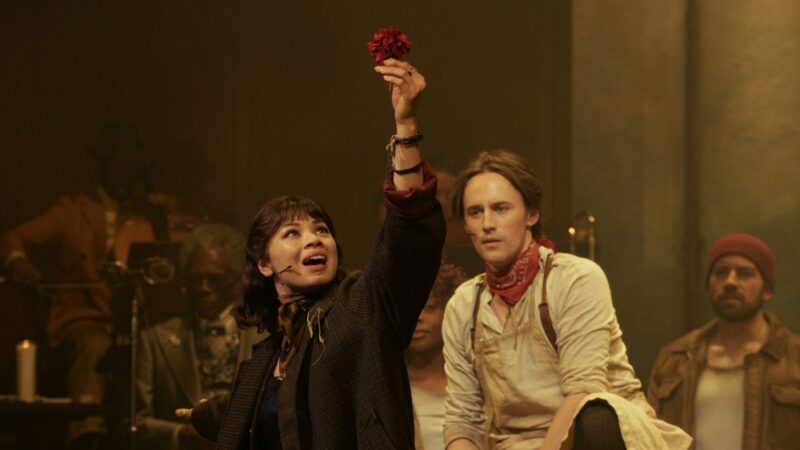
Winner of eight Tony Awards, including Best Musical, Anaïs Mitchell’s acclaimed reimagining of the myths of Orpheus and Eurydice and Hades and Persephone has now made the journey from stage to screen with Hadestown: The Musical. Filmed live at London’s Lyric Theatre, the cinematic presentation reunites original Broadway principals Reeve Carney, Eva Noblezada, André De Shields, Amber Gray and Patrick Page, preserving their celebrated performances whilst giving audiences a perspective no theatre seat ever could.
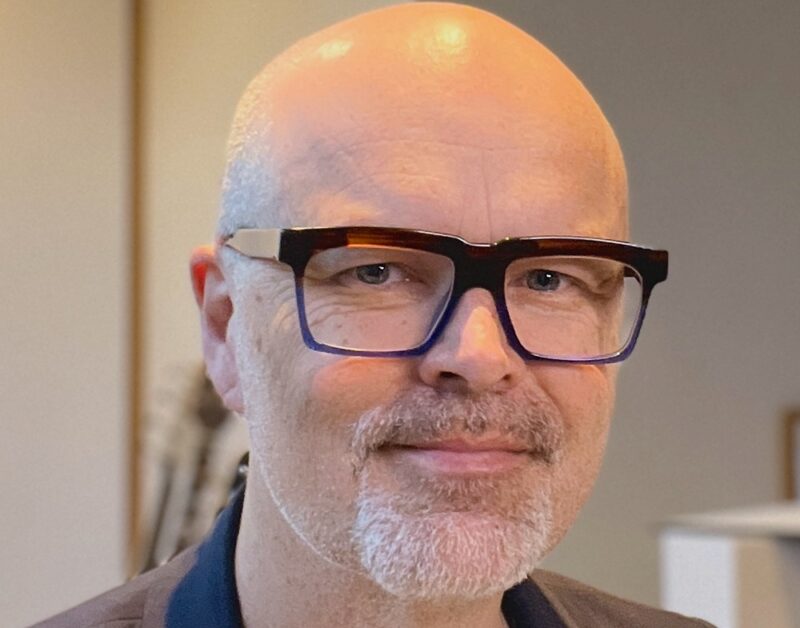
Charged with finding that balance is Australian director Brett Sullivan, whose extensive work capturing productions such as Billy Elliot, Newsies and Frozen has helped redefine what a theatrical pro-shot can be. Rather than simply placing cameras at the back of the auditorium and documenting what happens on stage, Sullivan takes them inside the production itself – moving amongst its performers, descending from the ceiling and finding intimate expressions amid Rachel Chavkin’s famously kinetic staging.
Speaking with Peter Gray ahead of the film’s release, Sullivan reflected on reuniting with Eva Noblezada more than a decade after documenting her journey to Miss Saigon, the last-minute uncertainty surrounding Patrick Page’s torn Achilles, putting his camera crew under the same one-take pressure as live performers, and why he doesn’t consider this the definitive Hadestown, but simply one version of a show designed to live differently every night.
I know you started out in Sydney, shooting rock videos and working with indie bands, and now you’ve become, I’d say, one of the definitive custodians of modern musical theatre on screen. When you’re standing in a theatre like the Lyric in London, surrounded by multicam rigs and looking at this Tony Award-winning cast, does the kid from Sydney who co-founded Steam Motion ever pinch himself? Or does your brain immediately revert to pure rhythm, lighting and frame rates?
I think immediately it’s panic mode. It’s quite a daunting task, and it’s funny because it only really dawns on me afterwards, at the end of the shoot. You’re going home that night, you’re in a cab or whatever, and it’s like, “Okay, what a journey.” You know what I mean? It’s that moment where you think, “This feels pretty special.” I’m very lucky to work with amazing talent and incredible actors, directors, choreographers and producers, and it’s been quite a journey to get there. So, yeah, it’s absolutely that reality check of, “I’m pretty lucky to have a go at this.”
Well, mentioning talent, I know you directed Eva (Noblezada) when she was practically a kid, making her West End debut in Miss Saigon over a decade ago, and now you’re capturing her as this seasoned Broadway heavyweight. What did you notice about the way she commands the lens now compared to back then? And did the two of you have a creative shorthand that picked up right where you left off?
I mean, it was great to see it in the rehearsals straight away because we documented Eva literally leaving home to do Miss Saigon when Cameron Mackintosh cast her, and then working on Saigon. She was just thrust into this huge situation, this massive show, at a very young age, and she was obviously incredibly talented even then. So, to come back 10 years later, she’s a powerhouse. She knows who she is, she knows how to perform, and she knows how to calibrate for the cameras. It was a really easy pick-up to rejoin with Eva, and certainly that Saigon experience was great to have between us. And she just delivers an incredible performance in this film.
And you’re reuniting all five original principals, which I imagine is almost like capturing lightning in a bottle. When you have a cast who’ve played these beats hundreds of times, what’s your role in the room? Where are you nudging their performances to accommodate the intimacy of a 4K camera, and where do you step back and simply let that alchemy happen?
It’s a good question. I think that’s the trick to it: honouring the live experience, but at the same time leaning into cinematic conventions. I really like to get close and see the actors’ eyes, because that’s something we understand on screen. But when you go to see a show, it’s essentially a constant wide shot. This is being built for the screen. I think the thing that really came to the fore was that, for these original five actors, it’s in their blood. They made this show. With Rachel Chavkin, who is the stage director, and Anaïs Mitchell, who wrote it, they developed it for a long time to get it where it was.
So, reuniting them after they’d had some time away from the show, all of that past experience was brought to the fore. There was this added layer of depth to everything they brought, but there was a freshness to it as well because they hadn’t done it for a while. So, yeah, there’s a little nudge here and there, but good actors know how to calibrate for the camera as well. They know how to dance that line between playing out to the rafters and also delivering those more intimate moments.
Well, talking of Rachel, the staging is so famously kinetic. You have the swinging lamps in “Wait for Me,” the turntable, the centre trap door – and you’re placing cameras in positions that regular theatregoers could never experience, like inside the lift shaft looking up at the characters. How did you plan those shots without breaking the illusion or interfering with the mechanics and safety of the show?
Yeah, for things that are literally going to get in the way, like having cameras on stage, we’ll do specific setups, and then the trick is marrying that with the actual live performance. So there are a certain number of days where we’ll get in there and put cameras very close or in unusual positions. We also had a camera that dropped from the ceiling, and that happened mid-show, so everyone was briefed beforehand. After a few days, the actors develop a bit of a Spidey sense for where the cameras are.
But the trick is, yes, there’s a little bit of re-blocking and restaging to make it work. David Neumann, who was the choreographer, helped with that as well. It’s quite an intimate stage, so there’s not a lot of space. Everyone has to dance around the cameras a little bit.
And I know Patrick (Page) was dealing with a torn Achilles, which meant incorporating this custom medical boot, the dog-headed cane and modified choreography – and you ultimately only had two performances with him rather than three. From an editorial and shot-planning standpoint, how close to the wire did that put you? And did that physical limitation ultimately add an unexpected layer of gravitas to his Hades?
I mean, it was very down to the wire as to whether he was going to do it or not. It happened during rehearsal, which was only a week out, so it was literally 48 hours, if not less, before we got the green light that Patrick was going to do this.
But then we leaned into it, and he leaned into it. It became part of his character and almost made him, not monster-like, but certainly kind of half-machine-like. He really embraced it, and I thought, “Okay, I’m not going to shy away from this big boot he has. I’m going to film that boot. Let’s understand what it actually is.”
So I think it was great that he leaned into it and just went with it.
The foundational message of Hadestown is this paradox of singing an old song even when you know how it turns out – there’s something beautiful in that fleeting act of trying. As someone who has spent his career preserving temporary stage magic as permanent cinematic artefacts, how do you wrestle with freezing a show that, by its very nature, is designed to change every single night?
Yeah, good question. You know what? This is a version of Hadestown. The live version changes every single night, and this just happens to be one version of it. That’s the way I view it, and it just happens to be the version I was involved with. Theatre is different every single night. The film is locked, but it’s simply one version of what the show can be.
In theatre, an audience member ultimately chooses where to focus their attention, whereas in film, the director makes that choice for them. During those more intense musical numbers, how did you balance capturing the kinetic chaos of the swinging lamps and turntables with the quieter, more intimate moments, like the subtle expressions on Orpheus’s face?
I always view the reactions of the characters as being just as important as whoever is singing or talking. It’s more of a dramatic convention – seeing the effect that something is having on another character.
In this particular case, we used a lot of deep two-shots, where you have two people in the frame. The person in the foreground might be singing while someone else is watching in the background, and then we switch focus between them. That way, we can keep the moment going without having to cut. I’m always looking for ways to reduce the edit as much as possible.
One of the songs, “Flowers,” which Eva performs, is just one take. The crane goes across the audience for the entire song. There are no cuts, and I knew from the beginning that was how we were going to film it. That was the only way we were going to shoot that song.
I think having something at stake is important. What the actors do every night on stage has something at stake because it’s live, and I wanted that for the film crew as well. You’ve got to throw them in the deep end and say, “You’ve got one go at this, and it’s one take.”
And just before I let you go, I feel like you’ve helped define the modern stage-to-screen genre, with Billy Elliot, Newsies, Frozen and so many others. What makes a pro-shot its own distinct art form, rather than simply a great documentary or a traditional narrative feature? And where do you think that art form sits today compared to when you first founded Steam Motion and Sound?
I think previously live shows were filmed more like a television experience, where the cameras were at the back of the room, so it tended to be more of a document of a moment. Whereas the moment you get three feet away from an actor and that camera is working in synergy with them, you’re stepping into the realms of film.
So I think what we’re doing is almost a hybrid. But it’s so important to always recognise that this is still actually happening live. All the vocals are live, everything is live, and the sound mix feels like we’re in the room. We’re not pretending to be a musical film, but we are stealing from some of those cinematic lensing conventions.
Hadestown: The Musical is screening in theatres in Australia for a limited engagement from October 13th, 2026. To find out where and when, head to the official site here.
