

A reimagining of Ang Lee’s acclaimed 1993 romantic comedy, The Wedding Banquet is a joyful, exuberant, fresh take on the genre, featuring a hilarious cast of multigenerational talent, headlined by Lily Gladstone and Bowen Yang.
Frustrated with his commitment-phobic boyfriend Chris, Min makes a proposal: a green-card marriage with their friend Angela in exchange for her wife Lee’s expensive IVF. Their plans are upended, however, when Min’s grandmother surprises them with an extravagant Korean wedding banquet to celebrate their nuptials.
Directed by Andrew Ahn (Fire Island), The Wedding Banquet is now charming audiences in Australian theatres (you can read our review here), and to celebrate, our Peter Gray spoke to the director about the pressure he felt in remaking such an important film, how his cast changed the script dynamic, and the decisions he specifically made to alter the under-representation of queer women of colour.
Do you remember the first time you saw The Wedding Banquet, the original, and how did it personally impact your approach to this remake?
Yeah, you know, Ang Lee’s The Wedding Banquet is the first gay film that I ever saw. It was a situation where my mom rented it, not knowing that it was a queer film, so we watched it as a family, and it feels incredibly meaningful to me that the first gay film that I ever saw was also a gay Asian film, and one that was told so beautifully. For that reason, it felt really full circle to have the honour and the privilege to reimagine the film for today. It put a lot of pressure on me (though). I put a lot of pressure on myself, because the original film is so beautiful and holds such a special place in my heart. But I also took a lot of that pressure off myself by really just focusing on telling a personal story that is meaningful to me today.
Were there any specific aspects of queer female identity that you wanted to bring forward that you feel are underexplored in cinema with this?
Yeah, sure. I think there’s a real question of motherhood that I think queer women, especially, have to explore and answer for themselves. I think that there’s a lot, whether it’s expectation or even biology, that dictate how they feel. I really wanted these characters to have different kind of journeys to motherhood and to really show the diversity of that experience. I think for me, I also wanted to create a found family that wasn’t all gay boys (laughs). Fire Island was so many gay boys, and I think that that’s very accurate for that story. And that’s one aspect of my life, but then I think about my queer community and it’s not just one gender. That was something that I wanted to show as well.
As you were saying about putting pressure on yourself, were there any non-negotiables for you in preserving the spirit of Ang Lee’s vision?
I knew that I wanted to have a wedding, and I feel like that was important. I also knew that I wanted to make it Korean, because I’m Korean, and that was one of my ways that I could make it my own. I really wanted to hold on to the storytelling philosophy of the original film. Ang Lee’s characters in (his) movie really feel like they exist outside of the bounds of that movie. I really wanted to show that same level of humanity. Really get that texture that these characters are human beings, and that we have the honour as an audience to get to watch them for a little while. But then they get to continue their lives after the movie ends.
I will say, without giving anything away, the final shot is beautiful and perfectly captures everything. It was such a nice send off. But obviously with preserving the spirit of the original, were there any aspects that you wanted to challenge or subvert? Whether that was tone, message or structure…
I definitely wanted to explore a different kind of aspect of family. The original film so beautifully explores fathers and sons. I don’t think I could tell that story any better. So I decided to talk about matriarchs, you know, mothers and grandmothers. And making that change also allowed me to work with two incredible actresses, Joan Chen and Youn Yuh-jung. I think something else that I really was interested in was examining options. I think one of the biggest changes since 1993 for the queer community is that we can get married now. We have that option. What is that burden of choice? In the original film they accidentally have a baby. What if we show characters trying to have a baby? So we’re talking about these options that these queer characters have now created, and it was exciting to explore that drama.
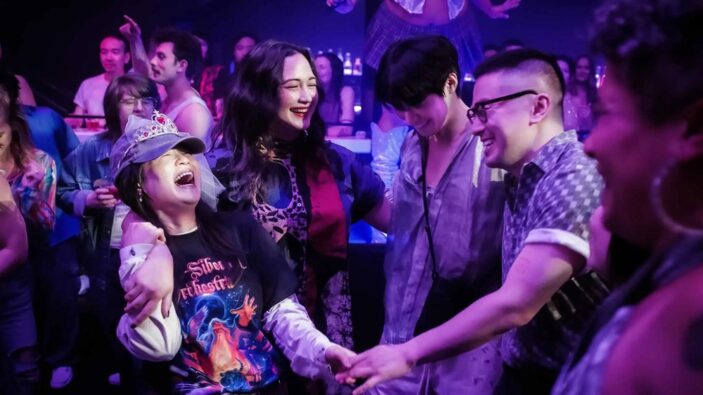
Mentioning the cast, here every character feels so lived in. We believe that these people know each other. Were there conversations with the cast that reshaped your own understanding of the story as you were telling it?
Oh, yeah, definitely. Lily Gladstone, it was her idea to make the character indigenous. She wanted to make the character Duwamish, and changed her character’s name to be Lee, short for Angeline, the name of Chief Seattle’s daughter, the Duwamish chief that Seattle is named after. And so that change really brought up questions of stewardship and the land. A feeling of home that was so important to the whole movie. I had a lot of conversations with Bowen Yang about millennial indecision and the roots of that, and how now we have options and how do we responsibly take them?
It was such a wonderfully collaborative process with my actors, and that was something I really wanted to establish from the get go. So even in our earliest casting conversations with each actor, I wanted them to feel that freedom to suggest authorship. To claim ownership over these characters. So one of the things that I did during our rehearsal process with each actor within the two couples, I had the couples create a secret together that they would never tell me, and that could be a tool that they use to just find the history and humanity of their relationships.
I love Bowen Yang, and because he was born in Brisbane we’re going to claim him as one of our own. And working with them, were there moments in rehearsal or early scenes where you saw an unexpected dynamic emerge between the actors? They either got along better than expected? Or they brought something different than what was on the page?
I really love the tenderness between Bowen’s character and Han Gi-chan’s character, Chris and Min. There’s a softness, a coziness to their relationship that I really love. That was something that we conceptualized on the page, but once I saw them in scenes together, (it) really felt so special. There’s a quick moment between the two of them (doing) their morning rituals of doing skincare that just feels very lived in. And then I do really love Bowen and Kelly Marie Tran together. Their friendship got even more kind of co-dependent and toxic in a way that they really enable each other to make bad decisions. I think that’s kind of part of the drama of the film. I think they had so much fun together. I could really see these two people as best friends. I love that dynamic. It’s one of the strengths of the film.
Mentioning Kelly Marie Tran and Lily Gladstone, I feel like queer women, and especially queer women of colour, are so under-represented, Were there specific choices made in casting to push back on that invisibility?
I really wanted to show a queer Asian woman, and that was a part of the screenplay from the beginning. And the character of Lee was written as an open ethnicity, but I was really interested in working with an actor of colour for that role. I think Lily just really embodied that character so beautifully. I really wanted someone who is in this frenzy of emotion from everybody else (and) she’s the grounding factor. That’s something that Lily does so beautifully and with so much humour. I think, for me, it was about that kind of emotional core that really led to that. And the bonus is that we have these two actresses getting to work together.
Queer stories matter. Representation matters. And I love that this film is continuing, I don’t want to say trend, but where queer characters are being treated and written like their sexuality isn’t just ticking off a box. It isn’t simply a quota. These are films that we can see our way into, and we need more of them. Thank you so much for creating these stories.
That means a lot to me. Thank you. I appreciate you chatting with me.
The Wedding Banquet is now screening in Australian theatres.
