
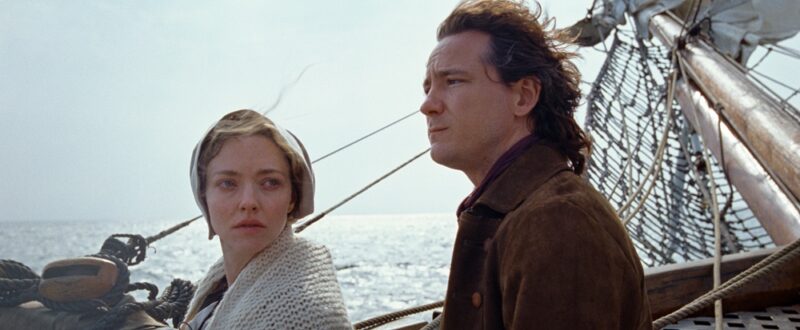
From the outside, The Testament of Ann Lee might sound like an unlikely cinematic proposition: a period biopic about the founder of the Shakers, structured as a musical, rooted in ecstatic song and movement rather than spectacle. But in the hands of writer-director Mona Fastvold and star Amanda Seyfried, the film becomes something far more urgent – a raw, genre-bending exploration of grief, faith, feminism, and the dangerous allure of absolute belief.
The film tells the extraordinary true story of Ann Lee, the 18th-century religious leader who founded the Shakers, a devotional sect defined by gender equality, communal living, and worship through song and dance. Seyfried plays Lee as both visionary and vessel, a woman who transformed profound personal trauma into doctrine, and doctrine into a radical form of salvation for thousands.
For Seyfried, the decision to take on the role was immediate. Known for carefully balancing her work with family life, she admits there are projects that require serious deliberation. This wasn’t one of them. “Mona asking me to play this insane role of a lifetime, I wasn’t deliberating,” she says. “I was just thinking, how do I make this work? I’m going to do this.” Some collaborators, she adds, are simply impossible to say no to, even when the challenge ahead isn’t fully clear yet.
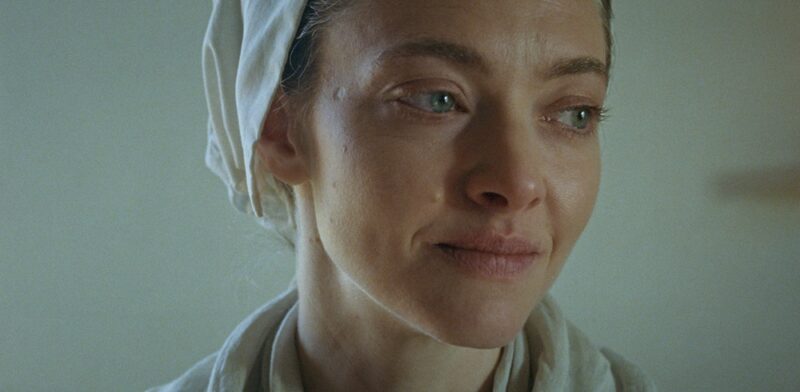
That challenge was immense. Ann Lee’s story is steeped in suffering – repeated imprisonment, violent persecution, and the devastating loss of her children – and yet her legacy is one of communal joy and ecstatic expression. Seyfried describes the psychological weight of the role as far more daunting than its physical demands. While learning choreography, lyrics, and movement was demanding, it was Lee’s grief that proved most difficult to inhabit. “Nothing is harder than trying to grapple with a character’s grief,” she explains. “To honor someone else’s pain, that’s a privilege, but it’s always the hardest part.”
Fastvold, whose previous films (The World to Come, The Brutalist) also explore interior lives within historical settings, is drawn to period storytelling not out of nostalgia, but necessity. For her, the past offers a clearer lens through which to examine the present. “I’m trying to understand my own time,” she says. “And I find it easier to do that by examining the past.” Distance allows clarity – a way to distill contemporary anxieties about power, gender, and belief without the noise of modern technology and immediacy.
That clarity is evident in how The Testament of Ann Lee approaches its musical elements. Unlike traditional Hollywood musicals, the songs here are not narrative embellishments or entertainment breaks. They are the story. Shaker worship was rooted in song and dance – a physical, communal expression of faith – and the film treats this with reverence rather than flourish. Seyfried, despite extensive experience in musicals, describes this as an entirely different discipline. “This music isn’t added to the story, it is the story,” she says. Singing becomes prayer; movement becomes survival.
Fastvold’s insistence on grounding these sequences in reality extended to the film’s technical choices. Shot on 35mm film and later blown up to 70mm, The Testament of Ann Lee uses scale not for grandeur, but for intimacy. The 70mm presentation, Fastvold explains, allowed for greater detail in darker scenes and large communal moments, capturing the physicality of bodies in motion and the tactile reality of lived-in spaces. Celluloid, for her, remains essential: “I love shooting on film. I love what it gives you in texture, depth, and presence.”
At its core, the film is also a meditation on power. Specifically, the discomfort society has long held with women who wield it. Both Seyfried and Fastvold point out that Ann Lee’s most “dangerous” quality was her unwavering belief in equality. A female religious leader preaching social and gender parity was incendiary in her time – and remains unsettling in many corners today. “Her ideas still feel dangerous to a lot of people,” Seyfried notes. “That hasn’t changed.”
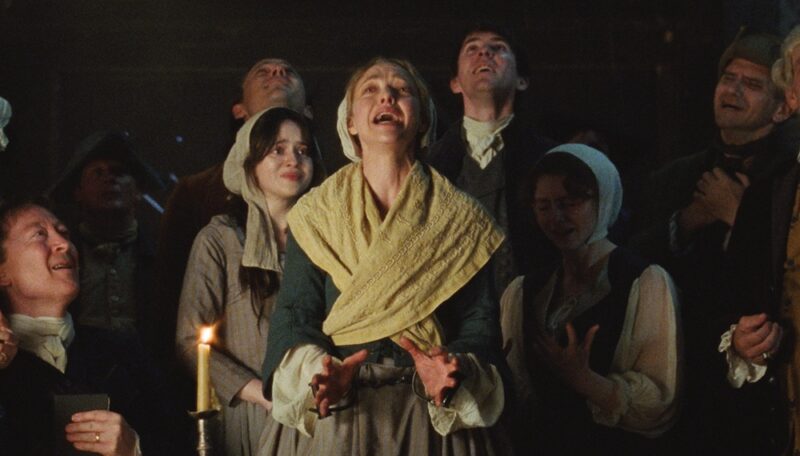
Fastvold was drawn to Ann Lee in part because history has largely erased her. In America, the Shakers are better known for their furniture than for the woman who built one of the largest utopian societies in the country’s history. At its peak, the movement had more than 6,000 followers. “This was a radical feminist, deeply complicated woman,” Fastvold says. “That’s a story worth telling — especially now.”
What makes The Testament of Ann Lee truly singular, however, is its refusal to sanctify its subject or treat her suffering with solemnity alone. The film embraces contradiction: grief and ecstasy, brutality and absurdity, devotion and doubt. Seyfried notes that Fastvold was determined to capture the strange humor that exists even in the darkest human experiences. “There are moments of pure hilarity,” she says. “It doesn’t take itself too seriously, even while dealing with very heavy things.”
That tonal bravery, combined with its fusion of biography, musical, and spiritual inquiry, makes the film feel almost unclassifiable, and, perhaps, nearly unmakeable. “Movies like this don’t get made,” Seyfried admits. “It was almost impossible.” And yet, against the odds, it exists. A film that bends genres, challenges assumptions, and insists that faith, like cinema, is most powerful when it is embodied, risky, and alive.
In a cinematic landscape often driven by safety and scale, The Testament of Ann Lee stands as something rare: a devotional act in itself – fiercely personal, defiantly strange, and deeply human.
The Testament of Ann Lee is screening in Australian theatres from February 26th, 2026, including 35mm and 70mm across select locations.
