

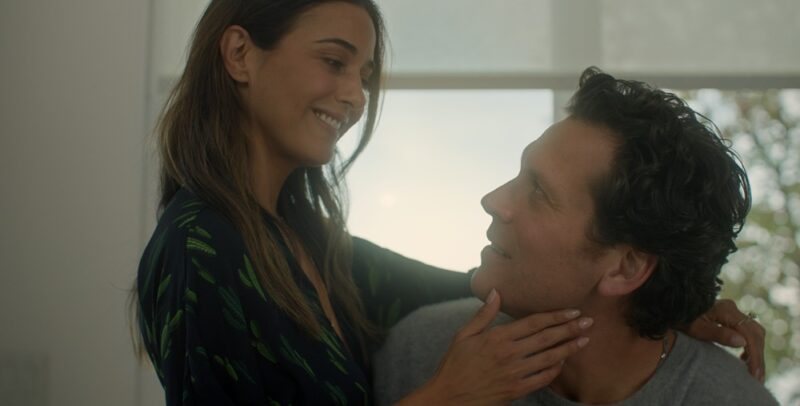
There’s something inherently voyeuristic about A Love Like This – a film that invites us to peer through the cracks of a relationship that perhaps isn’t meant to be seen. Set over one sun-drenched but emotionally volatile weekend in Malibu, the film follows Paul and Leah as they attempt to exist, however fleetingly, as a “normal” couple – despite the inconvenient truth that their love is built on secrecy, betrayal, and borrowed time.
Speaking with director John Asher and stars Emmanuelle Chriqui and Hayes MacArthur, it becomes clear that the film’s power lies not in judging its characters, but in understanding them. There’s a delicate tension at play – between fantasy and reality, desire and consequence – and the trio lean into that ambiguity, crafting a story that asks whether love, no matter how deep or consuming, can ever truly exist outside the moral boundaries that define it.
John, this film asks us to emotionally invest in this relationship that exists outside moral boundaries. There’s this tension between fantasy and intrusion throughout. Do you see the outside world as a kind of moral conscious pressing in on them? Or the inevitable collapse of an unsustainable reality?
John Asher: Wow, that’s an awesome question. I feel like we’re peering through the keyhole, and we’re allowed to look into a moment that maybe we shouldn’t be seeing. But if you are paying attention, you will truly see that they love each other. That’s the design.
Emmanuelle and Hayes, you have worked together on Super Troopers 2. There’s familiarity there. This film is so obviously very tonally worlds apart, but how did that prior working relationship inform, or complicate, the intimacy and emotional depth required here?
Emmanuelle Chriqui: I mean, for myself, there’s so many parts to this. Hayes and I worked together in Boston, and we had just such a great time. So when he joined (John and I) to make this movie, I was so excited. We know each other, we have a lot of people in common, but, also, Hayes is so hilarious, and there were so many moments of just joy and levity. It’s amazing how laughter can draw you closer. Even though we were shooting this really intense thing, the moments in between…there was a lot of joy in making this, which I think really informed our intimacy.
Hayes MacArthur: For me, I wouldn’t have told a story like this unless it was with Emmanuelle and John. I looked at it holistically as the whole script, and I saw what the shooting schedule would be, and I thought that whoever I was partnering with to tell this story…I’m going to pretend like Emmanielle is not in this interview room for a second, but she’s such a professional. Being able to jump from emotional scene to a scene of levity without having all those hours to prepare…she was just so game to do each scene in a moment. If I didn’t know the person that I was telling this story with before going into it, I would have been trepidatious. But because we had time in more of a levity setting, I was like, “Oh, yeah, we’re all just game to do this and jump right into every scene and every moment and use whatever’s happening to tell the story.” It wasn’t going to be a bunch of bullshit around it all. It was like, let’s get into this couple that have known each other forever, and they’ve been in love with each other forever, and then film it.
You can definitely tell that there’s history and chemistry there. Watching it, I just wanted you two to get together! And obviously one of the big things in the film is this mix tape. I wanted to ask all of you if there’s one song that you associate with a complicated or transformative love in your own lives?
Hayes MacArthur: That would be a MacGuffin? Isn’t that how you looked at it, John? (Laughs).
John Asher: Yeah, I mean there’s so many great songs out there. You’re asking me to pick one? Holy, man. So, Cody Lacey. There’s a scene in the film where (Hayes) talks to the liquor store owner about Cody Lacey. Cody Lacey in eight grade is a real gal. I still think about her to this day. And the song that I sent her was Van Halen’s “Why Can’t This Be Love?”
Emmanuelle Chriqui: Aww, that’s so great. I have one that the lyrics slay me. It’s Alicia Keys, and it’s called “Unthinkable.” And it’s like, “Do you have the courage to jump off the cliff, or don’t you?” That’s essentially the song. Yeah, that would be on my mix tape.
Hayes MacArthur: I’m thinking back to when we shot (the movie), because we would play music on set, and we would play music that we thought would be on this couple’s mix tape. I think we ended up with our Orchestral Manoeuvres in the Dark – the OMD – and that would have been on my mix tape when I was in high school.
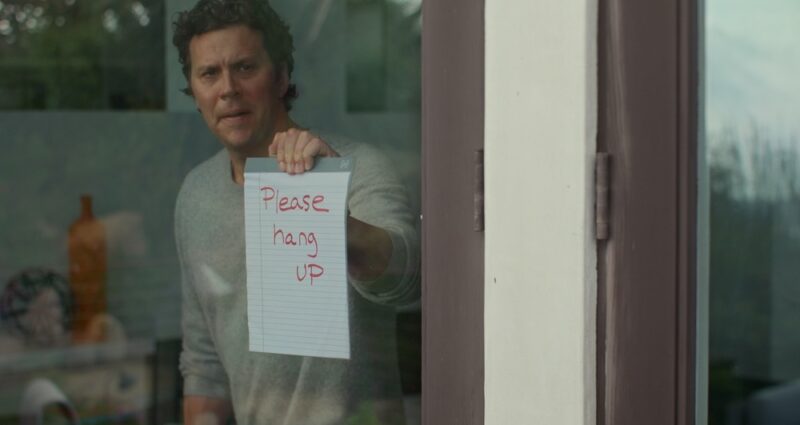
I was wondering if you were every going to play us the final song in the film. I thought maybe it was going to be left for us to decide. But when you hear that song, did you have the discussion as to who that song belonged to? Was it Paul? Leah? The relationship itself? And did that shape how you played the emotional beats knowing that it was their final song?
Hayes MacArthur: It’s a great question!
John Asher: I hate to say it’s left up to interpretation, but it is left up to interpretation. It’s supposed to leave you wanting more, and hopefully we can achieve that. That’s what I wanted to do.
It is nice to have this romantic story that could go in so many different ways. I left the film convinced they are back together. The looks they give each other, the passion in the arguments, that dress…these two absolutely belong together. And the film suggests that love can be both sincere and destructive at the same time. Do you personally believe that love is ever enough? Or is this illusion that the film is gently dismantling?
Hayes MacArthur: It’s interesting hearing your question. It feels like it’s coming from the point of view of a filmmaker, right? The overwhelming response that we’ve gotten in how it’s been received has been really cool, because filmmakers have seen it, and they have the same questions in their approach. The people I’ve talked with that have seen it are almost coming at it from the point of view of how they would execute it. And they all said we did it very specifically and spot on. That’s really cool to think of.
This is not a studio movie. These characters would be greenlit because of their circumstances. We just wanted it to be as real as possible in telling it. Hearing your question is almost as if you’re looking at from the perspective of if you had the script and how you would pull it off. That feels like a very spot on lens to look at it through.
Was there a scene for any of you that shifted the understandings of these characters midway through filming? Was there something Emmanuelle and Hayes brought to Leah and Paul that you weren’t expecting, John, and vice versa in terms of you thought you had these characters figured out, but a line or even a look changed the perspective?
John Asher: You know, so much went into the planning before the shoot that we knew what we were going to do. I will say that casting Hayes and him bringing the levity and that light, sweet smile and that vulnerability is what opened up the movie even more for me. I knew (Paul and Leah) were in love, but the second he started being sweet and charming, and I could see him kind of falling apart inside in places…I was like, “That’s what I want.”
I have to say it feels like me, but when you’re the director of the film, I have to identify with something. Emmanuelle is my Cody Lacey, and Hayes is me. And I’m balancing that. I’m like, “God, I wish I was in Malibu,” but then on Emmanuelle’s side, just the sheer strength that she has as a performer once the camera is rolling…
I’m watching the monitors and I’m just pulled in to her performance, and I don’t want to stop. I don’t even want to say cut, because she’s right there. She pulls Hayes in, and they’re locked into each other. You can feel it. Even when I was cutting (the film), they were just so honed in on each other. I’m going to cite this,(the scene where) she’s eating the hamburger in the car, shoving her face, you can feel her suppressing the sadness with food. Those moments really stood out to me. Cohesively, the whole film was assembled, and before I gave it to my producers – Emmanuelle and Hayes – I watched it by myself with my dog. I was praying and, you know, you get these moments where you get chills on your arms. I was like, “Okay, I have something.”
Emmanuelle Chriqui: Oh, John, that’s so beautiful. Like John said, we came in ready to just jump in and swim. But there was definitely, over the course of the 12, 13 days that we were shooting where I started to feel so protective. Like, the more that John, Hayes, and me (were there), I recognised these moments as really raw and really authentic. It did something to my heart. The whole experience was so moving.
Hayes MacArthur: The most real shit I’ve seen is when a couple has a huge, kind of climactic fight moment, where they show the worst sides to each other, and then stuff happens when they’re apart – and it’s the first time they are apart in the movie – and when they come back together, they’re like, “Where are we going to dinner?” They don’t talk about it. It’s a really special love story.
It really does feel like two people that we know. I think, in some capacity, we all have that one that got away, or the one that we hold onto in some capacity. And that’s what Paul and Leah represent.
I’m also going to keep the Emmanuelle love flowing by saying I love Wrong Turn! You’re so great in that.
Emmanuelle Chriqui: That’s old school! Wow. Thank you.
And just before I let you go – I promise I’ll let you all go – my final question is about the film and its timing. Did you have the conversation around if this story took place either 10 years earlier or later in Paul and Leah’s lives if their choices or courage would be different in any way?
John Asher: I’m sure. Yeah, of course. The more life we have, the more experience we have. Yeah, if it was 10 years prior, we would be catching them at a different time in their lives where you’re living by the seat of your pants, without any consequences, and then you move to where the movie takes place, where you’re still kind of right there. You’re vibrating, and you’re thinking how fun it is. “Let’s give this one more whirl.”
Then you go another 10 years, and you’re like, “Man, let’s not do this. This is hurting.” I think everything’s going to have an evolution as you grow mentally, for sure.
Hayes MacArthur: It’s fun to think of it like that. Like, what weekend are we joining them on? Where are we dropping into the story?
Emmanuelle Chriqui: That’s true. I don’t know if Hayes and John remember this, but, to me, I was always thinking that these two are finding their way back to each other. Even if it’s five years from now, 10 years from now, these two are finding their way back. I have always felt that way. From the second I read the script, that was imprinted in my brain, and I was really fighting for it a certain amount.
We were all on set every day watching each other’s stuff, and when I saw the scene where Hayes gets the painting…Oh, my God, just being a fly on the wall and watching Hayes and John do that. I was literally in tears just watching it unfold. I knew these two had to get back together. They have to.
A Love Like This is now available on Digital and On Demand in the United States.
