
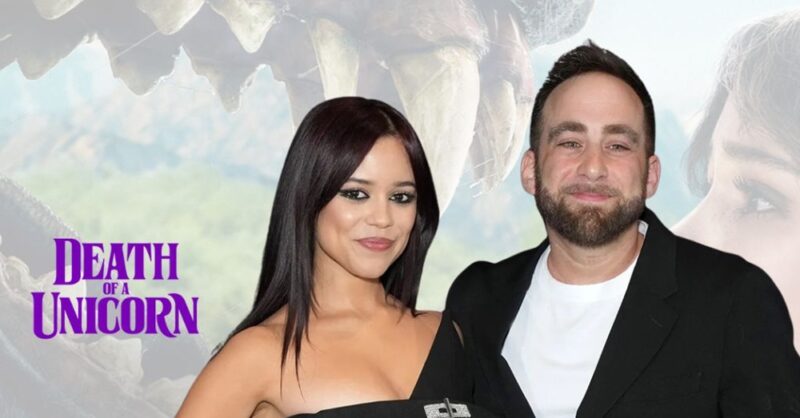
A movie that sells you exactly what it says on its genre blending box, Death of a Unicorn stars Paul Rudd and Jenna Ortega as a father/daughter duo who accidentally hit and kill a unicorn while en route to a weekend retreat, where his billionaire boss (Richard E. Grant) and his greedy family (Téa Leoni and Will Poulter) seek to exploit the creature’s miraculous curative properties.
Written and directed by Alex Scharfman, the film – described in our review as “a blackly comic creature feature that eats the rich and delights in mythological madness” – is set to be unleashed on Australian screens this week, and to coincide, our Peter Gray spoke with the filmmaker about lucking out with this cast, the genre films he references throughout, and his personal “North Stars” that he made sure to stick to during its production.
There’s so much to talk about with this film, but I have to talk about this cast straight up. Will Poulter is having an absolute moment right now. I don’t know anyone who doesn’t like Paul Rudd or Jenna Ortega. And I’m a massive Téa Leoni fan, so the fact that she’s back on screen makes me very happy. I think The Naked Truth is one of the greatest sitcoms that no one talks about! And I’ve spoken to writer/directors before who have different processes when it comes to casting and their idea of their characters. Some hear a voice or see the face of the characters they write, others have no one specific in mind. When it came to these characters, how was it for you that they came into your orbit?
That’s a great question. It’s kind of a mix. I can’t help myself. I put together lists of the people I think could do it. I did write Paul’s role for him explicitly. We had talked about another movie a few years ago that I had written, but wasn’t directing, and he liked my writing. We just got on so well, and it was one of those conversations that led me to think, “Oh, I should write something for him.” I did. And he read it.
With the other roles, I was kind of writing without a specific actor in mind, for the most part. At the same time, I had actors in mind, like three or four for each part. If this person couldn’t do it, then this other one could. That sorta thing. On this, I was incredibly blessed. I’m a huge fan of every actor in this movie, and they were all people who I had thought about for a long time for the roles.
Jenna is just an absolute force. She’s incredible. Richard (E. Grant), I’m a huge fan of. It’s actually funny, when Paul and I met, like, eight or nine years ago, we talked about our love of Withnail and I, so it was funny that when it came to casting Odell, we were all, like, “It’s Richard, right?” Odell, as a character, was what Richard referred to as being a gas bag. I refer maybe to loquacious or self aggrandizing, but it was always that thing of few people do it better than Richard.
And Téa was honestly a suggestion from our casting director, Avy Kaufman, who is a genius. It’s why you work with geniuses like Avy, because she knew Téa was thinking about starting to get back into work. She’s someone I love as a comic performer. I mean, as a performer in general, but I think her comic timing is second to none. And she took a lot of time off. She was doing television, and she took a few years off for herself, and didn’t really want to work. That’s why casting directors are geniuses though, they know who’s thinking about getting back into film, and Avy suggested Téa to me, and the second I heard that I knew it had to be her. It can’t be anyone but her.
It’s just the way she delivers certain lines. “Particularly girthsome,” was just said so specifically in a way that only she could say it. The way she says “Protrusion” too…
Protrusion, yeah. She’s such a good comic actor. She just makes great choices. Sometimes, with a word like “Protrusion”, she does this beautiful hand gesture as she’s trying to think of the word. And then with the “Girthsome” line, she’s eating a blackberry, and the timing of that is everything. There’s another line too where she swigs from a bottle of vodka, and she was so specific about the timing of the vodka to the dialogue, and getting the glug of the bottle coming down just right. You just realise how professional she is. And it never feels rehearsed, it’s always so vibrant and alive and kinetic. She’s just figured out the funniest way to do it.

Obviously, she brought something specific to her character. Was there anyone else who brought something that you weren’t expecting? Anyone who changed the nature of their character?
I think Jenna…her ability to just play everything so sincerely and with such commitment is really remarkable. She’s truly a force of nature in the most incredible way that sometimes I couldn’t believe I wrote what she was saying. She just makes you believe things in a really remarkable way. She brings gravity to everything because she’s so committed, and I think that’s something that really helps this story. This story is so many things, and at the end of it is this emotional centre, and that’s her.
Will brought something really special (too). Will has perfect comic timing, and he’s just so, so funny. His is a character that’s very easy to get lost in the theatricality or the bigness of it. It’s a tough needle to thread, and it’s nearly impossible to do what he did, which was make that character feel psychologically grounded in a way. It’s all rooted in his character’s sense of inadequacy and that wanting to prove himself to his parents and earn their love. Just to be told that he’s enough. And that’s something that is easy to lose, but I think there’s something that Will pulls off in the movie where that character is both villainous and tragic. I don’t know, when I watch (the movie), I sympathize with the guy. Like, someone really did a number on this dude, you know? He’s fucked in the head in ways that no one can be, and it’s too late, you know? It’s all led him to these decisions that are kind of his fault, but maybe it’s not his fault, because of that whole nature/nurture argument.
I find that kind of moral grey area interesting. There’s something interesting about asking the question of, “How would people actually behave if they came upon this?” Isn’t it good to cure cancer, even if only for a few people? It’s a good thing, but at what cost? I think that’s what this movie is interrogating. I hope it’s interrogating that and questioning, “Do the ends justify the means? Or do the means really matter more in the end?”
And there’s the societal metaphors here too. There’s that magic purity that the unicorns bring, which is then offset with this eat-the-rich/pharmaceutical narrative. Was that always the balance for you? Taking that beauty of what we think of with the image of a unicorn, and then twisting that with real world issues…
Yeah, the idea was always to recontextualize and synthesize unicorn lore. Specifically in the Middle Ages. And we wanted to put that in structure of a monster movie, or a creature feature. And when you start looking into medieval unicorn mythology, you start immediately getting onto conversations about class and, you know, the unicorn tapestries are about a nobleman sending out his employees, his court, into the woods to bring him a unicorn so that he can trap it and keep it forever. Because it is a resource.
So when you start thinking about that in a contemporary context, it immediately brings up these questions of class and politics and socioeconomic status. When you go into the research of unicorn mythology, they were always prized and hunted and sought for their medicinal properties. Their curative properties. And that kind of automatically puts you in context, or in conversation, with pharmaceuticals and healthcare. The movie kind of presented these things somewhat organically to me once I came upon the story.
It’s funny, because when I started writing (Death of a Unicorn), which I started outlining in the fall of 2019, and I remember going to see Knives Out, and I remember thinking how there was something there. Then I wrote a little throughout the pandemic, and as it was developing with A24, more social satires were coming out. But as I was writing I was thinking about updating the unicorn myth in a contemporary context. And to do that, the setting really had to be a contemporary context, (because) I wasn’t really interested in setting it in the Middle Ages.
Mentioning creature feature, obviously the shot of Jenna recoiling with the unicorn’s face right in hers is very Alien inspired. But, and I could be reaching with this, is there something of a Red Riding Hood reference with her character wearing the red hoodie and looking at Richard, Téa and Will as big bad wolves?
It was something we thought about. I think the red hoodie is specifically referencing the maiden in the tapestries. The hoodie itself is really unusual in its shape. It’s by this Japanese brand called Sacai, and they actually made that custom for us, because they didn’t make it in red, and we really wanted it in red. So we chose that hoodie because it looked kind of medieval. But it was also a reference for Elliot’s red hoodie in E.T.. A little bit of Red Riding Hood for sure, but we really tried to pull from the tapestries themselves.
In terms of wearing red, and Jenna’s character wearing that colour, she’s red coated throughout the whole movie. She’s most red at the beginning, and Paul is most blue, and then over time they kind of move towards each other and it brings them to purple. That was one of those colour stories we were trying to tell in a hopefully unconscious way. There’s actually a deleted scene where (Jenna’s character) is referred to as Red Riding Hood.
Filming the movie itself, was there anything you learned about yourself as a filmmaker or storyteller during the process of making the film?
I’m sure I’ll have more perspective on it in a few months. I learned so much about craft and process and how I like to work. I know what I enjoyed on this, and what I want to improve upon on the next film. Anything specific that I learned about myself in an emotional context? I realised that I’m a big softie. I found myself crying a lot on set, to be honest. Not out of stress, but this is just the first film I’ve directed, and I felt so exposed and vulnerable.
Yeah, this movie is fun and it’s a popcorn (film) and escapism, but there’s a lot of myself in the movie. There are versions of myself. Versions of who I used to be. Who I hope I don’t become. Who I hope I’m not. I was expressing feelings about how we’re supposed to navigate the world, and I found myself more exposed than I realised. I’ve produced features before, so I thought I knew what it was going to be like, but when it was me in that (director’s) chair, it was like, “Here it is world, here’s my heart. Stab it if you want.” That’s a really weird feeling.

Watching the film, obviously it embraces the horror and comedy elements, but, as you said, there’s the mythology of everything and a surprising depth of emotionality. When you were writing the film and blending everything together, was there ever a genre that displayed itself more than the others?
I write a lot of notes to myself, which are basically essays that don’t exist to anybody but me, and they help clarify my own thoughts. I have this notes document that is titled “North Stars of the movie,” and it’s laying out what we’re doing, things I can change, things I can’t change, and asking “Why am I making this movie?” One of the reasons I wanted to make the movie was for it to be an R-rated Amblin movie. That was my hope, to make something that was like E.T. as a horror.
And part of that meant a certain kind of naked emotionality. To not be afraid of that. Ultimately, in this maximalist sensibility of the movie, I love it when you can feel different things. It makes me laugh and it makes me scared. And my hope with this is that emotionality is surprising. It kind of creeps up on you.
And then my other North Star that I thought a lot (about) was trying to make an English language Korean movie. It’s something that I really set out to do, in that there’s a tremendous amount of genre blending. Obviously Parasite is a major influence, but I love The Host and Train to Busan. I’m a huge Bong Joon Ho fan. Train to Busan is a movie that you look at as a high-concept zombie movie. It’s a capitalist satire about selfishness and it’s a super fun action-horror movie. And by the end, I’m always crying. Every time I watch that movie, I’m weeping. It’s just one of those things. I also feel that way about Shaun of the Dead. I always get really emotional.
There was always a maximalism to the DNA of the movie. I know some people won’t like that we’re doing all these things, and there was certainly versions of the movie that I thought about being more cynical. That was just about a bunch of people getting killed by unicorns for an hour and a half. But I always thought about this great David Foster Wallace quote where he talked about the problem with cynicism and sarcasm, is that at the end of it you’ve torn something down, but you haven’t built something new. I always wanted to make sure I’m positing a positive value structure. A positive way to live. It’s not enough to say, “Hey, here’s a problem.” My hope was always to be able to say, “This is another way forward.” I couldn’t see myself making something in a purely cynical way.
It all came together so cohesively. It really did. I was not expecting to be swept up in Paul and Jenna’s characters relationship. And you’re always barracking for the unicorns! We need fun, original cinema, and that communal experience of laughing and being shocked together. I really loved this.
Oh man, I appreciate hearing that. It’s the kind of movie I used to go and love. You don’t know what you’re going to get, but it’s going to have everything under one tent. It’s fun to watch with a bunch of strangers, because this is a movie that invites you to have physical reactions. My hope was to make something that was original in its construction, but familiar in feeling.
Death of a Unicorn is screening in Australian theatres from April 10th, 2025.
