

If the modern media landscape increasingly feels like a race to see who can shout the loudest, frighten the most people, or manufacture the most irresistible headline, Ink is an electrifying reminder that none of this happened overnight.
In adapting James Graham’s acclaimed stage play, director Danny Boyle traces such sensationalism back to the smoke-filled offices and ink-stained machinery of Fleet Street in 1969, when Australian newspaper proprietor Rupert Murdoch (Guy Pearce) purchased the struggling The Sun and handed its reins to Yorkshire journalist Larry Lamb (Jack O’Connell). What follows is less a traditional newspaper drama than a heist movie in which circulation is the score, rival publications are the enemy, and journalistic decorum is the first casualty.
It’s material seemingly engineered for Boyle’s particular brand of controlled chaos.
With cinematographer Alwin H. Küchler, Boyle attacks Graham’s story with the restless visual vocabulary that has defined so much of his work. Cameras tilt, frames distort, edits collide and music barrels across sequences as Lamb assembles his newsroom like a criminal mastermind recruiting a crew. It’s frantic without feeling arbitrary, and, crucially for a film born on the stage, Ink rarely betrays its theatrical origins.
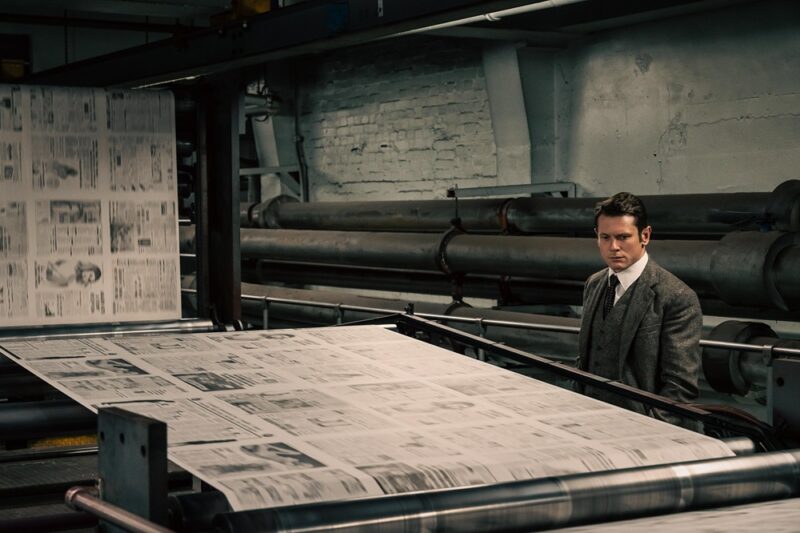
Instead, Boyle makes Fleet Street feel enormous. Printing presses become industrial beasts, offices buzz with desperation, and the physical creation of a newspaper takes on an almost intoxicating rhythm. The film understands the seduction of putting something into the world and watching people respond to it, even when what they’re responding to becomes increasingly questionable.
And for a considerable stretch, watching Lamb reinvent The Sun is tremendous fun.
He understands something his more respectable contemporaries don’t: people don’t necessarily want a newspaper that tells them what they should care about. They want one that understands what they already do. Sex, drinking, celebrity, sport, scandal, fear – Lamb isn’t so much lowering the bar as realising there’s an enormous audience that has never been invited into the room in the first place.
That distinction gives Ink more texture than a straightforward condemnation of tabloid journalism would allow. Lamb and Murdoch are outsiders themselves. One is a Northerner navigating the entrenched class structures of British journalism; the other an Australian businessman treated with condescension by the Fleet Street establishment. Their desire to dismantle that exclusivity isn’t inherently without merit. It’s what they’re willing to replace it with that gradually becomes Ink‘s more uncomfortable concern.
O’Connell is sensational in charting that evolution.
His Lamb is charismatic enough that we understand why people follow him, dangerous enough that we’re never entirely comfortable doing the same. There’s a mischievous charge to his early scenes, particularly as he gathers a newsroom of overlooked and unwanted journalists and encourages them to disregard convention. But O’Connell gradually turns that same determination into something more obsessive. Circulation stops being evidence of success and starts becoming an addiction.
It’s a muscular, magnetic performance that allows Ink to work precisely because Lamb never registers as a simple monster. O’Connell finds the insecurity underneath the bravado and the resentment fuelling his ambition, creating a man who seems permanently energised by the possibility of proving someone wrong.
Pearce has the less explosive assignment as Murdoch, but his comparative restraint proves interesting. This isn’t yet the fully formed media titan history would come to know. His Murdoch can seem almost cautious beside Lamb, occasionally baulking at the vulgarity or recklessness of what his editor proposes before inevitably being persuaded by the numbers.
That dynamic creates one of the film’s more provocative ideas: that media degradation doesn’t necessarily require everyone involved to passionately believe in what they’re publishing. Sometimes it merely requires them to discover that people will buy it.
Claire Foy provides the film’s strongest counterweight as Jules Davies, a composite character who operates as both journalist and moral conscience without being reduced entirely to either function. Foy brings warmth and intelligence to a newsroom dominated by masculine bravado, and Jules’ relationship with Lamb gives his descent a personal dimension that statistics and circulation figures alone couldn’t provide.
For its first half especially, Ink moves with such exhilarating momentum that it threatens to become exactly what it’s interrogating. Boyle makes rule-breaking look exciting. Sensationalism is funny. The newsroom feels rebellious. Watching respectable institutions get rattled carries its own anarchic pleasure.
And then the party curdles.
The 1969 kidnapping of Muriel McKay (Lucy Russell), the wife of Murdoch executive Alick McKay (Jonathan Hyde) who was abducted after being mistaken for Murdoch’s wife, dramatically alters both the film’s rhythm and its moral terrain. Suddenly the question isn’t simply what people will read, but what happens when a newspaper’s hunger for a story begins influencing the story itself.
Boyle deliberately pulls back some of the manic energy here, and though the film consequently loses a little of its propulsive force, that tonal shift feels largely necessary. The mechanisms that seemed so mischievous earlier are considerably less amusing once real lives are caught inside them.
It’s here that Ink‘s darker purpose fully reveals itself.
The film isn’t merely interested in the invention of the modern tabloid. It’s interested in the moment journalism discovers that attention itself can be monetised – and the Pandora’s box opened once attracting that attention becomes more important than considering why it has been attracted in the first place.
That makes Ink uncomfortably contemporary without Boyle needing to underline every parallel. Newspapers may no longer possess the cultural dominance they did in Lamb’s era, but the instincts he exploits have hardly disappeared. They’ve mutated. Headlines became clickbait. Circulation became engagement. Editors chasing sales became algorithms chasing attention. The technology changed; the appetite didn’t.
There’s an obvious irony in Boyle packaging this warning inside something so ferociously entertaining, but that contradiction ultimately works in the film’s favour. Ink understands the thrill before examining the consequences. We need to understand why this approach worked before we can appreciate what it helped unleash.
And Boyle, reunited with the grungier, more aggressive filmmaking sensibility that made his early work so distinctive, is having far too much fun making us complicit.
Even when its second half can’t entirely sustain the extraordinary velocity of its first, Ink remains a fierce, funny and increasingly unsettling examination of the moment news stopped simply reporting what happened and learned how profitable it could be to provoke what happened next.
The presses may have changed, but the machinery is still running.


FOUR STARS (OUT OF FIVE)
Ink is screening as part of this year’s Toronto International Film Festival, running between September 10th and 20th, 2026. For more information, head to the official site here.
Ink is scheduled for release in select theatres in the United States on December 11th, 2026, before arriving in Australian theatres on January 7th, 2027, and on Netflix (US) on January 8th.
