

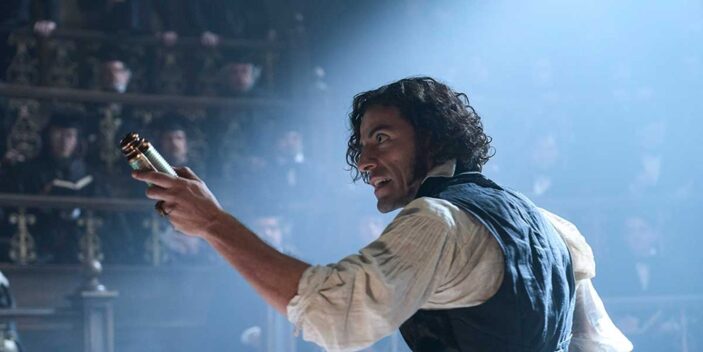
Though it’s been a story told countless times before, you can’t help but still be monstrously excited at the prospect of Guillermo del Toro adapting Mary Shelley’s classic Frankenstein. His name above the title just feels correct, and not just because the director has been talking about helming his version of the story for close to two decades now, but in a story that centres itself around creator and creation, there’s a beautiful sense of synthesis to the proceedings of it all.
Indebted to the core text’s tenets, but never entirely recreating such in a straightforward manner, del Toro splits his narrative in half, dedicating portions to both director (Oscar Isaac) and design (Jacob Elordi) in a bid to further distance audiences from any familiarity they may expect from such a known story.
Expectedly lavish and visually sumptuous from its opening – which only adds to the necessity to see this on the big screen wherever possible before it arrives on Netflix – the film’s prelude details Victor Frankenstein’s (Isaac) recount of how he created a monster to a crew of arctic explorers who have rescued him from the freezing surroundings. His story traces back to his childhood, where he suffered abuse at the hands of his father (Charles Dance), persevering through such through the love of his mother (Mia Goth).
Her eventual death during his childhood creates a wound that remains unhealed through to his years as an adult, paving the way for his mentality of creating new life to spite the world that refused him affection from one parent, and took the life of the other that showed him any grace; the irony is not lost that he essentially recreates this cycle of emotional removal when his creation forms its own psychological self. Henrich Harlander (Christoph Waltz), a wealthy benefactor, steps in at pivotal moment in Frankenstein’s life, believing the doctor is on the cusp of a scientific breakthrough regarding his intention to manufacture life, unaware that his presence will essentially begin the downward spiral of Victor’s being.
With Harlander comes Elizabeth (Goth, a secondary role that is purposeful by design in how she is meant to resemble Victor’s late mother), his niece, betrothed to William (Felix Kammerer), Victor’s younger brother. Though she is initially unimpressed with Victor, she soon can’t help but develop an affection for his genius. This relationship is only further complicated when she grows sympathetic to the plight of the Creature (Elordi, impressively tender), who is near-immediately discarded by the one man he’s of the mind would protect him.
It’s always been an interesting facet of the Frankenstein story that the monster is so easily villainized and the Doctor is painted as something of a victim, when, in fact, Frankenstein himself plays God in a manner that is vicious and cruel towards a creation that knows no better than the environment it’s brought into. Elordi’s stature and boyish face add to the emotional layering of del Toro’s telling, and it’s his story that truly ignites the film. There’s an understandable theatricality to del Toro’s temperament, and the explosion of fury of the Creature, mixed with his gentle footing play further into the film’s operatic nature.
Whilst such a story as Frankenstein means there’s an inherent sense of telegraphing on screen, del Toro makes this tale very much his own, reaching the conclusions of the original material on his own terms. It’s haunting and beautiful, and seemingly more timely than ever as it talks of man and if his soul can ever be exonerated in the face of such repulsive actions.


FOUR STARS (OUT OF FIVE)
Frankenstein screened as part of this year’s Toronto International Film Festival, which ran between September 4th and 14th, 2025.
Frankenstein is scheduled for a limited theatrical engagement from October 17th, 2025, before streaming on Netflix from November 7th.
