

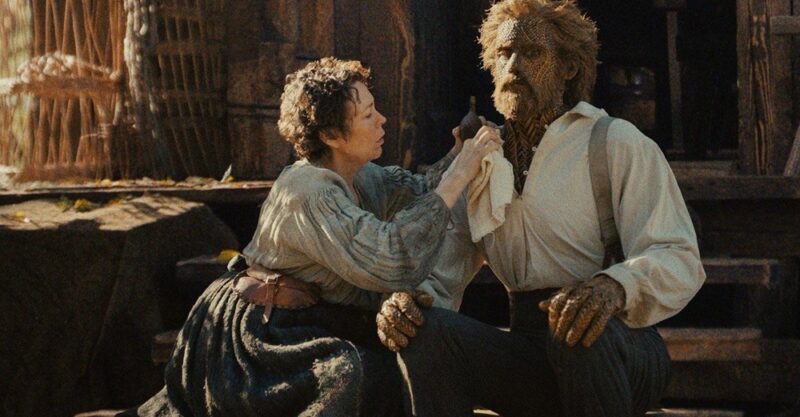
What if the secret to a happy marriage wasn’t finding the perfect man, but having one made to order? It’s a wonderfully ridiculous proposition at the heart of Wicker, a deliciously peculiar romantic fable that finds unexpected tenderness beneath its twisted sense of humour. Directors Alex Huston Fischer and Eleanor Wilson, adapting Ursula Wills‘ short story “The Wicker Husband”, have fashioned something that feels simultaneously ancient and remarkably contemporary, using the conventions of a fairy tale to explore the indignities of loneliness, the expectations placed upon women, and the peculiar resentment that other people’s happiness can inspire. Equal parts dark comedy, unconventional romance and social satire, it’s a film that understands how easily love can become something to be judged, controlled or even punished by those who have never experienced it themselves.
At the centre of this wonderfully strange world is Olivia Colman‘s Fisherwoman, a lonely, unmarried woman whose unfortunate combination of social awkwardness, a pronounced limp and the lingering smell of her daily catch has made her the village’s favourite punching bag. Surrounded by people who consider marriage less a romantic partnership than a social obligation, she’s resigned herself to an existence without affection until she approaches a mysterious Basketmaker (Peter Dinklage) with an unusual request: build her a husband. What arrives is Alexander Skarsgård, an impossibly handsome creation of woven branches and botanical magic who possesses virtually every quality the village’s flesh-and-blood men lack. He’s considerate, hardworking, emotionally available and, much to his new wife’s considerable delight, surprisingly enthusiastic in the bedroom. Naturally, the sight of a woman everyone has dismissed suddenly enjoying a fulfilling marriage proves absolutely intolerable to those around her.
Much of the film’s considerable charm comes from the extraordinary chemistry between Colman and Skarsgård, two performers who somehow make a romance between a weary fish seller and a walking piece of wicker feel more emotionally convincing than most conventional screen relationships. Colman is especially wonderful, allowing her character’s transformation to emerge through the smallest gestures; a softening expression, an unexpected smile, the gradual confidence of someone discovering what it means to be genuinely desired. Skarsgård, meanwhile, delivers a beautifully restrained performance beneath his elaborate appearance, finding warmth and sincerity in a character who could so easily have become an extended visual gag. Their relationship is funny, occasionally outrageous and unexpectedly moving, particularly because the film never treats the Fisherwoman’s desire for physical intimacy as something embarrassing or inappropriate. There’s something quietly radical about allowing a middle-aged woman to experience unapologetic pleasure without making her the punchline.
Of course, happiness rarely goes unpunished in a community sustained by bitterness, and Wicker grows increasingly mischievous as the villagers begin turning their dissatisfaction towards the Fisherwoman’s newfound contentment. Elizabeth Debicki is particularly effective as the venomous Tailor’s Wife, whose immaculate appearance barely conceals an increasingly ugly jealousy, while Dinklage brings an appealingly dry humour to the Basketmaker’s limited but important presence. The film’s greatest strength is how confidently it balances its competing sensibilities, finding absurdity in the village’s grotesque marital customs while allowing the cruelty beneath them to register. Not every narrative development feels entirely organic, and the escalating chaos occasionally threatens to overwhelm the simplicity of its central romance, but the film’s heightened reality accommodates much of that unevenness. Lol Crawley‘s beautifully textured cinematography further enriches the experience, creating a world that feels tactile, lived-in and just unsettling enough to suggest that something unpleasant is always waiting beyond the picture-perfect countryside.
For all its eccentricities, Wicker ultimately has something surprisingly sincere to say about the difference between possessing a partner and genuinely loving one. Its most uncomfortable observation isn’t that a woman has fallen in love with a man made from branches, but that a supposedly civilised society finds his kindness and consideration so threatening. Fischer and Wilson have created a film that is playful without being frivolous, sensual without feeling exploitative, and dark without sacrificing its enormous heart. Beneath the peculiar mythology and wicked humour is a rather beautiful argument that love shouldn’t require someone to diminish themselves to make others comfortable. And if it takes a man made entirely of wicker to demonstrate what a decent husband looks like, perhaps the real problem was never the woman who couldn’t find one.


THREE AND A HALF STARS (OUT OF FIVE)
Wicker is screening in Australian theatres from November 5th, 2026.
