

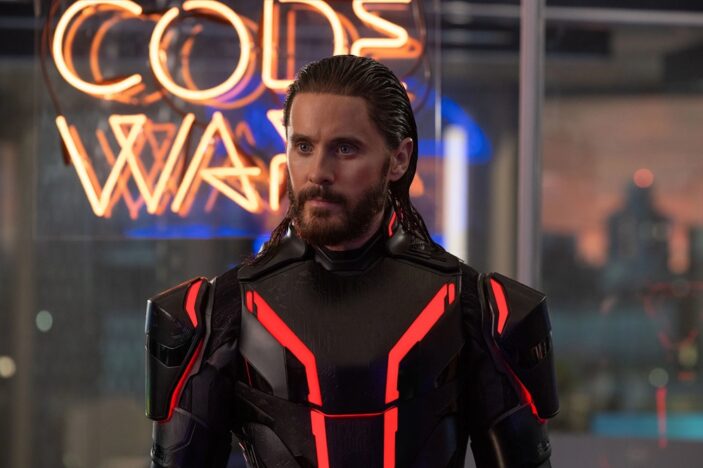
The Tron series has always existed in an interesting space within cinematic history. The 1982 original (Tron) and its 2010 sequel (Tron: Legacy) were more a cult phenomenon than box office successes, with the first film something of a visual revolution as it introduced audiences to the notion of entering a digital world, before Joseph Kosinski’s lush sequel built on that foundation with thrilling, advanced visuals and an immersive Daft Punk-produced soundtrack.
Whilst both films are flawed, they presented interesting, forward-thinking ideas that, understandably, provided enough basis for worlds to be built upon. With that, there is something of a pressure riding on Tron: Ares, another long-gestating sequel that looks to push the narrative into a newer direction whilst fighting off the divisive nature of its leading actor, Jared Leto, who is no doubt hoping that his self-professed “super nerd” status when it comes to the series will be enough for audiences to momentarily overlook his personal controversies over the course of its near-two hour run time.
Because both previous films were so exciting in how they presented their visual language, here, director Joachim Rønning (Maleficent: Mistress of Evil, Pirates of the Caribbean: Dead Men Tell No Tales) wisely leans into the physical over concept, pushing the neon aesthetic of the virtual Grid into the real world. The idea of what happens when a digital life meets that of flesh-and-blood is something the series has long been flirting with, and though some purists may not appreciate how “human” this makes proceedings, it’s what makes the most sense for Jesse Wigutow‘s script to explore.
Though it helps to have seen both Tron and Tron: Legacy in the lead up, it should be handed to Wigutow and Rønning in that they have created Tron: Ares as its own beast, utilising its opening credits to serve as an exposition of sorts, clueing all into the Tron universe and what has happened to the presence of series mainstay Jeff Bridges (whose character created the in-universe Tron arcade game, based off his own virtual reality experience) and Garrett Hedlund (who fronted Legacy as Bridges’ character’s son, investigating his disappearance and finding himself in the virtual Grid as a result) in the years since; the company they were, respectively, the CEO and primary shareholder of, ENCOM International, now overseen by the passionate, if aloof, Eve Kim (Greta Lee, injecting much needed heart and personality into it all).
Eve is hoping to use the technological advancements of ENCOM for the greater good – to better mankind – which puts her as the moral opposite to rival Dillinger Systems CEO Julian Dillinger (Evan Peters, occasionally a little too campy for his own good), a more reckless archetype, who is intent on creating weapon-grade inventions with the technology at hand, something that also puts him at odds with his stern mother (Gillian Anderson, underused but effective nonetheless). In spite of their differences, they have the same objective in locating the Permanence Code (we love a MacGuffin!), a vital piece of code left behind by the legendary Kevin Flynn (Bridges) that could allow virtual programs to exist on a physical plane.
One such program hoping to leap frog into existence is the AI creation Ares (Leto, admittedly quite effective with his more subdued nature), whose initial reason for being is to serve Dillinger as a virtual soldier, infiltrating ENCOM’s servers to sabotage any of their advancements. Given Dillinger’s unfortunate flawed model that only allows creations like Ares and the more brutally-minded Athena (Jodie Turner-Smith, immensely watchable), his second-in-command, to hone a physical form for 29 minutes before they self-destruct, his determination to find the Permanence Code is fueled by a certain bloodlust, which only escalates when Ares, curious to learn more about what it truly means to exist in reality, turns his back on his maker and aligns with Eve.
Amidst its dazzling visuals and a Nine Inch Nails-infused soundtrack (which proves more than mere musical accompaniment, but serves as actual narrative propulsion), Tron: Ares can’t escape certain downfalls, with its exposition-heavy script and lost character potential serving as its main culprits. Players like the aforementioned Anderson, Hasan Minhaj as ENCOM’s chief technology officer, and Cameron Monaghan as a member of Ares’ special forces unit all feel as if they are victims of the edit (Monaghan especially), whilst, on the flipside of that, Arturo Castro, as a co-worker and friend to Eve, is given too much grace, with his supposed comedic quips wearing thin early on and, unfortunately, not letting up.
Overall, whilst Tron: Ares certainly adheres to a more standard “action film” structure, it can’t be blamed for moving outside of the Grid. Rønning dares to pivot outside the virtual, though he does so without entirely sacrificing the films’ penchant for spectacle, resulting in a sequel that continues the series’ mentality of taking bold swings that don’t always hit, but make a singular impact regardless.


THREE STARS (OUT OF FIVE)
Tron: Ares is now screening in Australian theatres, before opening in the United States on October 10th, 2025.
