

Anthony Bourdain knew exactly what kind of young man he had been. Tony opens with his own less-than-flattering assessment: “I was – to be frank – a spoiled, miserable, narcissistic, self-destructive and thoughtless young lout, and badly in need of a good ass-kicking.”
It’s both a warning and something of an invitation.
Rather than attempting to condense Bourdain’s extraordinary life into the usual biographical highlight reel, writer-director Matt Johnson (BlackBerry) zeroes in on the period when none of what we associate with Anthony Bourdain had happened yet. There’s no Kitchen Confidential, no No Reservations, no Parts Unknown, and certainly no worldly television personality wandering through unfamiliar cities with curiosity, wit and an appetite for whatever was put in front of him.
There’s just Tony.
It’s 1975, and 19-year-old Tony (Dominic Sessa) is convinced he’s going to be a writer. His actual output is another matter entirely. Arrogant enough to assume a prestigious writing fellowship is his for the taking, he spectacularly talks himself out of it before impulsively following Nancy (Emilia Jones), a young woman he barely knows, to Provincetown, Massachusetts. She hasn’t invited him, has a boyfriend, and isn’t especially thrilled to discover he’s turned up.
It’s the type of behaviour Tony refuses to romanticise. This version of Bourdain is frequently exhausting company: pretentious, insecure, selfish and capable of treating the people around him terribly. But Johnson understands that a compelling coming-of-age film doesn’t require its protagonist to already possess the qualities they’ll eventually grow into. Tony’s roughness is the point. We’re watching someone before he has learned how to properly exist in the world.
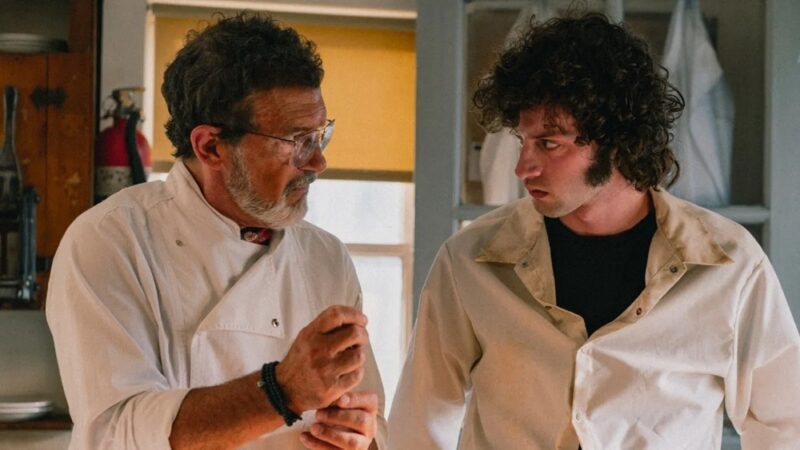
Penniless and effectively homeless, Tony drunkenly causes enough trouble at a local restaurant that he somehow winds up employed there. Its enigmatic owner, known simply as Chef (Antonio Banderas), gives him a job washing dishes and lets him sleep in a hammock outside his home, with the added indignity of waking him each morning via a bucket of seawater.
And somewhere amongst the dirty plates, burns, shouting and barely controlled chaos, something clicks.
Johnson is particularly alive whenever Tony enters the kitchen. There’s an intoxicating physicality to these sequences, where cooking is presented less as some romantic artistic calling and more as organised violence. Everyone is moving, sweating, swearing and improvising. For a young man seemingly unable to find any structure elsewhere, the kitchen paradoxically offers it through disorder. Tony may still insist he’s a writer temporarily slumming it as a dishwasher, but you can almost see his future quietly taking shape around him.
Of course, knowing where Bourdain ultimately ended up lends these scenes an unavoidable poignancy. Johnson wisely doesn’t overplay that knowledge. Tony isn’t constantly elbowing its audience with references to things Bourdain will eventually say, write or become. Nor does it treat every formative encounter as another piece clicking neatly into the mythology of Anthony Bourdain.
Indeed, one of the film’s smartest decisions is allowing its subject to remain simply Tony for as long as possible.
That approach is immeasurably aided by Sessa, who follows his breakout turn in The Holdovers with another performance built around a young man whose intelligence is frequently undermined by his own spectacular capacity for being an arsehole. There’s an obvious danger in casting him in such familiar territory, but Sessa makes Tony distinctly his own. He doesn’t particularly resemble Bourdain, yet chasing physical impersonation would have been the less interesting choice anyway. Instead, he captures something more persuasive: the swagger covering insecurity, the compulsive need to perform intelligence, and the restless energy of someone convinced he’s destined for something without having the faintest idea what that something is.
Sessa also understands that Tony’s abrasiveness has to occasionally become genuinely unpleasant. The film never asks us to forgive him simply because we know who he’ll become. There are moments when his selfishness tests our investment in him, and the darker tendencies hinted at throughout the story eventually come into sharper focus. Yet Sessa keeps enough vulnerability simmering underneath that bravado to remind us that much of Tony’s obnoxiousness is armour.
Banderas provides a wonderfully understated counterweight. His Chef could easily have become the archetypal mentor who conveniently dispenses exactly the wisdom his troubled protégé needs, but Tony resists making him quite so tidy. He’s eccentric, spiritual and somewhat mysterious, with his own peculiar rituals and philosophy surrounding food. Banderas brings an enormous warmth to the role without sanding away its stranger edges, and his relationship with Tony gradually becomes the film’s emotional anchor.
Then there’s Leo Woodall as Sal, representing a considerably more dangerous version of belonging. Charismatic, reckless and steeped in sex, drugs and masculine bravado, Sal offers Tony another possible education entirely. Woodall is magnetic enough that we understand the attraction whilst remaining unsettling enough that the danger is never far away.
The push and pull between Chef and Sal consequently becomes more significant than simply determining whether Tony learns how to cook. They represent competing versions of the man he could become: discipline against indulgence, creation against destruction. The irony, of course, is that anyone familiar with Bourdain knows elements of both men will follow him into adulthood.
That knowledge gives Tony an intriguing tension. This is a film about becoming when we already know the person he became, and Johnson allows that contradiction to exist rather than forcing Bourdain’s life into an inspirational trajectory. The man who eventually encouraged millions of viewers to approach other cultures with curiosity and humility was once a self-absorbed teenager who could barely see beyond himself. Growth here is messy rather than miraculous.
It also helps enormously that Johnson refuses to make a sombre film simply because we know Bourdain’s story ultimately has a tragic ending. There are stretches of Tony that are enormously funny, rambunctious and genuinely joyous. Its Provincetown setting feels wonderfully lived-in, populated by characters who seem to have lives continuing somewhere beyond the edges of the frame, and there’s a scrappy energy to the filmmaking that suits both Johnson and his subject.
The film does venture somewhere considerably darker in its final act, and for a moment it threatens to tip the balance too aggressively. But Johnson ultimately finds his way back to what makes Tony so affecting. This isn’t a film interested in explaining Bourdain’s death through his youth, nor should it be. It’s interested in the spark of discovery that came much earlier: that intoxicating moment when a directionless kid realised the world might contain more experiences, people, tastes and stories than he could possibly consume in one lifetime.
Perhaps that’s why Tony works so well even when separated from the famous name attached to it. Strip away everything we know about Anthony Bourdain and there’s still something moving about watching this lanky, obnoxious, strangely endearing young man repeatedly fuck up, get back up and stumble towards the first thing that makes him feel genuinely alive.
Bourdain would eventually become a cook, a chef, an author, a traveller, a television personality and, whether he would have appreciated the designation or not, a cultural icon. But Johnson isn’t particularly interested in any of those labels.
For these two hours, he’s a 19-year-old dishwasher sleeping in a hammock, telling anyone who’ll listen that he’s a writer.
And maybe, underneath all the bullshit, he already is.


FOUR STARS (OUT OF FIVE)
Tony is screening in Australian theatres from August 20th, 2026.
