

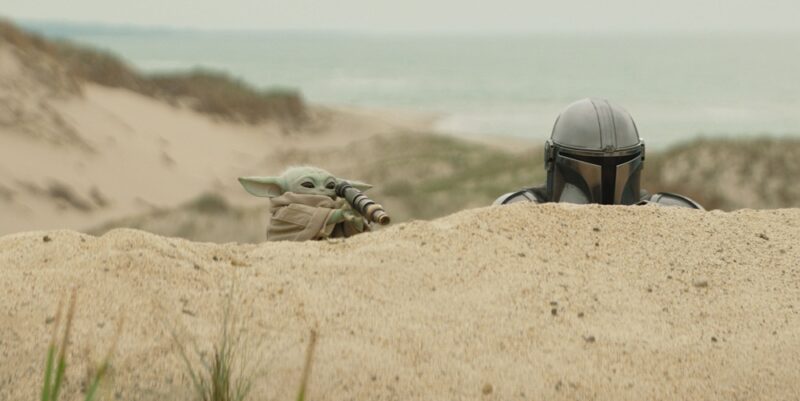
For a franchise built on cinematic awe, Star Wars: The Mandalorian and Grogu arrives with surprisingly small ambitions. Expanded from the enormously successful Disney+ series The Mandalorian, the film technically delivers everything fans have come to expect: dusty space-western imagery, blaster-heavy action, adorable Grogu reaction shots, and endless lore connective tissue. What it struggles to deliver, however, is a compelling reason for why this story needed the jump from streaming television to the theatrical big screen.
Set between Return of the Jedi and the sequel trilogy, the film follows Din Djarin (Pedro Pascal) and Grogu as they take on missions for the fledgling New Republic while remnants of the Empire continue lurking throughout the galaxy. Director Jon Favreau frames the story as a standalone adventure accessible to newcomers, but in practice, The Mandalorian and Grogu feels almost entirely engineered for people already deeply invested in the show’s mythology.
That isn’t inherently a flaw. Fan-service driven filmmaking can absolutely work when the emotional stakes are strong enough to carry casual viewers along for the ride. The issue here is that the film rarely pauses to establish why any of this matters beyond existing affection for these characters. If you haven’t watched multiple seasons of The Mandalorian, much of the emotional shorthand simply lands with a shrug. Relationships, history, and even tonal rhythms are presented with the expectation that audiences already understand them.
As a result, the movie often resembles an extended television arc rather than a fully formed cinematic experience. Scenes move with the stop-start structure of episodic storytelling: mission briefing, side quest, action beat, creature encounter, sentimental Grogu moment, repeat. There’s entertainment value in that formula, certainly, but it rarely builds toward anything emotionally or narratively substantial.
The film’s biggest asset remains Grogu himself. The practical puppetry work continues to be extraordinary, filled with tiny expressions and physical nuances that genuinely bring the character to life. Even after years of cultural saturation, Grogu still works because the craftsmanship behind him is so tangible and sincere. The problem is that the film leans on his cuteness almost as a substitute for dramatic momentum. So many scenes hinge on audiences simply reacting to Grogu being adorable that eventually the emotional manipulation becomes visible.
Meanwhile, Din Djarin himself feels oddly flattened. Pascal has always relied heavily on vocal performance and (someone else’s) physicality to sell the character beneath the armor, but here the performance drifts into monotony. The stoic gunslinger persona that once felt mysterious now often feels emotionally inert, especially across a feature-length runtime. The father-son dynamic remains the heart of the story, yet the film rarely deepens it in ways that justify revisiting the same emotional beats explored more effectively in the series.
There are flashes of what the film could have been. Sigourney Weaver brings welcome authority and gravitas as Colonel Ward, embodying the weary idealism of the New Republic era. Some of the IMAX-shot sequences carry genuine scale, particularly when the film embraces the tactile “used universe” aesthetic that has always separated Star Wars from cleaner sci-fi franchises. Ludwig Göransson’s score also continues to do a great deal of heavy lifting, injecting momentum and grandeur into scenes that otherwise risk feeling dramatically weightless.
But the final act exposes the film’s biggest issue: despite constant movement and action, the stakes never truly feel urgent. The climactic stretch extends well beyond its natural endpoint, becoming increasingly numbing as set piece after set piece crashes together without escalating tension. Instead of building toward exhilaration, the movie gradually exhausts itself.
Ironically, for a film so focused on legacy and apprenticeship, The Mandalorian and Grogu feels trapped between mediums. It’s too reliant on prior television investment to function cleanly as a standalone blockbuster, yet too thin narratively to feel like a major cinematic chapter. Fans of the series will likely enjoy spending more time with these characters, and there’s enough charm and spectacle to make the journey intermittently fun. But as the long-awaited return of Star Wars theatrical storytelling, it feels more like a comfortable side mission than an essential adventure.


TWO AND A HALF STARS (OUT OF FIVE)
Star Wars: The Mandalorian and Grogu is screening in Australian theatres from May 21st, 2026, before opening in the United States on May 22nd.
